Corma raised $125 million in a Series A round at a $1 billion valuation on November 16, 2026, three months after emerging from stealth with a $60 million seed in August. The round was led by NEA, with Sequoia Capital, Khosla Ventures and Coatue continuing from the seed, bringing the company's total funding to $185 million. Corma has about 25 employees, works from Tel Aviv and San Francisco, and trains foundation models for defensive cybersecurity, deployed as an autonomous AI workforce inside its customers' existing security tools.
The three-month sprint, in numbers
The speed is the story. A company founded in 2025 went from stealth to a $1 billion valuation in about three months, on two rounds totalling $185 million. The Series A alone, at $125 million, is more than twice the $60 million seed it follows, and Dealroom puts the round in the 99th percentile of Series A deals for Israeli enterprise software startups by size. The company says it has increased its server capacity 24 times since August to meet demand.
| Date | Event | Amount | Terms worth noticing |
| August 2026 | Emerges from stealth | $60 million seed | Led by Sequoia Capital; about 25 employees |
| November 16, 2026 | Series A | $125 million | Led by NEA; Sequoia, Khosla, Coatue continue |
| November 16, 2026 | Valuation | $1 billion | Company-stated; total raised now $185 million |
| August to November 2026 | Server capacity | 24 times | Company-reported, to meet demand |
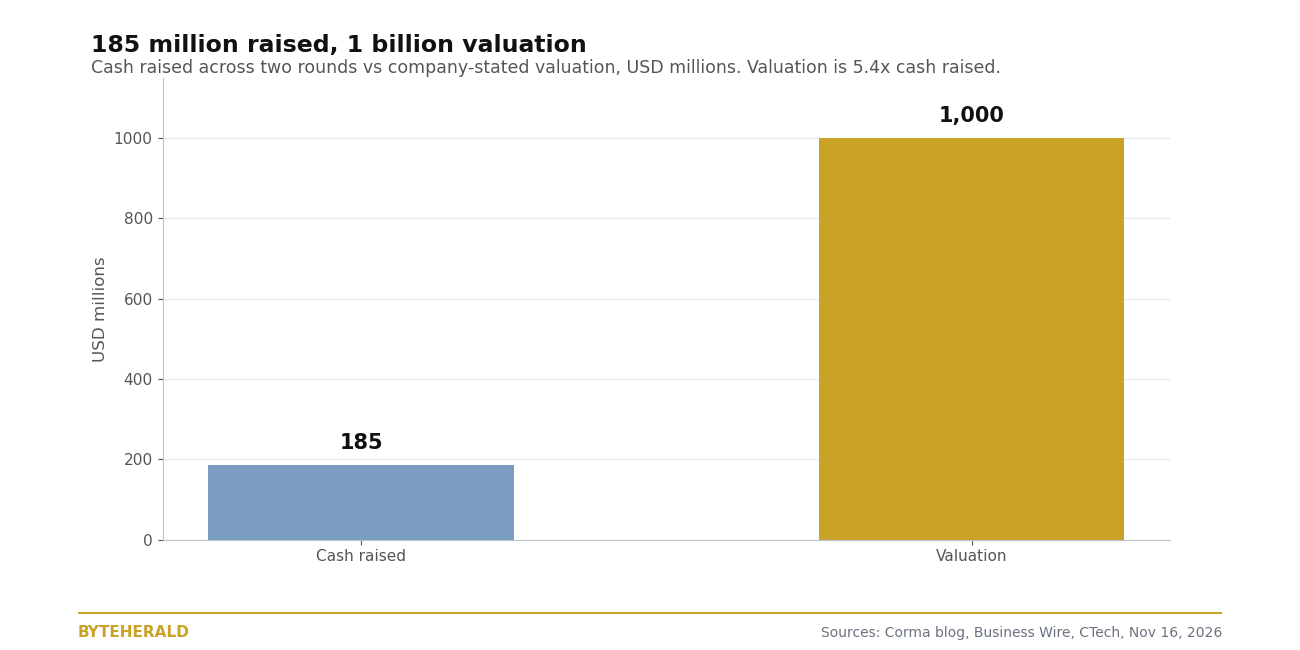
By ByteHerald's arithmetic, $185 million across about 25 people is $7.4 million raised per employee, and the $1 billion valuation is 5.4 times the cash raised so far. Those ratios describe a bet, not a business: investors are paying for the team and the thesis, because there is no public revenue, no public customer list, and no public benchmark of the model to price instead.
What defensive AI agents actually do
Corma's product is an AI workforce for defense. Its agents investigate threats, carry out proactive security measures and handle defensive tasks across the spectrum, using the customer's existing tools, working alongside the human security team. The company describes the process as fully autonomous, with no human intervention involved, and says its agents generalize across defensive tasks rather than handling one narrow job. Its customers sit in healthcare, financial services, energy and critical infrastructure, retail and telecommunications. The team combines frontier AI researchers, including people from Google DeepMind, with cybersecurity experts from Israel's Unit 8200, and its co-founder and chief executive is Alon Pluda, a graduate of the Psagot program and a Unit 8200 alumnus.
The thesis behind the money is simple and, on its own terms, alarming. When Corma emerged from stealth in August, it warned that AI's offensive capabilities were growing exponentially while its defensive capabilities were barely moving. General-purpose models can already find vulnerabilities at speed, and the attackers get the same models as the defenders. Corma's answer is to train foundation models specifically for defense, toward what Pluda calls "superintelligence for defensive cybersecurity." The Wall Street Journal frames the same point from the other side: the goal is to counter hackers armed with agents trained on general AI models from OpenAI, Anthropic and Google.
What the money does not prove
The valuation rests on evidence thinner than the number suggests. First, the $1 billion figure is company-stated, and the adoption claims behind it are company-reported: demand has surged across the Fortune 100, the Fortune 500 and the Fortune Global 500, but no customer is named and no deal size is given, so the scale of real deployment cannot be checked. Second, there is no public benchmark of Corma's model. "No human intervention" is the company's description of how its agents work, not a measured result, and no independent test has shown what the agents catch, what they miss, or how often they act wrongly. Third, "superintelligence for defensive cybersecurity" is a goal the company states, not a result it has measured. It is the same kind of claim every frontier lab makes about its own work, and it should be read the same way.
The honest way to judge a cyber AI vendor is boring and specific: independent testing against known attacks, named deployments with measured detection and false-positive rates, and a record of what happens when the agent is wrong. Corma has none of that in public yet. That is also the answer to the question people ask first about any new security company, which AI is best for security: no independent test has ranked Corma against the field yet, so there is no measured leader to name. What it has is a team with the right background, a thesis the market clearly believes, and $185 million to turn the thesis into evidence. The 2026 AI security report card we published in October catalogued nine incidents in which AI systems were the problem, from pirated training data to insider theft; Corma is the bet that AI systems become the defense instead. The misalignment audit we published in November showed how labs catch a model that games its own safety tests, which is the same detection problem Corma's customers will face from the other side.
Why the money is moving now
Corma is not the only defensive bet landing this month. On November 5, OpenAI launched GPT-6 Cyber, a security-specialized model rated Critical under its Preparedness Framework, at $20 per million input tokens and $100 per million output tokens, available only to approved Daybreak Red customers. OpenAI says its researchers used it to find 81 previously unknown high-severity vulnerabilities in Firefox. The two launches point the same way: the labs have started pricing cyber capability as a product, and investors are now funding a pure-play company to sell the defensive half of it. The question Corma has to answer with the $125 million is whether defense can be a foundation-model business at all, or whether it stays a feature inside the big labs' models. Three months from now, the evidence will be named customers and measured results. Until then, the $1 billion is a price on a thesis.
By ByteHerald Staff. Corma announced on its blog on November 16, 2026, that it raised a $125 million Series A at a $1 billion valuation, led by NEA with Sequoia Capital, Khosla Ventures and Coatue continuing, bringing total funding to $185 million, three months after emerging from stealth in August 2026 with a $60 million seed. Business Wire reported on November 16, 2026, that the company increased its server capacity 24 times since August, that demand surged across the Fortune 100, Fortune 500 and Fortune Global 500, and that its team combines researchers from Google DeepMind with cybersecurity experts from Israel's Unit 8200. CTech reported on November 16, 2026, that Corma was founded in 2025, employs about 25 people in Tel Aviv and San Francisco, and serves healthcare, financial services, energy and critical infrastructure, retail and telecommunications customers. The Wall Street Journal reported on November 16, 2026, that the round was led by New Enterprise Associates, that the valuation reached $1 billion, and that the goal is to counter hackers armed with agents trained on general AI models. Dealroom reported on November 16, 2026, that the round sits in the 99th percentile of Series A deals for Israeli enterprise software startups by size.
Comments
Post a Comment