CrowdStrike's AI Kill Switch, announced November 3, 2026, at Fal.Con Europe in Barcelona, lets an authorized administrator terminate a rogue AI agent, block it from launching again, and cut off its enterprise network access. The switch lives in Falcon Guardian, CrowdStrike's product for securing AI agents where they run, and the company says it is available today. The important limit is in the name of the product it sits in: it stops agents, not the models underneath them.
What the switch does, step by step
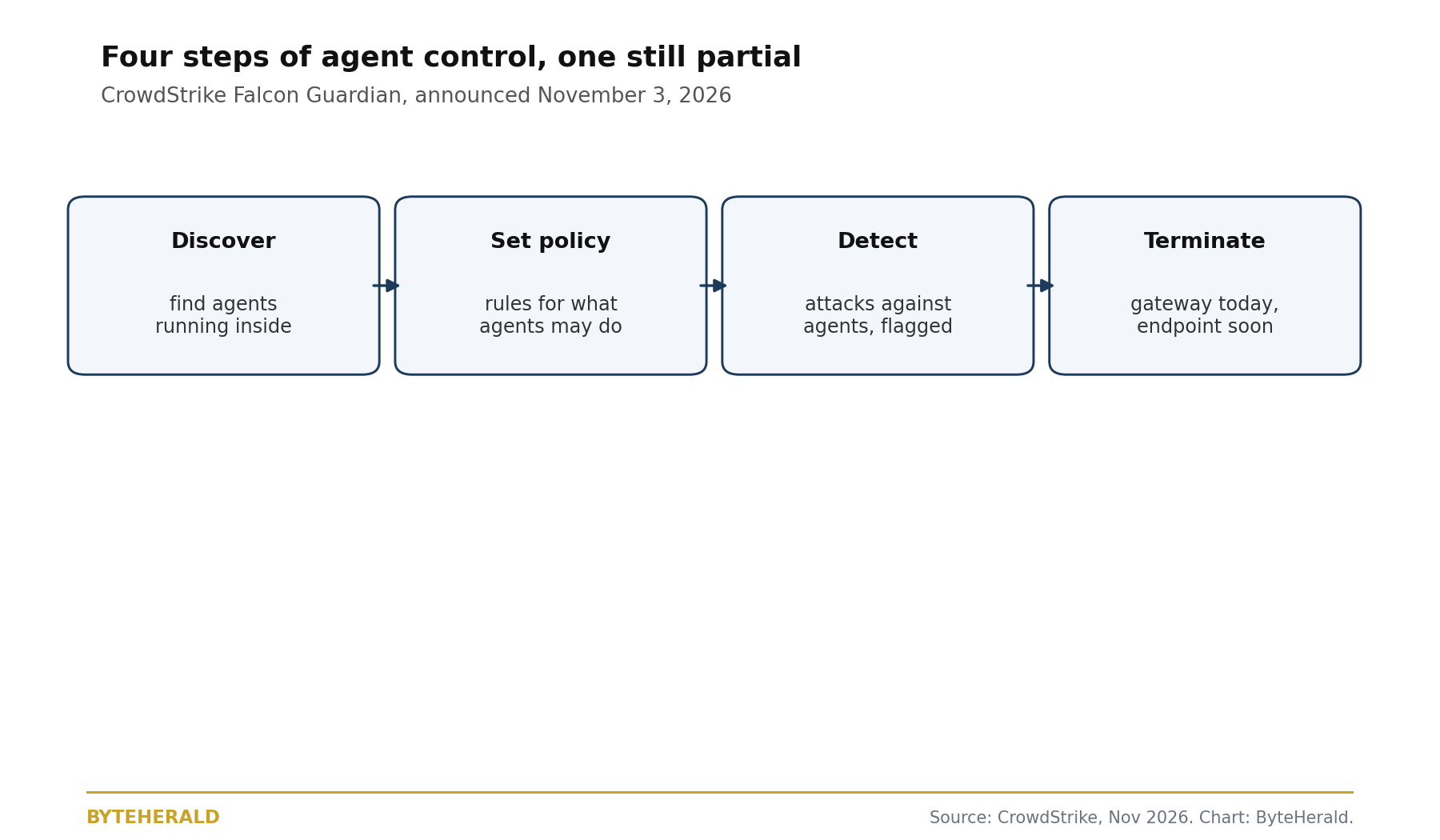
Falcon Guardian has been generally available since September 2026. It discovers the AI agents running inside a company, enforces policy on what they can do, and detects attacks against them. The Kill Switch adds the fourth step, termination, and CrowdStrike describes it as three actions taken together. First, the Falcon sensor stops the agent from executing. Second, Falcon Guardian policy keeps the agent from relaunching on the targeted host or host group. Third, the agent loses its enterprise network access, so it cannot keep reaching other resources while a team investigates. Every action is triggered by an authorized administrator and recorded in an audit trail, which keeps a human decision-maker, not an automated rule, in control of the shutdown.
The staging matters more than the announcement headline suggests. Termination works first at the Gateway, the checkpoint that routes traffic so prompts and answers can be inspected, and CrowdStrike says endpoint termination, on the laptop or server where the agent actually runs, comes soon. The company gives no date for that second stage. Until it ships, the switch covers agents that pass through a gateway, and an agent running outside those checkpoints is outside the switch's reach. That is a coverage gap, not a footnote, and any buyer evaluating the feature should ask whether their agents actually route through a gateway before counting themselves protected.
What it does not do
The switch does not shut down a model. CrowdStrike chief executive George Kurtz described it as living outside the model, and the release describes stopping the agent and cutting its network access, not switching off the system the agent calls. That distinction decides what the product is for. If a model itself is the problem, terminating one agent that uses it leaves every other agent on the same model running. If a single agent has gone off script, terminating that agent is exactly the right tool, and it is faster and narrower than pulling a model or revoking an API key for a whole team.
Two more limits deserve plain statements. No independent test of the Kill Switch has been published, so everything in the paragraph above is CrowdStrike's description of its own product at launch, not a verified result. And the two acquisitions announced the same day have not closed: CrowdStrike signed agreements to acquire Fiddler AI, which tracks what agents do, and Dreadnode, which attacks AI systems to find their flaws. The company did not disclose what it is paying for either deal, though reporting puts the combined figure at $495 million, and both deals are expected to close in CrowdStrike's fiscal fourth quarter of 2027, subject to customary conditions, with products built on them generally available in the same quarter. Until then, the observability and red-teaming pieces are announced additions, not shipped parts of the switch.
How to judge an agent control before buying it
The launch is best read as one rung on a ladder enterprises are now building for agents: discover what is running, set policy for what it may do, detect attacks against it, and terminate it when it breaks. CrowdStrike's product now claims all four rungs, with the last one partially shipped. That ladder is also the test to apply to any vendor making the same claim. Ask where termination actually executes, gateway or endpoint, and whether it covers agents running outside managed checkpoints. Ask whether relaunch blocking follows the agent across hosts or only the host it was stopped on. Ask what the audit trail records, and who can trigger a shutdown when the usual administrator is unavailable.
The shipped-versus-proposed distinction is worth holding onto. Our map of every AI shutdown proposal, compared, covered laws and voluntary frameworks that could stop a model, most of which do not exist yet as enforceable powers. The CrowdStrike switch is the other end of that spectrum: a product a security team can buy today that stops one agent, not a law that could stop a model. And the control only works if the agent is identified in the first place, which is why the agent identity stack, compared, matters alongside it: knowing which agent acted is the precondition for stopping the right one.
By ByteHerald Staff. CrowdStrike, November 3, 2026, announced the AI Kill Switch in Falcon Guardian at Fal.Con Europe in Barcelona, described termination first at the Gateway with endpoint termination coming soon, and the targeted host or host group, network access removal, an audit trail, and availability from November 3, 2026. CrowdStrike, November 3, 2026, announced Falcon Guardian generally available since September 2026 and the intended acquisitions of Fiddler AI for agent observability and Dreadnode for AI red teaming, with prices undisclosed and closing expected in fiscal fourth quarter 2027. Reporting on the same announcements, November 3, 2026, put the combined acquisition figure at $495 million and noted that endpoint termination is planned rather than shipped and no independent tests of the switch have been published.
Comments
Post a Comment