DeepSeek's Super-agent is a research prototype, not a product: an MIT-licensed coding agent for one GitHub repository that routes permitted requests to worker sessions and returns proposed changes, published on October 31, 2026, by the company's Harness team. The distinction matters because most headlines about the release describe a challenger to Anthropic's Claude Code, while DeepSeek itself says the public code is for reference only, is not production-ready, and does not implement every idea in its accompanying design essay.
What was actually released
On October 31, 2026, DeepSeek's Harness team published dsh-superagent-prototype on GitHub under an MIT licence, alongside a design essay titled Super-agent Design Exploration: Towards More Autonomous Agent Systems, posted on the team's official WeChat account on the evening of October 31, Beijing time. The prototype is packaged as a bundle for DeepSeek Harness, the lab's open-source agent framework. It is scoped to a single GitHub repository at a time, and it can optionally connect to Feishu, ByteDance's workplace messaging app, which is sold as Lark outside China.
The design question behind it is simple to state and hard to run safely. Most coding agents wait to be summoned, do one job, and stop. DeepSeek's essay asks what happens when an agent system stays available, receives messages, and moves many pieces of work forward at the same time. The public prototype is the narrow version of that idea, not the full system described in the essay.
How the prototype works, in three steps
The architecture has two layers. A resident Router talks to people and dispatches work. Parallel Worker sessions do the work. A permitted request from GitHub, or optionally from Feishu chat, goes to the Router, which assigns it to a separate worker session with its own session and directory. That worker returns its result to the original conversation, for example as a pull request, which is a formal proposal asking the team to review and merge code changes.
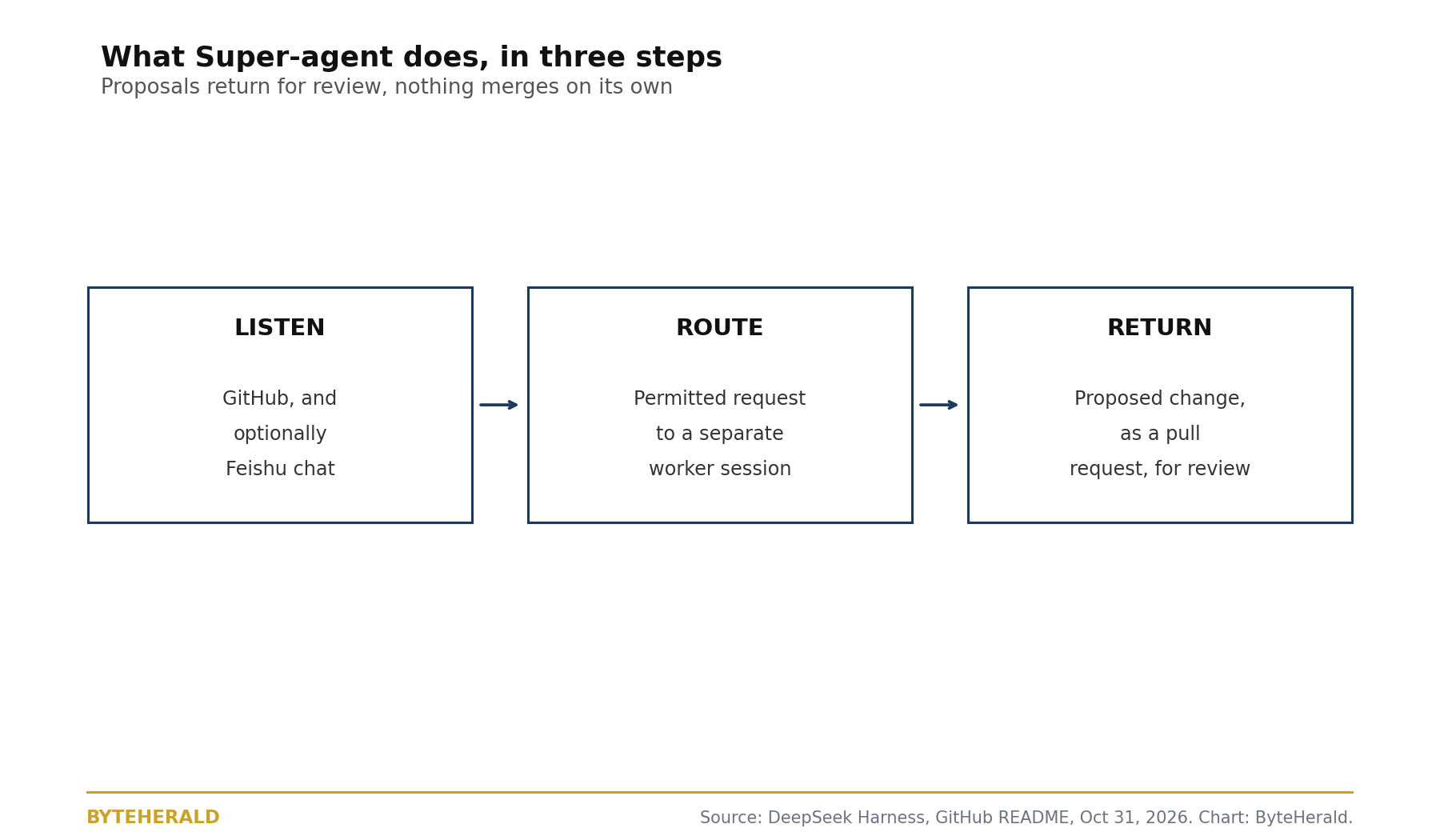
That return step is the part teams should judge first. A pull request keeps a human decision in the loop, because nothing merges until a person reviews it. A system that edited code directly, without a reviewable proposal, would be a different product with a different risk profile. DeepSeek's prototype, as published, proposes rather than ships on its own.
What the prototype is not
| Claim | Status in the public release | Why it matters |
|---|---|---|
| An official DeepSeek product | No, research prototype for reference only | No product support, roadmap, or availability promise follows from the release |
| Production-ready software | No, DeepSeek says it may still contain bugs | Teams must inspect and adapt the code before running it on real repositories |
| Identical to DeepSeek's internal system | No, the public code differs from the internal version | Internal results do not transfer automatically to the public prototype |
| Every design in the essay implemented | No, some designs are future directions | Reading the essay as a feature list overstates what the code does today |
| A measured rival to Claude Code | No benchmark comparison published with the prototype | Any ranking against Claude Code is framing by reporters, not a test result |
Bloomberg, as reported on November 1, 2026, framed the release as a move against Claude Code, Anthropic's popular coding agent. That framing is about market position, not measured performance. DeepSeek formed the Harness team earlier in 2026 to build agents that can take on coding services offered by leading United States labs including Anthropic, and the same reporting notes DeepSeek raised about 100 billion yuan, about 15 billion dollars, in a recent fundraising round ahead of a planned initial public offering. The fundraising figure is reported, not a DeepSeek filing quoted in the release coverage, and it should be read as context for why DeepSeek can sustain a longer agent effort, not as evidence that this prototype wins any coding test.
The attention paradox in DeepSeek's own warning
DeepSeek's most useful sentence in this release is a caution, not a boast. The team says the agent aims to take as little human attention as possible and give as much value as possible, and it also cautions that an agent operating on behalf of an entire team could end up consuming the attention of the whole team if it is not properly managed. That is the real test for a proactive agent. A summoned agent costs the attention of the person who summoned it. A proactive agent that watches team chat can cost the attention of everyone it notifies, everyone it asks to review a proposal, and everyone whose work it interrupts with a suggestion that turns out to be wrong.
Teams evaluating the prototype should therefore ask three questions that have nothing to do with model quality. First, who can permit a request, and can that permission be revoked for one repository without touching others. Second, what happens when two workers propose conflicting changes to the same code. Third, how a reviewer tells a worker's proposal apart from a teammate's proposal in the same conversation thread. The prototype's design answers the first part, with permitted requests routed to separate sessions, but the published reporting does not settle the second and third questions for production use, which is one reason DeepSeek calls the code research software rather than a tool to hand a repository to and walk away from.
An evergreen explainer: summoned agents versus proactive agents
A summoned agent is a tool you invoke. You write a prompt, it works, it stops, and the cost is visible in that one interaction. A proactive agent is a colleague that never leaves the room. It watches a channel, decides on its own that a problem is worth acting on, and starts work before anyone asks. That shift changes the failure mode. A summoned agent fails by doing the wrong job you asked for. A proactive agent fails by doing an unasked job at the wrong time, by duplicating work a teammate already started, or by training a team to ignore its messages, which then defeats the purpose of having it watch at all.
The history of coding tools suggests the proactive model will win only where the proposal is cheap to review and expensive to miss. A bug reproduction, a failing test fix, or a code review response fits that test, because a human can accept or reject the pull request in minutes. A design decision, a refactor across many files, or a change to shared infrastructure does not, because the review cost is the work itself. DeepSeek's prototype sits on the cheap-to-review side by design, with pull requests as the return format, but the essay's larger ambition, a system that keeps many jobs moving at once, will be judged on whether review stays cheap as the number of proposals grows.
DeepSeek's scale also puts this release in a longer story. ByteHerald tracked DeepSeek's 400 million dollar robot bet as part of a wider war chest race, and the same logic applies here: capital buys time to experiment, but it does not buy a production result. A prototype that is free to download is not free to run safely, because the model access, the review time, and the risk of an unreviewed change are the real costs. ByteHerald's earlier scorecard compared five coding assistants on the same tasks, and the lesson from that exercise applies directly: judge a coding agent on the same job, with the same review standard, or do not rank it at all.
What to watch next
Three checkable events will show whether Super-agent becomes a product or stays an essay. First, whether DeepSeek publishes a benchmark, a test suite, or a side-by-side evaluation against Claude Code or Codex on the same repository tasks, rather than a simulated timing figure. Second, whether the prototype gains a production hardening step, such as sandboxing, permission controls, or audit logs, that a team could point to in a security review. Third, whether teams report using it on real repositories for weeks, not just starring the repository on launch weekend. Until then, the honest summary is narrow. DeepSeek published an interesting architecture, with a clear warning label, and the market read it as a challenge. The code, not the headline, is what teams should evaluate.
By ByteHerald Staff. Bloomberg reported on November 1, 2026, that DeepSeek's Harness team released a prototype autonomous coding agent called Super-agent, that it monitors developer group chats and proposes solutions without being summoned, and that DeepSeek raised about 100 billion yuan, about 15 billion dollars, in a recent fundraising round ahead of a planned initial public offering. DeepSeek published dsh-superagent-prototype on GitHub on October 31, 2026, under an MIT licence, describing it as a proactive coding agent for one GitHub repository, packaged as a DeepSeek Harness bundle, that listens to GitHub and optionally to Feishu, and that is research prototype code for reference only, not an official DeepSeek product. DeepSeek's design essay, Super-agent Design Exploration: Towards More Autonomous Agent Systems, posted on WeChat on October 31, 2026, describes a Router that dispatches work to parallel Worker sessions and an internal system that reproduces and fixes issues, responds to code reviews, and contributes to DeepSeek Harness development, while noting that some designs in the essay are not implemented in the public prototype.
Comments
Post a Comment