Edge0 open-sourced Edge0-145B on November 12, 2026, a 145-billion-parameter model it says brings frontier-level coding and agent work to a personal computer, with 29GB of peak memory and more than 80 tokens a second. The headline number is real, but it counts only part of the machine. The model card's own measurements put the full run at about 61 GiB, and the model itself starts from Alibaba's Qwen.
What Edge0 actually released
Edge0 released two models, Edge0-145B and Edge0-120B, together with a unified inference framework and deployment tools. The 145B model has 145 billion total parameters, of which about 10 billion participate in computation on each inference step. It is a mixture-of-experts design: 48 layers, 512 experts per layer, with 10 routed experts plus one shared expert active per token, a 256K context window, and native 4-bit training. Each group of 64 experts shares two large matrices, which is how the company keeps the stored weights down while keeping the expert count up. The release includes the weights on Hugging Face, the edge0-infer and edge0-strata framework on GitHub, and a desktop Edge0 App. The company calls Edge0-145B the world's first open-source on-device AI model with 145 billion parameters.
The company says the model plans, writes and runs code, debugs errors, and checks results visually, for projects such as 3D scenes, games, hardware programs, and PCB designs. Its demonstrations show the model building a 3D scene of Manhattan in Blender within an hour, writing the program for a real drone that navigated obstacles and found a red backpack, and taking a PCB design from component placement through an assembly animation. The release follows the company's Edge0-35B phone model from September 10, 2026, and the company says its portfolio now covers 200 models across four families and more than 5 million production devices.
The 29GB number, taken apart
The blog post's headline figure is 29GB of peak memory, and the post says in one place 28GB. The model card tells a fuller story. For the NVFP4 build, the card measures 23.25 GiB of VRAM plus 38.27 GiB of host RAM, about 61.5 GiB in total. The weights alone are 47.79 GiB for the NVFP4 build and 40.81 GiB for the Q3_K build. The blog's own loading section explains why: an expert library of about 40GB sits in system memory, with experts brought into GPU memory as needed, and about 48GB of vocabulary data resides on the SSD and is read on demand. The 29GB is the GPU-side peak. The machine as a whole needs about twice that, plus disk.
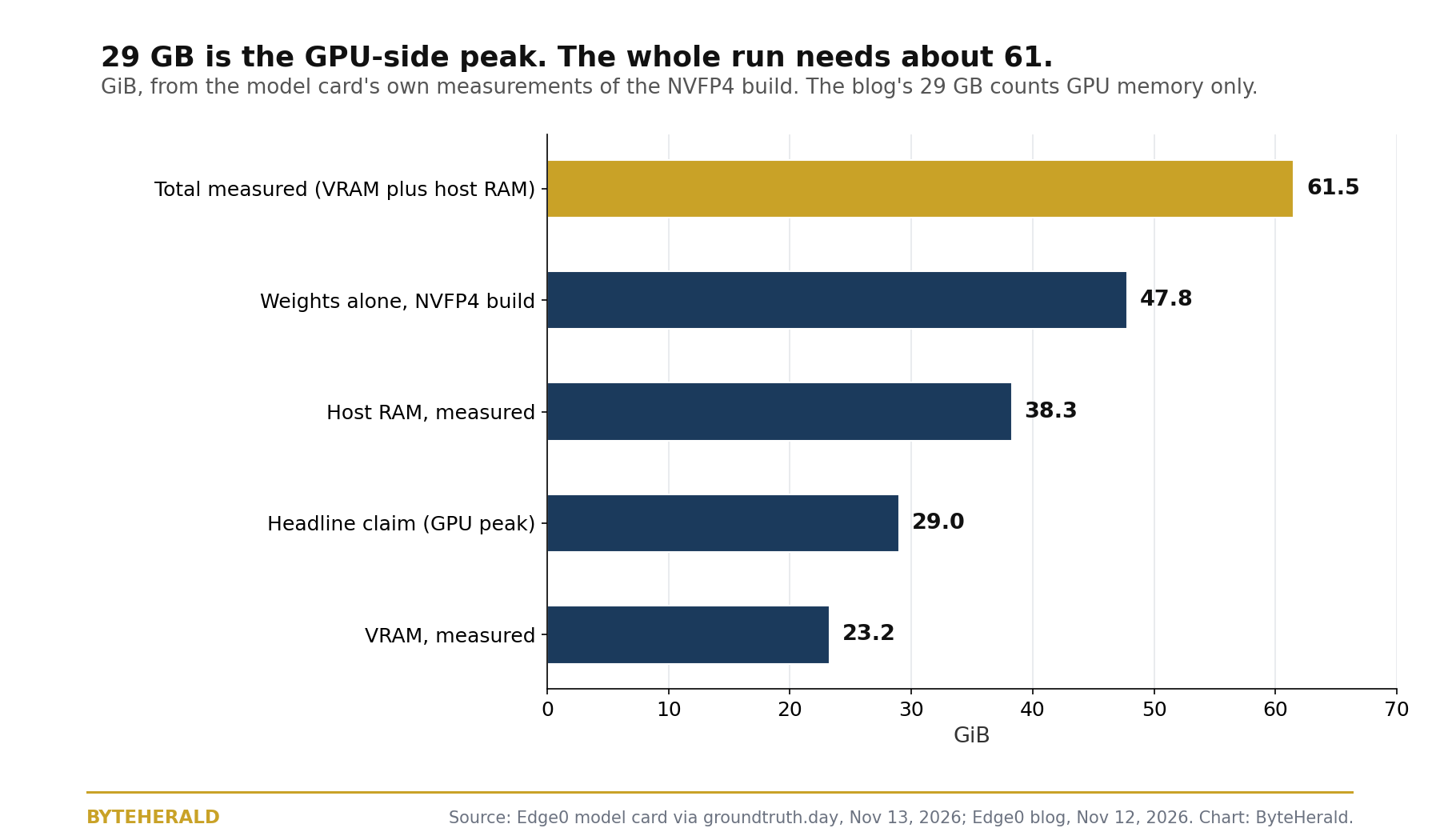
That does not make the release a fake. It makes the headline a partial measurement, and the partial measurement is the one that travels. A buyer with a 48GB laptop, the machine the blog names as the target, can run the model only if the 40GB expert library, the operating system, and everything else fit alongside the 29GB GPU peak, and the card's own numbers show the total memory demand is about 61.5 GiB. The GitHub release notes for edge0-infer v0.2.0 state CUDA 13, compute capability 7.5 or higher, and 16GB or more of VRAM. The blog says day-one support covers macOS, Windows, and Linux, including Apple M-series chips and Nvidia RTX platforms such as the 4090 and 5090, but an independent check found the shipped engine documents CUDA, not Mac. Until someone independent measures a laptop run, the story is the gap between a 29GB headline and a 61.5 GiB measurement.
The benchmarks, and who measured them
Edge0 reports that the model is competitive with specific frontier cloud models, and the table below is the evidence. Every number in it comes from Edge0's own internal evaluations, and the company says so in the post. The baselines for rival models are estimates for standard 4-bit deployment, not measurements. Readers should treat the table as the vendor's case, not as an independent ranking.
| Model | DeepSWE 1.1 | Terminal-Bench 2.1 | HLE | GPQA-Diamond | IFBench | AA-LCR | Six-benchmark mean |
|---|---|---|---|---|---|---|---|
| Edge0-145B | 64.6 | 86.52 | 35.4 | 90.4 | 80.6 | 79.3 | 72.8 |
| Qwen3.8-Flash-Next | 58.7 | 83.3 | 35.9 | 91.7 | 81.3 | 79.1 | 71.7 |
| DeepSeek-V4-Flash-0731 | 54.4 | 82.7 | 33.8 | 90.8 | 79.2 | 79.7 | 70.1 |
| Edge0-120B | 53.6 | 81.3 | 31.0 | 87.4 | 79.3 | 81.0 | 68.9 |
| Claude-Opus-4.6 (Max) | No public score | 78.2 | 40.0 | 91.3 | 62.5 | 78.0 | Not given |
The strongest results are in agent and coding work: 64.6 on DeepSWE 1.1, ahead of Qwen3.8-Flash-Next at 58.7 and DeepSeek-V4-Flash at 54.4, and 86.52 on Terminal-Bench 2.1, ahead of Qwen at 83.3 and DeepSeek at 82.7. On knowledge and reasoning the lead disappears: GPQA-Diamond 90.4 against DeepSeek's 90.8 and Claude-Opus-4.6 at 91.3, and HLE 35.4 against Claude's 40.0. The six-benchmark mean of 72.8 against Qwen3.8-Flash-Next's 71.7 is a 1.1-point gap on the vendor's own evaluations, and the company says the complete evaluation setup, hardware environment, and reproduction instructions are being released with a technical report that is not yet out. The honest reading is that the model looks genuinely strong at agent coding, and that the rest of the comparison is still the vendor's word.
The fine print
Three details in the release deserve the same attention as the headline. First, the base model. The Hugging Face metadata for Edge0-145B identifies Alibaba's Qwen3.8-Flash-Next as the base model, a roughly 180-billion-parameter model released in August 2026, and the company's own release-scope file states that the actual training base revision is unverified. The blog says the model is trained in its on-device architecture from the outset rather than compressed after a cloud training run. Both can be true only if the starting point was Qwen's architecture and weights, reworked for on-device execution, and the company has not yet published the technical report that would show the work.
Second, the license. The code stack on GitHub carries an Apache 2.0 header, but the weights carry a community license dated November 12, 2026, which reserves three uses for a separate written license: selling, renting, or licensing the weights; operating a model service for third parties financed by fees, subscriptions, advertising, or sponsorship where customers control inference inputs; and offering an independent AI coding or office-productivity product financed the same way, hosted or on-device. A team that plans to build a product on this model should read that license before writing code, not after.
Third, the platform. The blog promises day-one support for macOS, Windows, and Linux, including Apple M-series chips. The shipped engine documents CUDA, not Mac, and the release notes name Nvidia hardware. Mac owners should treat the release as a watchlist item until a Mac run is demonstrated, not as a download that works today.
How to read a "runs on a laptop" claim
The Edge0 release is a useful case study in how to read any local-model claim, because every number in it is true and the headline is still misleading. Ask four questions. First, whose memory is being counted: GPU memory, host memory, or both. Second, what the weights alone weigh, because that number cannot be argued with. Third, who measured the benchmarks, and whether the rival numbers are measurements or estimates. And fourth, what license the weights carry, because an open download is not the same as an open license. Edge0-145B passes the first test on its own terms and fails the headline test on the model card's. That is the difference between a model that runs on a laptop and a model that runs on a laptop you actually own. For the wider picture, our local AI scoreboard puts this 145B model on the same ladder as the 4GB models and the 284B frontier weights, with RAM, speed, and a source per row.
By ByteHerald Staff. Edge0 announced Edge0-145B and Edge0-120B on November 12, 2026, calling the 145B model the world's first open-source on-device AI model with 145 billion parameters, with a reported 29GB peak memory, more than 80 tokens per second of decoding, and about 10 billion active parameters per inference step. Ground Truth reported on November 13, 2026, that the model card's own measurement for the NVFP4 build is 23.25 GiB of VRAM plus 38.27 GiB of host RAM, about 61.5 GiB in total, that the Hugging Face metadata identifies Alibaba's Qwen3.8-Flash-Next as the base model, and that the community license dated November 12, 2026, reserves three commercial uses for a separate written license. ExplainX reported on November 13, 2026, that the GitHub release notes for edge0-infer v0.2.0 state CUDA 13, compute capability 7.5 or higher, and 16GB or more of VRAM, and that the 145B weights do not ship inside the download zip. Edge0's blog stated on November 12, 2026, that its benchmark figures are measured internal peaks, that baseline figures for rival models are estimates for standard 4-bit deployment, and that the complete evaluation setup and reproduction instructions are being released with a technical report.
Comments
Post a Comment