The FBI warned on November 16, 2026, that hackers are using an open-source AI tool called Artex to break into networks across the United States and beyond, and that some attacks move from first probe to full compromise in under three hours. The warning, issued as a flash cybersecurity advisory, names a tool built for legitimate penetration testing that attackers have turned into an autonomous hacking platform, and it follows breaches at the IT firm ConnectWise, across South Korea's financial industry, and at the security company Barracuda.
What Artex is
Artex is an open-source AI-powered penetration testing platform, software built to probe a network's defenses the way an attacker would. Its operator states a target in plain language, and the tool's agents scan the network, exploit simple flaws such as exposed or stolen passwords, and move on to databases and mailboxes. It has no model of its own. It connects to hosted frontier models from companies such as Anthropic and OpenAI, as well as to open-source and non-U.S. models, and researchers have seen it connected to DeepSeek, GLM and Grok in reported campaigns. The FBI describes Artex intrusions as noisy, generating reams of traffic that can trigger a target's defensive alerts, but the tool lets attackers move at a speed that makes it far harder for human defenders to keep up.
The incidents in the advisory
The advisory ties the tool to a set of campaigns across several industries, and the three named cases show the same pattern at different scales.
| Incident | What happened | Scale |
| ConnectWise | Artex used to break into the IT management firm and reach customer Microsoft 365 environments | At least 2,250 customer environments |
| South Korea financial institutions | Weak multi-factor authentication exploited; personal data stolen | At least 68,000 people |
| Barracuda | Exposed third-party credential, not revoked after vendor work ended; financially motivated criminals | About 10 cloud accounts, about 44 hours |
Microsoft confirmed the ConnectWise breach and attributes the attackers, tracked as Storm-0940, to a group it assesses as aligned with the Chinese state. The hackers used the tool to steal data from affected ConnectWise customers, and Microsoft recorded peak attempt rates of 2,900 per minute. Barracuda disclosed its own breach separately, saying it could not rule out access because its logs were not detailed enough, and chose to assume the worst and change all of its customer credentials. A spokesperson told TechCrunch the company directly notified a minority of its XDR customers to revoke and recreate their integration credentials.
The tool is still out there
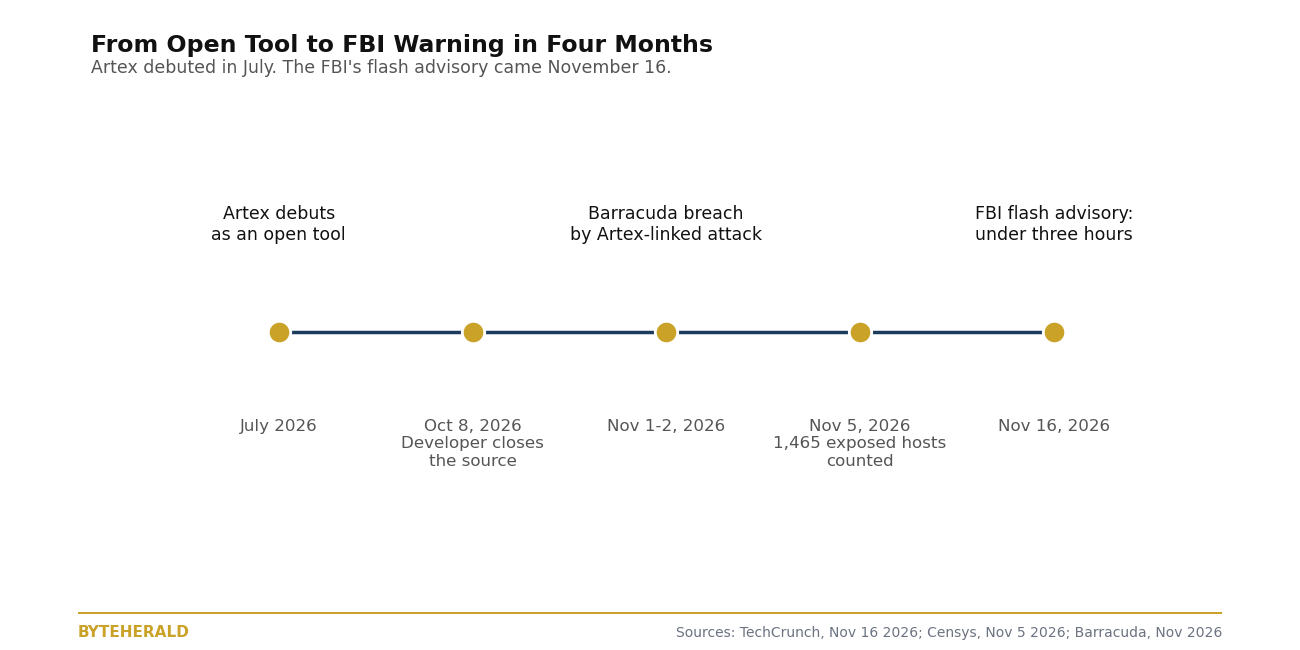
Artex debuted publicly in July 2026. After it was linked to attacks, its developer made the software closed-source on October 8, 2026, and took the original version offline. The FBI says the earlier open version continues to circulate and remains widely accessible. Researchers found hundreds of publicly exposed Artex systems online last week, some without password protection. We counted the exposure ourselves on November 5: 1,465 Artex hosts were visible on the internet, about 815 distinct-looking deployments, with 155 of them carrying another threat and 32 open directories leaking kits. The exposure is the point the advisory keeps returning to. Artex does not need a novel vulnerability. It finds the simple ones, exposed credentials and weak protections, and exploits them faster than a human team can respond.
What the FBI says defenders should do
The advisory's guidance is basic, and that is the point. Inventory which applications are visible from the internet. Limit administration services to trusted networks. Require multi-factor authentication. Review logs and application-to-application requests for unusual activity. None of it is new. The FBI's argument is that the basics are now the difference between a blocked probe and a compromise in under three hours, because the tool doing the probing no longer gets tired. The pattern matches the one our 2026 security report card graded in October: the breaches that succeed are usually the simple ones, and the grades for insider and data-theft defenses were poor.
By ByteHerald Staff. TechCrunch reported on November 16, 2026, that the FBI issued a flash cybersecurity advisory on the Artex tool, that some attacks move from targeting to compromise in under three hours, and that the tool was used against ConnectWise, South Korean financial institutions and Barracuda. Microsoft confirmed on November 16, 2026, as reported by TechCrunch, that Artex was used to break into ConnectWise and reach the Microsoft 365 environments of at least 2,250 customers. Censys reported on November 5, 2026, that 1,465 Artex hosts were exposed on the internet, about 815 distinct deployments. BleepingComputer reported on November 16, 2026, that the Barracuda attack moved through about 10 cloud accounts over about 44 hours.
Comments
Post a Comment