Anthropic said on November 4, 2026, that FlashProve can prove a reply came from a specific, committed set of model weights, and that the proof costs 70 to 95 times the GPU time of plain inference. The idea is simple to state and hard to do: when a model answers, the user should be able to check that the answer came from the model it was promised, not from a cheaper substitute, a censored variant, or a different version quietly swapped in. FlashProve is Anthropic's attempt to make that check possible, and its cost is the reason it will not be used for every reply.
The problem FlashProve solves, and the one it does not
The problem is substitution. A user who pays for a frontier model, or who relies on a model for a regulated decision, has no direct way to know which weights produced the output they received. A provider could run a smaller model to save cost, a different version to avoid a known flaw, or a modified model that refuses certain topics, and the output would still look like a normal reply. Anthropic's framing is that cryptographic proof, not a promise, is the fix: the provider commits to a set of weights in advance, then produces a proof with each reply that the reply came from those weights. The user, or an auditor, can verify the proof without seeing the weights themselves, which is the point for a proprietary model.
What FlashProve does not solve is truth. A proof that a reply came from committed weights says nothing about whether the reply is correct, safe, or free of bias. A model can be provably the promised model and still hallucinate, still repeat a training-data error, and still be manipulated through its prompt. Anthropic is explicit that FlashProve verifies provenance, the identity of the model, not the quality of the answer. Readers who treat a verified reply as a true reply are making the same category error as readers who treat a signed document as a true document. The signature tells you who wrote it, not whether what it says is right.
The proof-cost table: what Anthropic actually measured
Anthropic's numbers are the story, because they set the boundary between a useful audit tool and a curiosity. The company reports FlashProve at 110 tokens per second, with a one-time commitment of about 6.5 megabytes, a proof of about 18.78 megabytes per reply, verification in 17 seconds on 24 threads, and GPU overhead of 70 to 95 times plain inference. The proof size and the overhead are the two figures that matter most. A proof of nearly 19 megabytes is not a header a user will casually download for every chat message, and an overhead of 70 to 95 times means a provider running FlashProve for every reply would need roughly 70 to 95 times the GPU capacity it uses today for the same traffic. That is why Anthropic positions FlashProve for high-stakes, low-volume use, not for general chat.
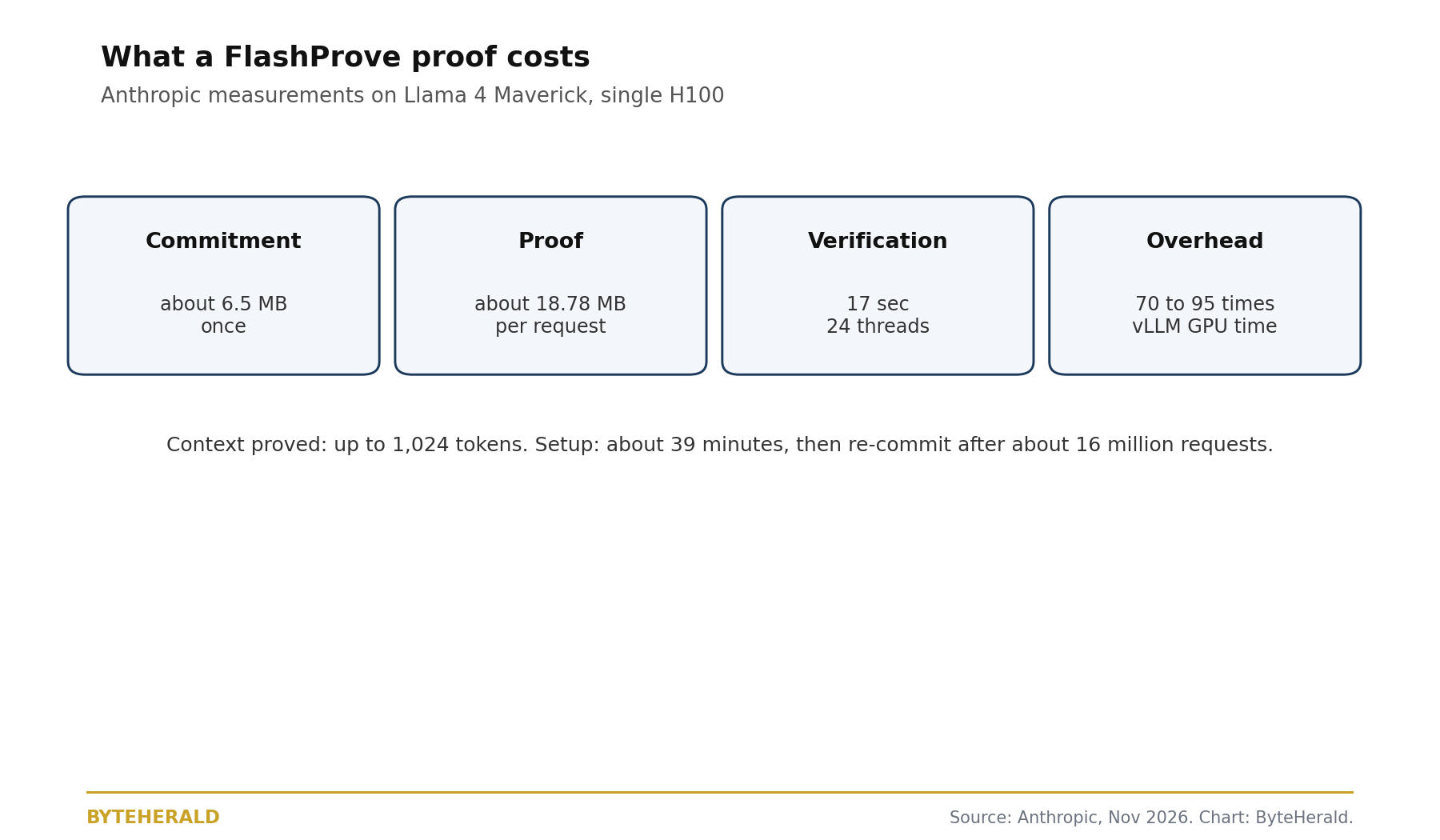
| Measure | FlashProve figure | What it means in practice |
|---|---|---|
| Throughput | 110 tokens per second | Slower than frontier chat, usable for audited replies |
| Commitment size | About 6.5 megabytes, once | The public fingerprint of the weights, published once |
| Proof size | About 18.78 megabytes per reply | Too large to attach to every casual message |
| Verification time | 17 seconds on 24 threads | An auditor's job, not a chat user's wait |
| GPU overhead | 70 to 95 times plain inference | The cost that limits FlashProve to high-stakes use |
Where a proof would actually be used
Think of three settings where a 70-times cost is still cheap. The first is regulated advice, where a financial or medical model must be shown to be the version that was approved, not a newer version that has not been cleared. The second is legal and audit evidence, where a party must show that a particular model produced a particular output at a particular time, for a dispute or a compliance record. The third is benchmark and evaluation integrity, where a lab must show that a score was produced by the model claimed, not by a stronger model substituted for the test. In each case the proof is not for the end user in the moment, but for an auditor later, and the cost is paid on a small number of replies that matter, not on millions of casual ones. A provider that offered FlashProve for every reply would be paying a fortune to prove what nobody asked to verify.
That framing also explains the 17-second verification time. Verification is not meant to happen inside a chat window while the user waits. It is meant to happen offline, by an auditor with 24 threads and a copy of the commitment, checking a stored proof against a stored reply. The user experience, if FlashProve ships as a product, would likely be a badge or a receipt: this reply is provable, and here is the proof file if you want to check it. The absence of a product announcement matters here. Anthropic describes FlashProve as research, not as a feature in Claude, and gives no launch date, no pricing, and no API for it. A developer cannot use FlashProve today, and should not plan a product around it until Anthropic ships it.
How much faster is this than what came before
Anthropic says FlashProve is dramatically faster than earlier zero-knowledge approaches to the same problem, and the comparison is worth stating carefully. Earlier methods for proving a neural network computation, often called ZKML, were so slow that proving a single frontier-model reply was impractical outside a research demo. Anthropic's claim is that FlashProve brings that cost down to a level where a high-stakes reply can be proved at all, even if it is still 70 to 95 times plain inference. The honest reading is that FlashProve moves the problem from impossible to expensive, not from expensive to cheap. A 70-times overhead is a breakthrough relative to a 10,000-times overhead, and it is still a non-starter for general use. Readers who quote the speedup without the remaining overhead are telling half the story, and the half they omit is the one that determines whether anyone will actually use it.
The five-question test for any verified-AI claim
FlashProve is the first system of its kind from a frontier lab, and it will not be the last. When the next vendor announces a verified model, a proof, or a trusted reply, ask five questions before believing the headline. First, what exactly is committed: the weights, the prompt, or both? Second, who can verify, and do they need the weights or just the commitment? Third, what does the proof cost, in time, size, and GPU overhead, and for how many replies? Fourth, does the proof cover the whole reply, or only part of the computation? Fifth, is the system available to use, or is it research with no product date? FlashProve answers the first three clearly, the fourth only in its paper's technical detail, and the fifth with a no: it is research, not a product. That scorecard is the useful way to read any future claim in this category, and it is the reason this post's headline leads with the cost. A proof that costs 70 times plain inference is a real advance, and a real limit, at the same time.
By ByteHerald Staff. Anthropic, November 4, 2026, announced FlashProve as a system to prove a reply came from committed model weights, reporting 110 tokens per second, a commitment of about 6.5 megabytes, a proof of about 18.78 megabytes, verification in 17 seconds on 24 threads, and GPU overhead of 70 to 95 times plain inference, positioned as research with no product launch date given.
Comments
Post a Comment