Google shipped the second version of its fast video model on November 5, 2026, and the two numbers that matter are 15 and 7. Gemini Omni 1.2 Flash generates and edits video clips up to 15 seconds long, up from 10 seconds in version 1.1, and it costs $0.07 per second of 720p video, 30 percent less than the version it replaces. The model is generally available now on the Gemini API and Gemini for business, according to the announcement from Anish Nangia, a product manager at Google DeepMind.
What changed in version 1.2
The headline change is length. Clips now run natively up to 15 seconds, and the duration can be set in one-second increments from 3 to 15 seconds, so a creator can ask for exactly the length a spot needs instead of trimming a 10-second clip or stitching two together. The second change is price: $0.07 per second for 720p video, down 30 percent from version 1.1. The third is editing. Multi-turn conversational editing now works across full 15-second clips, so a product, a background, the lighting, the weather, or the aspect ratio can be swapped with a follow-up prompt instead of starting over from scratch.
The remaining changes are about control. Reference adherence is stronger: the model takes character, product, or style images, motion clips up to three seconds, and audio cues, and holds faces, garments, packaging typography, and brand colors consistent across camera angles. Character, object, and scene consistency is better from the first frame to the last, with less visual drift or morphing across motion and camera transitions. Dialogue sounds more fluid, lip-sync is clearer, and multi-speaker scenes get distinct voice conditioning. Camera work is more controllable too, with continuous movements like sweeping FPV flythroughs and zoom-outs producing fewer unwanted jump cuts. Outputs carry an imperceptible SynthID watermark, and Provisioned Throughput is available for businesses that need reserved capacity.
The price math
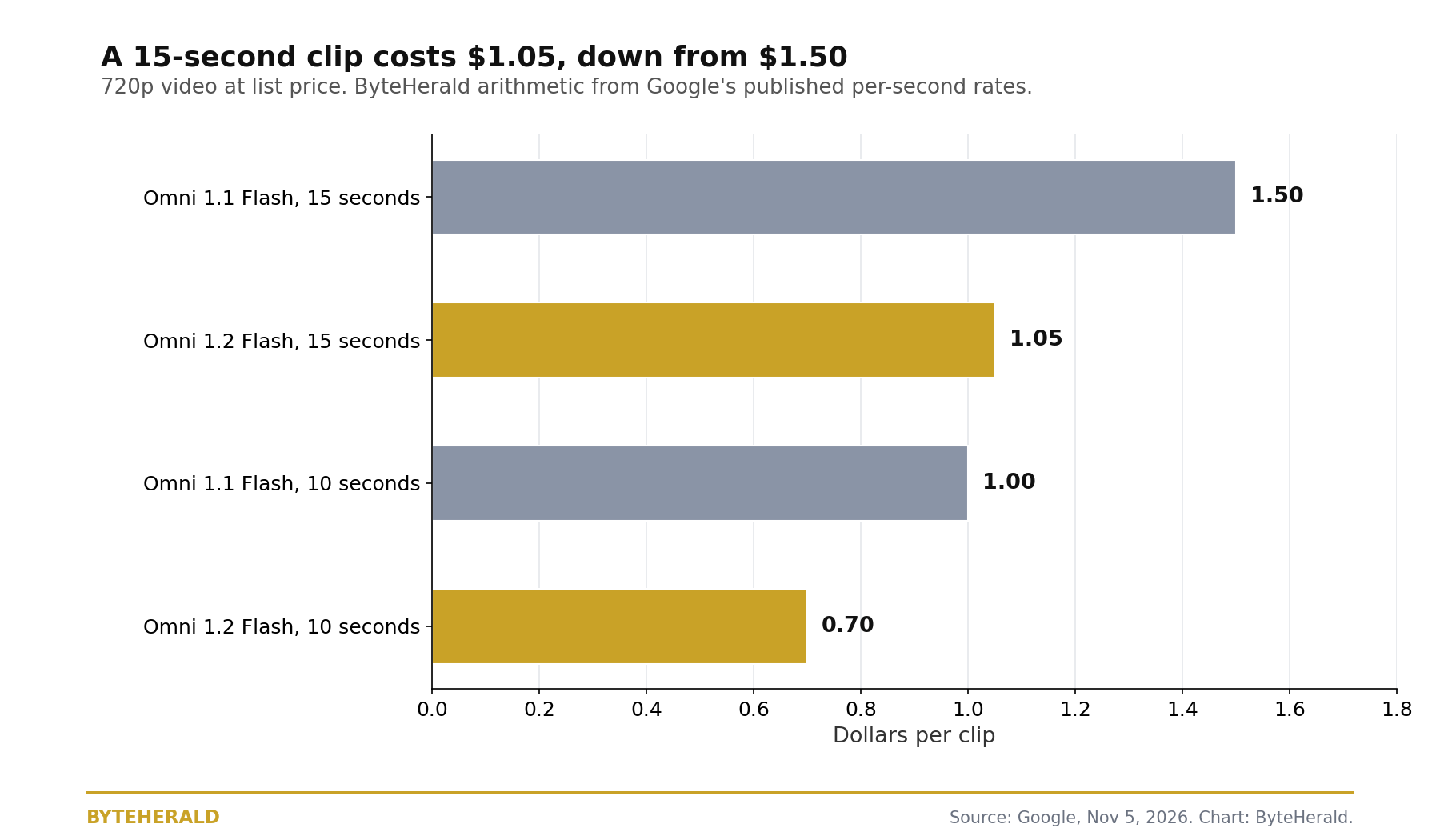
A 30 percent cut from $0.07 per second puts version 1.1 at $0.10 per second, a figure VentureBeat reported when the earlier model reached the API in July 2026. That makes the arithmetic straightforward, and ByteHerald's arithmetic below is labeled as such. A 15-second clip at 720p costs $1.05 on version 1.2, against $1.50 on version 1.1. A 10-second clip costs $0.70, against $1.00. The length gain is 50 percent, from 10 seconds to 15, while the per-second price fell 30 percent, so the longest clip the model can make now costs about what a 10-second clip cost before.
| Clip | Omni 1.1 Flash | Omni 1.2 Flash | Change |
|---|---|---|---|
| Per second, 720p | $0.10 | $0.07 | Down 30 percent |
| 10-second clip | $1.00 | $0.70 | Down $0.30 |
| 15-second clip | Not possible natively | $1.05 | New maximum length |
| Maximum length | 10 seconds | 15 seconds | Up 50 percent |
Google's own workflow advice is part of the price story. The company suggests drafting fast at 360p or 720p, fixing a detail with a follow-up edit instead of re-generating the whole clip, and upscaling only the best creations to 1080p or 4K. The edit-instead-of-regenerate step is where the savings compound: every avoided re-generation is a full clip price not paid.
The independent ranking
Google published no benchmark scores for version 1.2. The ranking that exists comes from LMArena, whose video leaderboards are built from blind head-to-head human votes. On the text-to-video board published November 5, 2026, Gemini Omni 1.2 Flash debuted first with a score of 1541, from 1,742 votes, ahead of version 1.1 Flash at 1514. On image-to-video it also debuted first, at 1502, ahead of MiniMax H3 at 1493 and ByteDance Seedance 2.5 at 1488. On video editing it ranks third, at 1395, behind Alibaba Wan 3.0 and Seedance 2.5. LMArena marks all three results preliminary, and the vote counts are early: 1,742 votes for text-to-video, 2,745 for image-to-video, 1,196 for video editing. A preliminary first place is a signal, not a verdict, and the gap to second place on text-to-video is 27 points on a scale where the confidence interval is about 15 points either way.
The image side of this race still belongs to OpenAI for now. GPT Image 2.6 holds the top spots on the image board, though each image costs more than the version before it, a trade-off we measured when the model launched. Google now holds the video board while OpenAI holds the image board, and the two companies are charging in opposite directions on price: Google cut, OpenAI raised the per-image token cost.
What 15 seconds unlocks
Clip length is the constraint that decides what a video model is for. At 10 seconds, a model makes a shot. At 15 seconds, it can make a complete social ad spot, a product explainer, or a virtual try-on sequence in a single generation, without a cut in the middle. Google's own example makes the point: one model photo plus front-and-back product shots of three outfits produces a 15-second try-on sequence across 360-degree turns and match cuts, with the model's identity and each garment's cut, drape, and back details held consistent. That is a catalog job, not a demo, and it is the kind of volume work the pricing is aimed at: product videos, virtual try-ons, and ads, in Google Cloud's words.
Video generation is priced by the second because rendering is priced by the work, and the work grows with length, resolution, and the number of references. A buyer comparing models should compare the per-second price at the same resolution, the maximum native length, and whether editing is charged as a new generation or as a cheaper follow-up. On those three measures, version 1.2 is cheaper per second than its predecessor, longer, and editable in conversation. The open question is quality at the new length: Google says consistency holds across 15 seconds, and the company is candid that fast sports action, rapid script changes, and complex physics are still in development. Those are the cases to test before committing a campaign to the model.
What to watch
Three things decide whether this launch matters beyond the announcement. First, whether the LMArena lead survives more votes, since 1,742 votes is a small sample and the results are marked preliminary. Second, whether the 15-second consistency claim holds on real brand assets rather than Google's chosen demos, because reference adherence is the feature advertisers will actually pay for. Third, whether rivals answer the price cut: one independent comparison puts Seedance 2.5 at about $0.23 per second, more than three times Omni 1.2 Flash, which leaves Google room to hold the price while competitors decide whether to match it. The model is available now through the Gemini API, Google AI Studio, Google Cloud, Flow, Google Vids, the Gemini app for Google AI Ultra subscribers, and Google Ads, so the testing can start today.
By ByteHerald Staff. Google DeepMind, November 5, 2026, announced Gemini Omni 1.2 Flash as generally available on the Gemini API and Gemini for business, with native 15-second clips and $0.07 per second pricing for 720p video. LMArena's video leaderboards published November 5, 2026, rank Gemini Omni 1.2 Flash first in text-to-video at 1541 points and first in image-to-video at 1502, with results marked preliminary. Google Cloud, November 6, 2026, confirmed general availability on Google Cloud with the same pricing and Provisioned Throughput for business users.
Comments
Post a Comment