On November 3, 2026, Google said AI products will be entirely off for K-12 student accounts until school administrators explicitly turn them on, and schools that restrict AI altogether will lose Google Search too, because Search and AI are now deeply integrated. That second half of the story: a school's decision about AI is no longer a decision about one tool, it is a decision about whether students can search at all.
What Google announced, and what it did not
Google announced the change on November 3, 2026, in a blog post by Chris Phillips, vice president and general manager of education, titled around Guided Learning, the company's study-coaching feature. The controls cover four products: Gemini, Gemini Notebook, Gemini in Classroom, and Google Search. Access to these products will be entirely off for K-12 student accounts until administrators explicitly turn them on, and Google says it will share more specifics with schools in the coming months so they have time to prepare before the changes roll out.
The same post brings Guided Learning into two more places. In Search, it will walk students through homework problems step by step instead of going straight to the answer, starting with a pilot in select United States schools later in November 2026, expanding to other districts in the coming months. In Google Classroom, Guided Learning is globally available from November 3, 2026, for activities assigned by a teacher, anchored in class material.
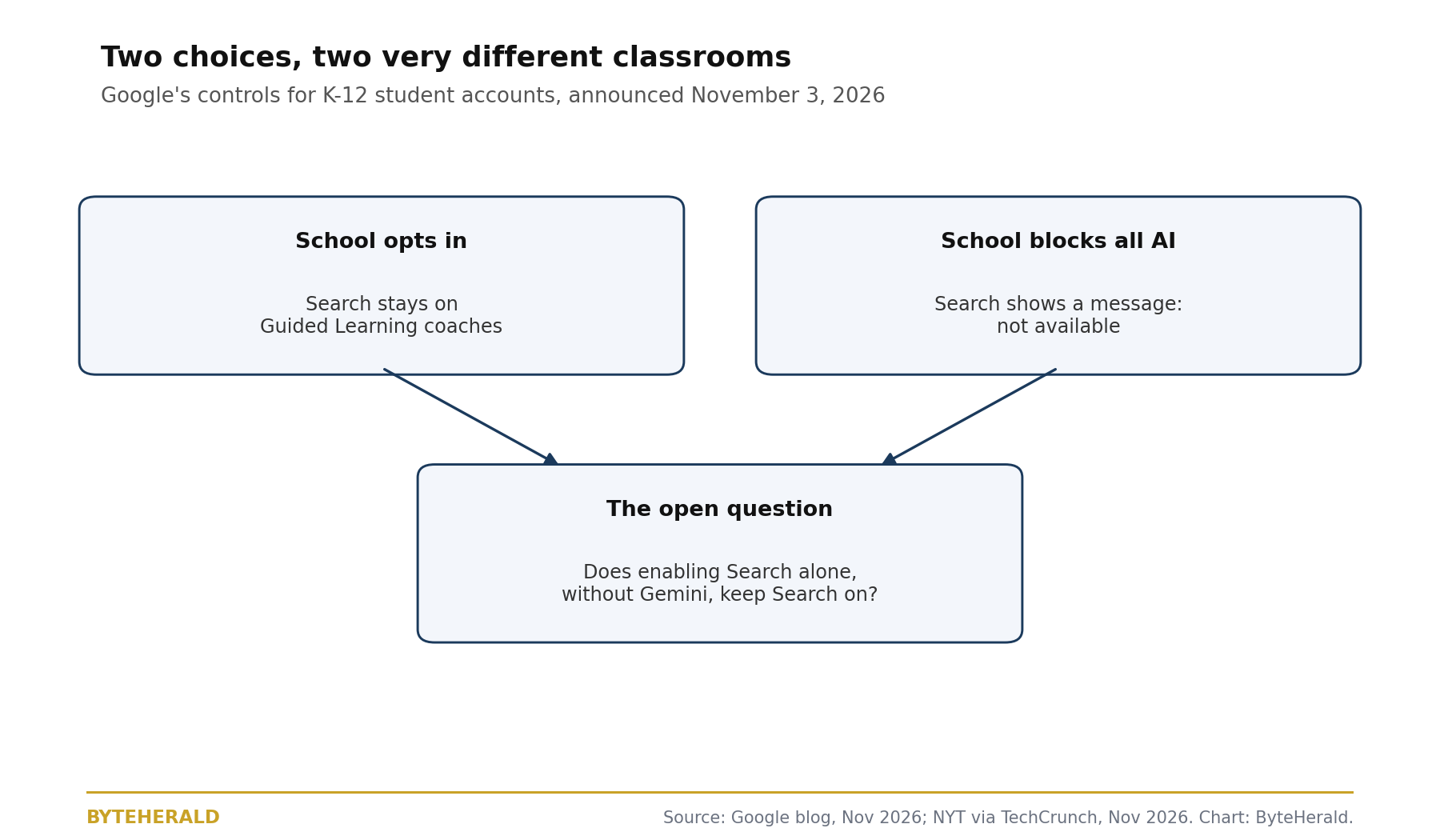
What the blog post does not say is the consequence that made the news. It does not state that blocking AI removes Search, it does not give an exact rollout date, and it does not list which districts plan to opt in. Those details come from Phillips speaking to The New York Times, as reported by TechCrunch on November 3, 2026: the tools will be off by default in early 2027, and a school that restricts AI altogether will find that students "will not have access to search, and they'll see a message from their school that indicates it's not available." The distinction matters for reading the announcement honestly. The opt-in is Google's own words. The Search penalty is Google's education chief explaining the opt-in to a newspaper, not a line in the blog post.
Why Search cannot be separated from AI inside Google
The technical reason, as Phillips stated it, is integration: AI features such as AI Overviews are built into the Search experience itself, and Guided Learning is now being built into Search as well. A school administrator gets a switch for each product, but Search is a product that contains AI, so switching AI off entirely switches Search off with it. The controls described here apply to K-12 student accounts managed by schools; the announcement does not describe changes to personal accounts, which sit outside administrator control. That is an architectural claim about Google's product, not a claim that searching without AI is impossible in principle. Other search engines exist, and a school that loses Google Search on managed accounts could point students elsewhere, at the cost of leaving the managed Google environment its teachers and devices are built around.
The honest gap in the announcement is the partial case. Google has not publicly explained what happens if a school enables Search but disables Gemini, or whether an administrator can keep ordinary Search while refusing the AI features inside it. TechCrunch's reporting notes the same gap: Google has not explained exactly what controls administrators will get or how Search can be managed separately. Until Google publishes those controls, the only two outcomes it has confirmed are the ones in the diagram above: opt in and keep Search with its AI features, or block AI entirely and lose Search. Any article promising a middle setting today is inventing one.
The choice schools actually face
For administrators, the decision now has three parts, and only two of them are settled. First, the default flips: where AI tools were available unless restricted, they will now be off unless enabled, which reverses the burden of action onto schools that want them. Second, the bundle is all or nothing at the extremes: keeping Search means accepting its AI features, and refusing AI means finding another way for students to search. Third, the timing is tight but not immediate: a pilot later in November 2026, more specifics in the coming months, and the default-off state arriving in early 2027, which gives districts a planning window but not an indefinite one.
This is the vendor-side mirror of a pattern ByteHerald has tracked all year: institutions restricting AI tools, sometimes by law and sometimes by policy. Our database of every government AI ban, mapped across 15 countries, shows governments drawing the line from the outside. Google's move draws it from inside the product: the vendor, not the state, decides what refusing AI costs. And the closest single case to this one is Sweden's government ban on ChatGPT and Claude, where an institution chose restriction and accepted the loss of the tool. Schools now face the same shape of decision, except the tool they lose is the search box itself.
The question worth asking before early 2027 is not whether AI belongs in classrooms. Districts disagree on that, and the opt-in respects the disagreement. The question is whether a search engine with AI woven through it should be sold as one indivisible product to schools at all. Google's answer, for now, is that it is one product, and schools that want the search part must take the AI part with it.
By ByteHerald Staff. Google, November 3, 2026, announced Guided Learning in Search and Classroom, controls making Gemini, Gemini Notebook, Gemini in Classroom, and Google Search entirely off for K-12 student accounts until administrators explicitly turn them on, a Search pilot in select United States schools later in November 2026, and Guided Learning globally available in Google Classroom from November 3, 2026. The New York Times, November 3, 2026, reported Phillips stating that Search and AI are deeply integrated and that students at schools restricting AI altogether will not have access to search and will see a message from their school indicating it is not available. TechCrunch, November 3, 2026, reported the early 2027 timing for the default-off change, the Search consequence for schools restricting AI altogether, and that Google has not yet explained exactly what controls administrators will get.
Comments
Post a Comment