Google introduced the Gemini Decisions API on November 11, 2026, and the model behind it, Gemini Decision 1, answers up to 1,000 yes-or-no, multiple-choice, or rubric questions about one document, image, recording, or video in a single pass, in 150 to 250 milliseconds, at 10 cents per million input tokens, and it never writes a word. The point is not another chatbot. It is a model built to make small, bounded judgments fast enough to sit inside software that is already running, where a generative answer would be too slow, too expensive, or too hard to trust.
What a decision model is
A normal language model answers by writing text one token at a time, which means every answer costs time and output tokens, and the answer has to be parsed back into a decision. Gemini Decision 1 skips the writing. It scores the candidate options for each question in one forward pass and returns probabilities and a confidence score from 0 to 1, so code can branch on the result directly, or route an uncertain case to a person. That routing choice is also a permission question, which is why how an AI agent proves what it is allowed to do matters before the model ever runs. Google calls this a closed-set decision: the possible answers are fixed in advance, and the model picks among them instead of inventing new text.
There are three question types, and they cover most of what software needs to judge. A noul question asks whether a yes-or-no condition holds, with optional descriptions of what counts as true and false. A choice question picks a winner from 2 to 255 named options and returns normalized probabilities for every candidate. A score question grades an input against an ordered rubric starting at 0 and returns a continuous weighted score with per-level probabilities. One request carries a single shared input of up to 256,000 tokens, across text, images, audio, video, and PDFs, plus up to 1,000 independent questions, and the shared input is billed once no matter how many questions are asked. Each question adds only its own instruction and criteria tokens.
| Question type | What it does | What it returns |
| noul (yes/no) | Checks whether a condition holds | Probability the condition holds, plus confidence |
| choice (multiple choice) | Picks from 2 to 255 named options | Winner and normalized probabilities for every candidate |
| score (ordered rubric) | Grades against a rubric starting at 0 | Continuous weighted score and per-level probabilities |
The use cases Google names are tool selection, policy checks, model routing, and context grading. Google already runs the API inside its own products: Gemini Notebook uses it as a real-time router that sends everyday queries to cheaper model tiers and reserves deep reasoning for complex ones, which Google says cuts latency by up to 40 percent for everyday queries; the new rapid canvas experiment in Stitch uses it to generate playable wireframes and apply voice or tap edits almost instantly; CC from Google Labs uses it to pick an emoji reaction from a palette of more than 200 options; and Google Search uses it as a safety layer that detects adversarial behavior against its tools. That internal use is the strongest signal in the announcement, because Google is trusting the model with its own latency-critical paths.
The numbers Google publishes
Google reports median model compute of 50 to 100 milliseconds and end-to-end latency of 150 to 250 milliseconds, across multimodal inputs and contexts up to 16,000 tokens, staying nearly flat from 1 to 100 questions per request. The price is 10 cents per million input tokens with zero output tokens billed, and there is a no-cost tier in Google AI Studio for prototyping. On Google's own benchmark table, Gemini Decision 1 leads across the suite and has the lowest calibration error, and Google says it is nearly five times cheaper across the shared benchmark suite than Gemini 3.5 Flash-Lite with the Interactions API.
| Test (Google's table) | Gemini Decision 1 | Best rival reported |
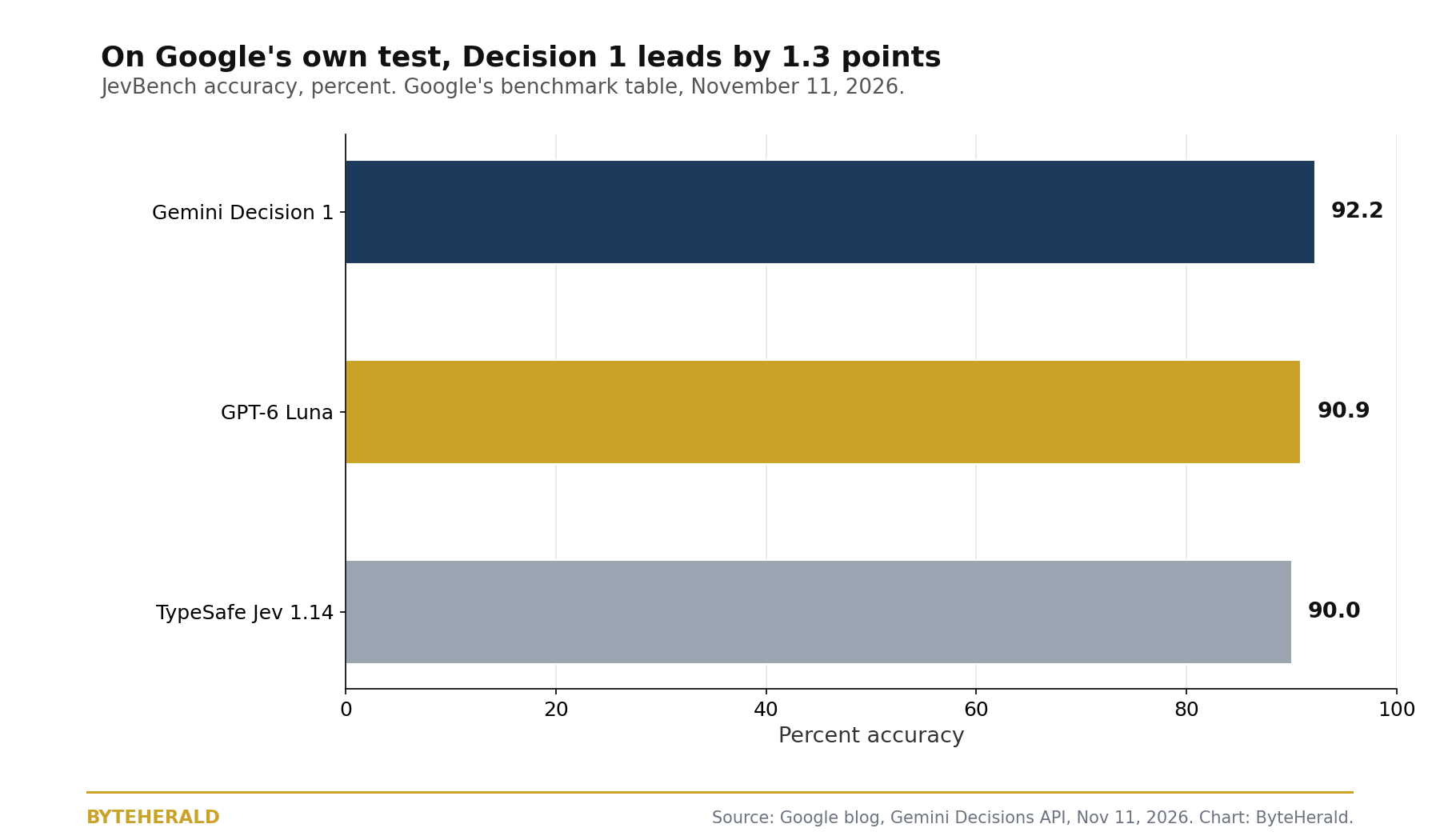
| JevBench (accuracy) | 92.2% | GPT-6 Luna 90.9% (Jev 1.14: 90.0%) |
| Amazon ESCI | 58.7% | Jev 1.14 56.7% |
| New Yorker Caption | 79.7% | Jev 1.14 72.0% |
| Mind2Web Multimodal (browser tasks) | 86.2% | Jev 1.14 86.8% |
| PubMedQA | 79.8% | Jev 1.14 78.2% |
| Global-MMLU-Lite | 86.0% | Jev 1.14 85.0% |
| When2Call (when to invoke tools) | 79.9% | Jev 1.14 82.0% |
| MMAU audio | 71.8% | Gemini 3.5 Flash-Lite 67.7% |
| Video-MME | 69.1% | Gemini 3.5 Flash-Lite 63.3% |
| Calibration error (Top-1 ECE, lower better) | 0.0250 | Jev 1.14 0.0494 (Luna 0.0721) |
Read the table carefully, because it is Google's own. Decision 1 wins the headline JevBench number by 1.3 points over GPT-6 Luna and 2.2 over Jev, and its calibration error is about half of Jev's, which is the number that matters most for a model whose job is to say how sure it is. But Jev wins the two tests that look most like real agent work: browser-task decisions on Mind2Web Multimodal, 86.8 percent to 86.2, and deciding when to call a tool on When2Call, 82.0 percent to 79.9. Decision 1's other leads are narrower: Amazon ESCI 58.7 percent to 56.7, New Yorker Caption 79.7 to 72.0, PubMedQA 79.8 to 78.2, and Global-MMLU-Lite 86.0 to 85.0. Google's table also shows Decision 1 leading five of the seven tests all four models ran. The two media tests were run against Gemini 3.5 Flash-Lite, not against Jev or Luna, so they show a generational improvement, not a head-to-head win.
The independent check tells a narrower story
Google's table is not the only scoreboard, and the independent one is less flattering. The Artificial Analysis Decision Index v2.1, which combines six evaluations scored as accuracy minus a calibration penalty, puts Gemini Decision 1 ninth of 18 decision models at launch, with a score of 65.98, just behind Jev 1.14 at 66.23 and well behind the leader, Drex Max v1.1, at 72.62. The index measures the model at 211 milliseconds per task and 345 dollars per million tasks, which makes it the most expensive model in the top half of the board and fifteenth of 18 on cost.
The component scores explain the gap. Decision 1 is first of 18 on knowledge and reasoning tests: AA-Omniscience-Decision at 66.3 and HLE-MultiChoice at 48.7. It is ninth on AA-Paperclip, the document-decision test, at 56.8, where only 33 percent of documents were answered completely correctly, against 35.5 percent for Jev and 63 percent for Drex Max. On Artificial Analysis's own When2Call run, Drex Max scored 94.6 percent accuracy, Jev 80.8 percent, and Gemini Decision 1 75.2 percent, lower than the 79.9 percent in Google's table because the two runs use different harnesses. The pattern is consistent across both scoreboards: Decision 1 is strongest where the question is knowledge or reasoning, and weakest where the job is reading a whole document and getting every fact right, or deciding exactly when to act.
That pattern also sets the price question. At 10 cents per million input tokens, Decision 1 costs more than twice Jev's 4.2 cents per million, and the Artificial Analysis cost column puts Decision 1 at 345 dollars per million tasks against 156 dollars for Jev and 103 dollars for Drex Max. The counterweight is the shared-input billing: one 256,000-token input can carry up to 1,000 questions, so the per-question cost falls fast when a request is packed. A single-question request is expensive for what it does. A thousand-question request is cheap per question. The same cost-versus-capability trade is what we tracked when Gemini 4 Carbon became usable at a price that doubles on December 1.
Where it fits, and what it does not do yet
The decision-model category is now a three-way race, and Google is the third entrant, not the first. OpenAI made its Decisions API generally available on October 22, 2026, with GPT-6 Luna as the only supported model. TypeSafe shipped Jev in September. Microsoft followed with Microsoft-Decision-1, built on Alibaba's Qwen. Google's entry is the most capable on knowledge tests and the most expensive per task, and it arrives with the widest integration list: OpenRouter, LangChain, Vercel, LiteLLM, Pydantic AI, Pipecat, LiveKit, and OpenCode are rolling out support, alongside the google-genai SDKs.
There are limits worth knowing before building on it. The API runs only on the Gemini Developer API at v1beta, with Gemini in Google Cloud listed as coming soon and no date given. There is no context caching and no Batch API yet, so repeated context is billed in full. The free tier is capped at 200 requests per minute, 50,000 tokens per minute, and 10,000 requests per day. Question instructions are text-only, and conversation history and tool-call blocks are not supported. The model is also the routing layer for decisions like which tool an agent may call, and the same routing logic decides which model tier answers a query.
What to test before you trust it
A decision model earns trust the same way any classifier does: on your data, not the vendor's. Run a hundred of your own questions through it and check the calibration, because a confidence score of 0.9 that is right only 70 percent of the time is worse than no confidence score at all. Test the document cases specifically, since that is where Decision 1 is weakest on the independent index, and test the tool-timing cases, since Jev beats it there on both scoreboards. Compare the per-task cost on your actual workload, not the per-token price, because the shared-input billing makes packed requests cheap and single-question requests expensive. And keep a fallback for low-confidence answers, because the model's best feature is that it tells you when it is unsure, which only helps if your code listens.
By ByteHerald Staff. Google announced the Gemini Decisions API on November 11, 2026, in a post by Min Choi, product manager at Google DeepMind, and Felix Yu, principal scientist at Google DeepMind, stating that Gemini Decision 1 evaluates up to 1,000 questions in a single pass across text, images, audio, video, and PDFs, with 150 to 250 milliseconds of end-to-end latency and pricing of 10 cents per million input tokens with zero output tokens billed. VentureBeat reported on November 11, 2026, that the Artificial Analysis Decision Index v2.1 ranks Gemini Decision 1 ninth of 18 decision models with a score of 65.98, behind Jev 1.14 at 66.23 and Drex Max v1.1 at 72.62, and that Google's own table gives JevBench scores of 92.2 percent for Decision 1, 90.9 percent for GPT-6 Luna, and 90.0 percent for Jev 1.14. Artificial Analysis data, as reported by OrcaRouter, shows Decision 1 passing 33 percent of AA-Paperclip documents outright against 63 percent for Drex Max v1.1, and scoring first of 18 on AA-Omniscience-Decision at 66.3 and on HLE-MultiChoice at 48.7. ApiDog reported on November 12, 2026, that the free tier is capped at 200 requests per minute, 50,000 tokens per minute, and 10,000 requests per day.
Comments
Post a Comment