The artificial intelligence buildout is not being paid for out of pocket. It is being paid for with bonds, with stock, with leases, and with shares swapped for chips, and in the first days of November 2026 the financing ledger grew by tens of billions of dollars in a single week. Five deals, announced or filed between October 26 and November 2, show the full menu of ways the industry is funding its factories, and each one carries a different risk. Read together, they answer the question that hangs over every earnings call this season: who actually pays when the bill for computing arrives.
The November ledger, in one table
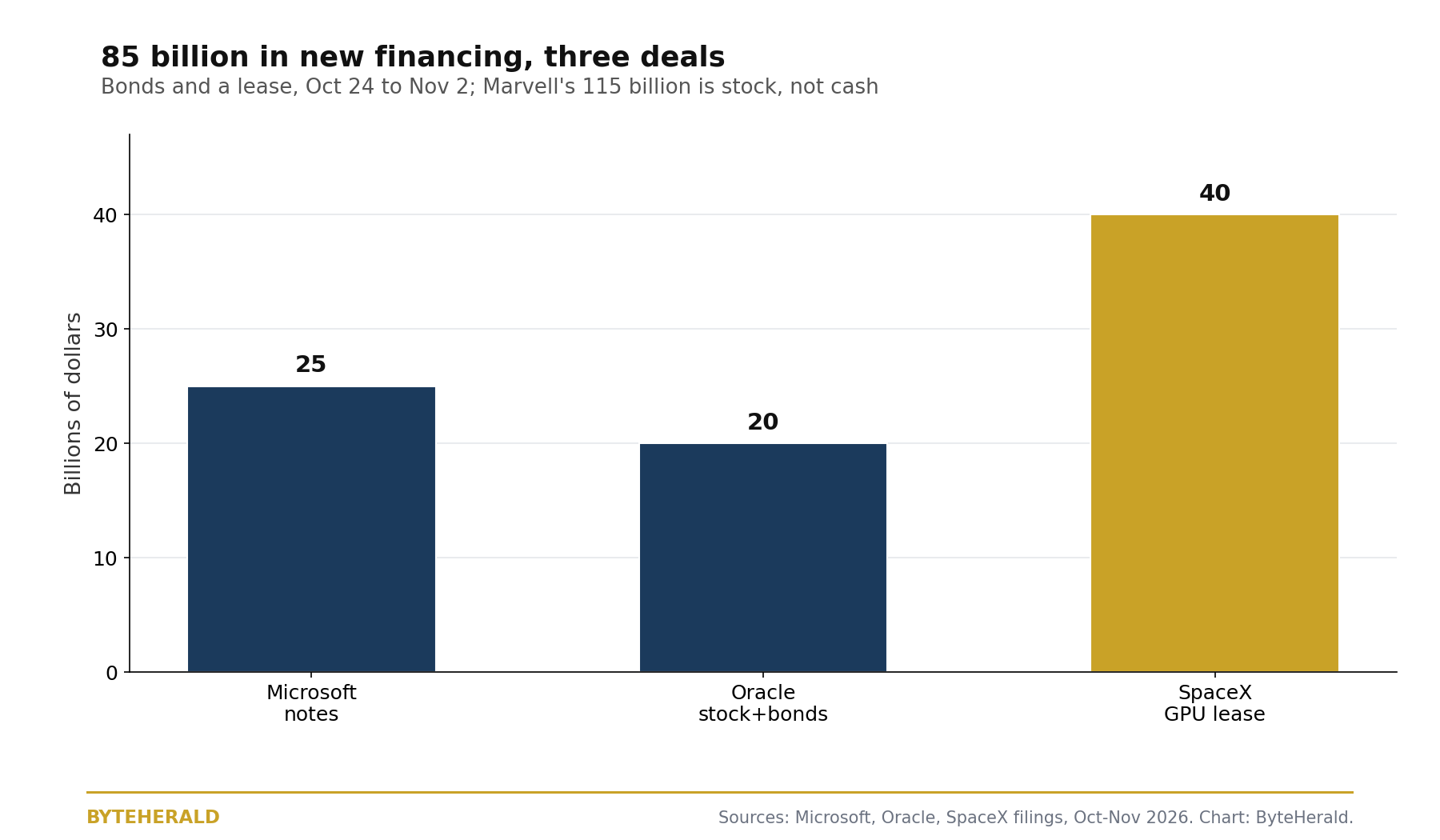
| Deal | Size | Instrument | Who pays first |
|---|---|---|---|
| Oracle stock program, filed November 2 | Up to 10 billion dollars | At the market equity | New shareholders, through dilution |
| Oracle bonds, planned November 2 | 10 billion dollars | Corporate debt | Bondholders, serviced from future cash flow |
| CoreWeave GPU lease, reported November 2 | 40 billion dollars | Operating lease via a special purpose vehicle | CoreWeave, then Meta as the customer |
| AMD and OpenAI stock swap, announced October 2026 | Up to 115 billion dollars in value | Warrants for up to 160 million AMD shares | AMD shareholders, if OpenAI's valuation holds |
| OpenAI shares as chip collateral, reported October 2026 | Not disclosed | Equity pledged against hardware | OpenAI, with its own equity at stake |
1. Oracle: the balance sheet route
Oracle's pair of filings is the most conventional financing on the list, and the most transparent. An at the market stock program lets a company sell shares gradually, at prevailing prices, and a bond offering borrows at a fixed cost for a fixed term. Oracle disclosed both on November 2, using the 20 billion dollar shelf it had filed a week earlier, after an 18 billion dollar bond sale in September. The risk here is legible to any reader of a balance sheet: debt must be serviced whether or not the data centers it funds are fully used, and dilution, even gradual, reduces existing shareholders' claim. The protection is also legible: Oracle has a 455 billion dollar backlog of contracted work, and its customers have signed for capacity before it is built. ByteHerald covered the Oracle filings in full in Oracle Is Raising $20B in Stock and Bonds for Its AI Buildout.
2. CoreWeave and Meta: the lease route
CoreWeave's reported 40 billion dollar arrangement is the least visible kind of financing, and the most consequential for how risk moves through the system. Under the structure reported by the Financial Times, a special purpose vehicle buys graphics processors and leases them to CoreWeave, which in turn supplies computing to Meta. Meta does not own the chips, CoreWeave does not carry the full purchase on its own balance sheet in the same way, and the vehicle sits between them. The advantage is speed: capacity can be assembled without a single company funding the entire purchase. The risk is opacity. Leases, vehicles, and pass through contracts make it harder for outsiders, and sometimes for the companies themselves, to see where the obligation finally lands if demand falls. The deal's size, 40 billion dollars, is large enough that the answer matters to more than the parties involved.
3. AMD and OpenAI: the equity swap route
The AMD and OpenAI arrangement, announced in October, is the most novel, and the most dependent on a rising market. AMD granted OpenAI warrants for up to 160 million shares, potentially worth up to 115 billion dollars, in exchange for OpenAI buying AMD chips and building on AMD hardware. No cash changes hands at the start. The value exists only if AMD's share price rises as OpenAI exercises its warrants, and only if OpenAI's demand for AMD hardware materializes at the scale the deal assumes. If both hold, AMD gains a marquee customer and OpenAI gains cheap, aligned supply. If either fails, the headline value evaporates, and what looked like a 115 billion dollar deal becomes a much smaller one. The structure aligns the two companies' fortunes, which is its strength and its fragility at once.
4. OpenAI's pledged shares: the collateral route
Reports in October that OpenAI pledged its own shares as collateral for chip purchases extend the same logic one step further. Pledging equity means borrowing against a valuation that the borrower itself is still proving, and a fall in that valuation can trigger demands for more collateral or faster repayment. It is a financing tool more familiar from leveraged buyouts than from technology companies, and its appearance here signals how far the industry will reach to secure hardware now. The details are undisclosed, which is itself part of the story: the most leveraged corner of the buildout is also the least documented.
What the ledger means, and what to watch
Three patterns run through all five deals. First, nobody is paying cash up front at the scale of the buildout; every deal spreads the cost over time, across parties, or into the future value of the companies involved. Second, the risks are shifting from the companies building the capacity to the financial system around them: bondholders, lease vehicles, and shareholders who may not realize how much AI exposure they now hold. Third, the deals depend on demand holding at today's pace, because each structure assumes the capacity being financed will be used, and used profitably, for years.
That is why the next disclosures matter more than the headlines. Watch Oracle's bond pricing, which will show what lenders charge after the September deal. Watch whether CoreWeave's lease structure is replicated, which would signal that off balance sheet capacity is becoming the industry's default. Watch AMD's share price and OpenAI's chip orders, which together decide whether the warrant deal is worth anything near its headline. And watch for any disclosure of pledged share terms, which would show how much of the buildout is financed against valuations rather than cash. The buildout is real, the demand is real, and the financing is inventive. The ledger is how you tell whether the invention is sustainable.
By ByteHerald Staff. Oracle filed November 2, 2026 to sell up to 10 billion dollars in stock through an at the market program and planned 10 billion dollars in bonds, using a 20 billion dollar shelf filed October 26, 2026, after an 18 billion dollar bond sale in September 2026 and a 455 billion dollar remaining performance obligation, up 359 percent. The Financial Times, November 2, 2026, reported CoreWeave's 40 billion dollar GPU lease structure supplying Meta through a special purpose vehicle. AMD and OpenAI announced in October 2026 warrants for up to 160 million AMD shares, potentially worth up to 115 billion dollars, tied to OpenAI chip purchases, and October 2026 reports described OpenAI pledging shares as chip collateral on undisclosed terms.
Comments
Post a Comment