On November 2, 2026, Artificial Analysis released Intelligence Index version 5, and the new leaderboard does not look like a reshuffle. It looks like a correction. The test suite that ranked AI models for two years has been rebuilt around private, held-out questions and harder scientific work, and the models that dominated the old index have moved in different directions. Some open-weights systems fell further behind. One closed frontier model moved to the top by a single point. And the gap between the best open-weights model and the best closed model, the number that frames the whole open-versus-closed debate, widened from 3 points to 12. This article explains what changed, what the new table actually shows, and how to read the next change without being misled by it.
What changed, in one table
The Intelligence Index is not a single test. It is a weighted composite of many benchmarks, and version 5 changes the ingredients in three ways that matter more than any single score. First, it replaces public benchmarks that models may have seen in training with private, held-out versions, so a model cannot score well by memorising the test. Second, it adds harder science tasks, including graduate-level questions in biology, chemistry, and physics, where frontier models still differ sharply. Third, it reweights the suite so that reasoning and knowledge tasks count more than the short, easily gamed prompts that dominated earlier versions. The result is a test that is harder to game and harder to top out on, which is why scores in version 5 are lower in absolute terms than the version 4 scores many readers remember. A lower score in version 5 does not mean a model got worse. It means the test got harder.
| What changed | Version 4 | Version 5 |
|---|---|---|
| Test questions | Mostly public benchmarks | Private, held-out questions |
| Science tasks | Limited graduate-level coverage | Harder biology, chemistry, and physics tasks added |
| Weighting | Short prompts counted heavily | Reasoning and knowledge tasks count more |
| Score level | Higher absolute scores, easier to top out | Lower absolute scores, harder to game |
That table is the whole story in miniature. Everything that follows, the new order, the widened gap, the fall of a familiar name, is a consequence of those three changes, not a separate event. Readers who compare a version 5 score directly with a version 4 score, without noting the harder test, will draw the wrong conclusion every time. The correct comparison is within version 5, model against model on the same test, and the correct historical comparison is gap against gap, not score against score.
The new leaderboard, and the gap that widened
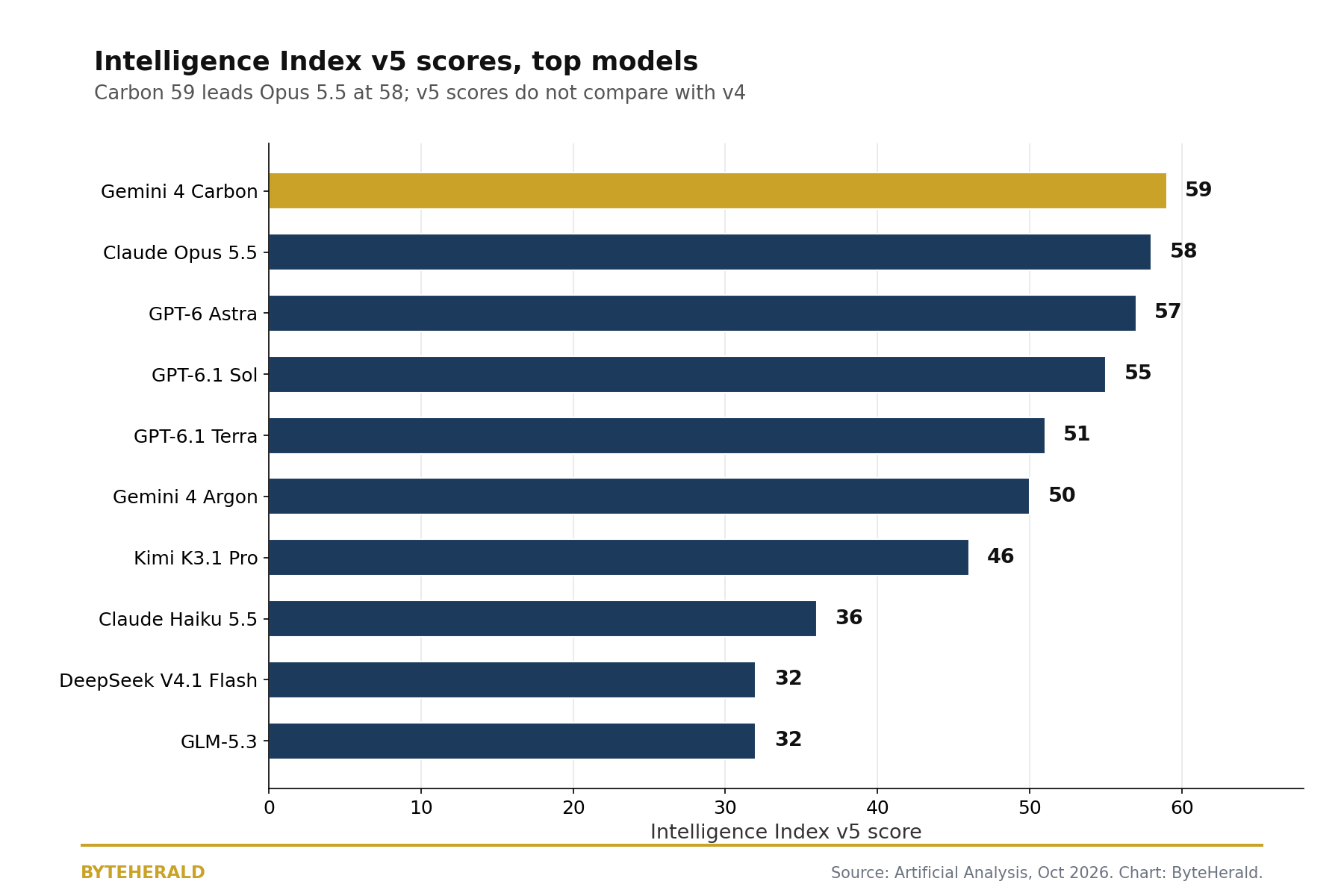
On that like-for-like basis, the version 5 leaderboard is headed by a model the index calls Carbon, with a score of 59. It is followed by Opus 5.5 at 58, Astra at 57, Sol at 55, Terra at 51, Argon at 50, Kimi at 46, Haiku at 36, and DeepSeek and GLM tied at 32. The full table, as published by Artificial Analysis, is reproduced below, and it rewards a careful read: the top three are separated by only 2 points, the middle is crowded, and the bottom of the top ten is a long way behind the top, which is itself a finding about how far the frontier has pulled away from the rest of the field.
| Rank | Model | Intelligence Index v5 | Type |
|---|---|---|---|
| 1 | Carbon | 59 | Closed |
| 2 | Opus 5.5 | 58 | Closed |
| 3 | Astra | 57 | Closed |
| 4 | Sol | 55 | Closed |
| 5 | Terra | 51 | Closed |
| 6 | Argon | 50 | Closed |
| 7 | Kimi | 46 | Open weights |
| 8 | Haiku | 36 | Closed |
| 9 | DeepSeek | 32 | Open weights |
| 9 | GLM | 32 | Open weights |
The headline gap is the distance from the top of the table to the best open-weights model. In version 4 that gap was 3 points. In version 5 it is 12 points, from Carbon at 59 to Kimi at 46, and that widening is the single most consequential number in the release. It does not mean open-weights models got worse in absolute capability. It means that on a harder, less gameable test, the best closed models held their ground better than the best open models did, or that the private questions and science tasks in version 5 reward capabilities where closed labs currently lead. Either reading points the same way for builders: the frontier is not closing as fast as the version 4 table suggested, and the open-weights field's next breakthrough will need to show up on held-out science and reasoning, not on public benchmarks it can train on.
Two other moves in the table deserve attention, because they correct common shorthand. The first is the position of Haiku at 36, far below the frontier models, which reminds readers that a smaller, faster model from the same lab is not a near-frontier model, however good its price and speed may be. The second is the tie at 32 between DeepSeek and GLM, two open-weights systems that, on this test, are 14 points behind the best open-weights model, Kimi, and 27 points behind the leader. That spread inside the open-weights field is larger than the gap between first and sixth place, and it should end any talk of open weights as a single bloc. On version 5, there is a leading open-weights model, and then a long way back to the rest.
How to read the next leaderboard change
Leaderboards change for three reasons, and only one of them is that models got better. The first reason is that the test changed, as it did here, and a new test rewards different strengths. The second is that the model changed, through a new release, a new training run, or a new inference setting that the index does or does not capture. The third is that the measurement changed, through contamination, overfitting to a public benchmark, or a scoring error that is later corrected. Version 5 is mostly the first reason, with a deliberate attempt to reduce the third, and that is why its scores should be treated as a new baseline, not as a continuation of the old series. A model that gains 5 points on version 5 next quarter will have done something real. A model that gains 5 points because the test changed again will have done something different, and the release notes, not the headline score, will tell you which.
That gives readers a simple checklist for the next release, and it is worth keeping beside the table above when the next version lands.
| When a score changes, ask | What to check |
|---|---|
| Did the test change? | Release notes for new, removed, or reweighted benchmarks |
| Did the model change? | New release, training run, or inference setting |
| Did the measurement change? | Contamination, overfitting, or scoring corrections |
| Is the comparison like for like? | Same version, same settings, gap against gap |
For readers who follow the labs behind these models, ByteHerald's coverage of Anthropic's filing and comparison of lab safety frameworks give the financial and governance context that a leaderboard alone cannot, and this index article will be updated at this URL when version 6, or a major version 5 revision, is published, rather than replaced by a competing post. The leaderboard moved because the test moved. The next move that matters will be a model that closes the 12-point gap on the harder test, and that is the number to watch.
By ByteHerald Staff. Artificial Analysis, November 2, 2026, released Intelligence Index version 5, with private held-out questions, harder graduate-level science tasks in biology, chemistry, and physics, and reweighting toward reasoning and knowledge tasks, reporting Carbon 59, Opus 5.5 58, Astra 57, Sol 55, Terra 51, Argon 50, Kimi 46, Haiku 36, DeepSeek 32, and GLM 32, and a widening of the gap between the best closed model and the best open-weights model from 3 points in version 4 to 12 points in version 5.
Comments
Post a Comment