Microsoft 365 went down on November 12, 2026, and stayed down into November 13, knocking out Outlook, Teams and Copilot for users in 74 countries. Microsoft blames servers that became unexpectedly unavailable, not a cyberattack, and by Friday morning, Central time, it reported early signs of stabilisation but not a full recovery. It is the second major disruption to Microsoft’s 365 services this year, and the one that reached furthest into governments, hospitals and airlines.
What failed, and when
The problems began at about 16:00 GMT on Thursday, November 12, which was 10:00 a.m. Central. Users started reporting that they could not open Outlook, and Teams and Copilot, Microsoft’s AI assistant, were disrupted as well. By Thursday evening the tracking site Downdetector had logged about 140,000 reports of Outlook problems from 74 countries. In the United States the peak came to about 130,000 reports around 1 p.m. Eastern on Thursday, and there were still more than 18,000 reports at 11:30 p.m. Eastern. On Friday the outage stretched into Asia-Pacific business hours, with users in India, Australia and Japan reporting failures through the morning.
Microsoft’s own explanation is that a large number of its servers became unexpectedly unavailable, putting elevated load on the rest, and that the extra strain had not come from a rise in traffic. The company said it paused deployments, moved traffic off the affected infrastructure, and started restarting servers. In its latest Friday update it said it had applied adjustments to the affected servers, but they did not result in sustained recovery, although it observed some partial recovery in the regions where the adjustments were applied. Later on Friday it reported early signs of stabilisation, but said service capacity had not yet returned to normal and health remained variable as traffic was carefully reintroduced.
Who was hit
More than 430 million people use Microsoft 365 apps, according to the company’s own website, and the outage reached the parts of daily life that depend on email most. The table below is what was confirmed by Friday morning, Central time.
| Who | What happened |
|---|---|
| Governments | Australia’s spy agency ASIO and the Australian Federal Police were unable to use Outlook, and Australia’s Bureau of Meteorology confirmed its email was disrupted. |
| Health | Doctors’ surgeries and NHS services across England reported they could not access Microsoft services, according to The Sun. |
| Airlines | IndiGo reported a technical issue with its booking engine, and Akasa Air said email services across its systems were affected, and both cited a Microsoft Azure outage. |
| Airports | Heathrow Airport’s website showed no flights, although the airport said it was a data issue with a third party and flights were unaffected. |
| Business | More than 430 million people use Microsoft 365 apps, according to Microsoft’s own website. Companies reported that whole departments could not send or receive mail. |
| Products | Outlook, Teams and Copilot were down, and Microsoft’s own Dynamics 365 Contact Center was down for just under eight hours. |
What Microsoft says caused it
Microsoft has ruled out a cyberattack. Charles Lamanna, the company’s executive vice president for Copilot, Agents and Platform, said in a post on X late on Thursday that there was no indication the outage was the result of malicious or cyber activity. Australian Home Affairs and Cyber Security Minister Tony Burke said Microsoft had told him it did not believe the outage was caused by a cyberattack, and Microsoft said it was not aware of any malicious activity. The company’s service health notice said features of Microsoft 365 services that depended on Exchange Online and email were affected, while elements that did not rely on Exchange Online remained functional. Its live status page lists the outage under incidents EX1550543 and MO1550821.
The honest version of the cause is narrower than the headline. Microsoft has said what failed, servers becoming unexpectedly unavailable, and what followed, elevated load on the servers that remained. It has not said why those servers became unavailable, or how many were involved. That gap matters, because the same company is asking businesses and governments to trust it with the infrastructure their work runs on, and a second long outage in one year invites the question of whether the redundancy that is supposed to absorb a server failure actually did.
The AI angle: Copilot down, connectors broken
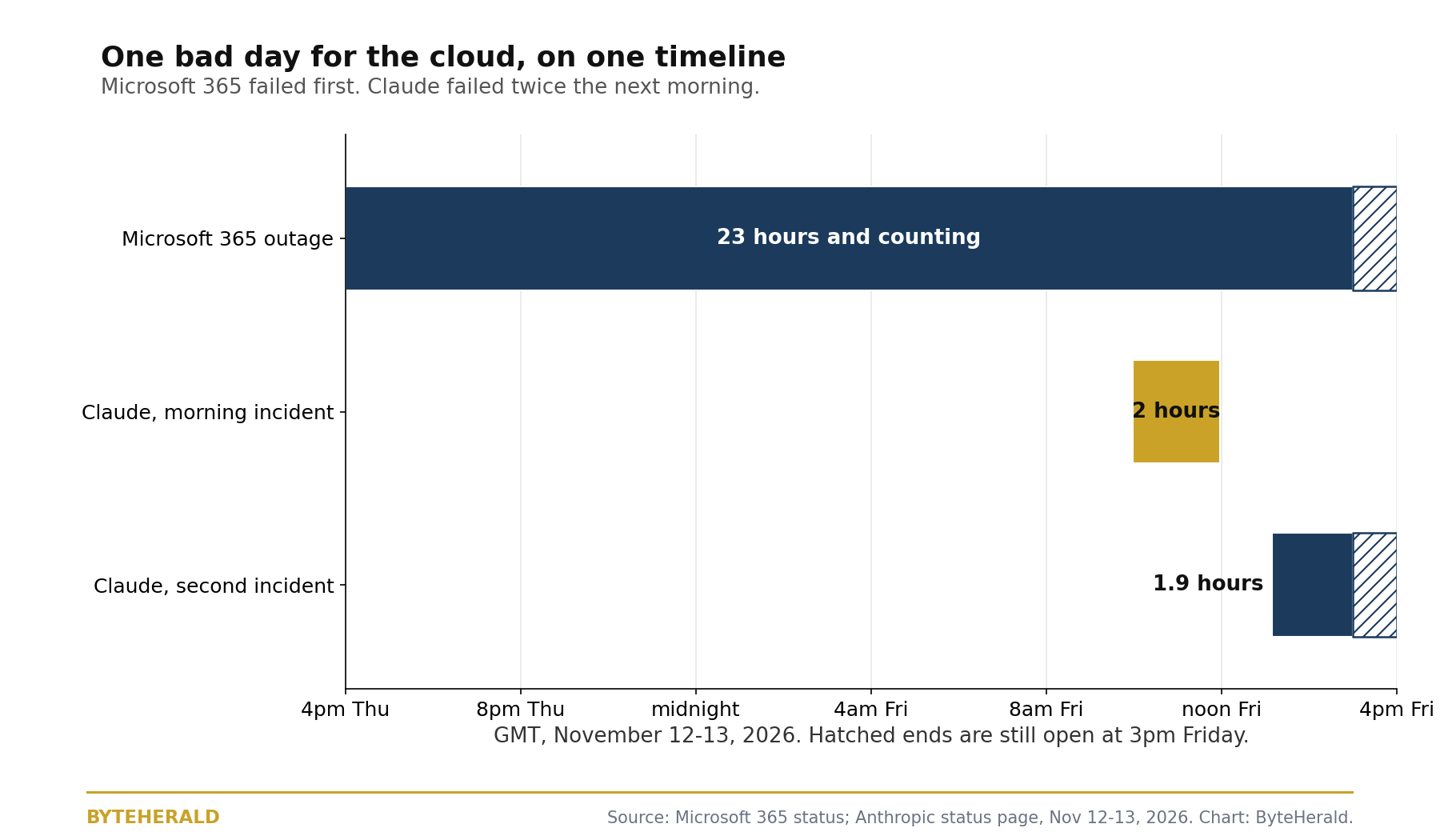
Copilot, the AI assistant built into Microsoft 365, was disrupted along with Outlook and Teams, which means the outage took out the AI layer as well as the email layer. The damage spread beyond Microsoft’s own products. OpenAI and Anthropic both said they had faced issues with Microsoft connectors, and Anthropic’s status page shows its Microsoft 365 connector failing since the evening of November 12, with mail, calendar and search tools in Claude failing for most requests. Claude itself went down twice on November 13, in incidents Anthropic has not linked to Microsoft, but the connector failure is directly tied to this outage, and it shows how one provider’s failure now breaks AI tools that sit on top of it. Our report on the Claude outages, published today, has the full timeline of those two incidents.
There is an irony in the timing. On November 10, Anthropic launched an office suite for Claude, and Microsoft’s stock fell as much as 3.5 percent intraday that day as investors weighed the new competition. Two days later it was Microsoft’s own suite that was down, and the AI assistant it sells as the reason to stay was down with it. Competition between AI assistants is a real story, but November 13 was a reminder that both sides run on infrastructure that can fail for a whole day.
What to do during a 365 outage
The first check is Microsoft’s own 365 status page, which carries the incident numbers and the recovery updates, and the second is Downdetector, which shows whether the failure is local or global. Do not assume a single failed service means all of them are down: Microsoft said parts of 365 that do not depend on Exchange Online stayed functional, so Teams chat or locally stored files may still work while email does not. For time-sensitive messages, use a channel outside the suite, phone or SMS, rather than waiting for queued mail to flush. And treat the outage as a planning input, not a one-off: two long outages in one year, with governments and hospitals among the affected, is the point at which an organisation should check whether its most critical work has a path that does not run through a single provider.
By ByteHerald Staff. The Telegraph India reported on November 13, 2026, that Microsoft’s Outlook, Teams and Copilot were still down on Friday as the outage stretched beyond 12 hours, disrupting businesses and governments worldwide, with Microsoft blaming server problems and reporting signs of stabilisation. Channel News Asia reported on November 13, 2026, that the outage affected users in 74 countries according to Downdetector, with continued recovery in North America and Europe and early signs of stabilisation. Rappler reported on November 13, 2026, that Downdetector showed more than 130,000 Outlook problem reports in the United States around 1 p.m. Eastern on Thursday and more than 18,000 at 11:30 p.m. Eastern, and that Microsoft said its adjustments did not result in sustained recovery. The Thursday Times reported on November 13, 2026, that about 140,000 Outlook reports came from 74 countries, that servers became unexpectedly unavailable, and that more than 430 million people use Microsoft 365 apps. JAM Radio reported on November 13, 2026, that Australia’s spy agency and federal police were affected, that Microsoft’s live status lists incidents EX1550543 and MO1550821, and that Dynamics 365 Contact Center was down for just under eight hours. Anthropic reported on its status page on November 12, 2026, that its Microsoft 365 connector began failing at 17:52 UTC because of a Microsoft 365 service incident.
Comments
Post a Comment