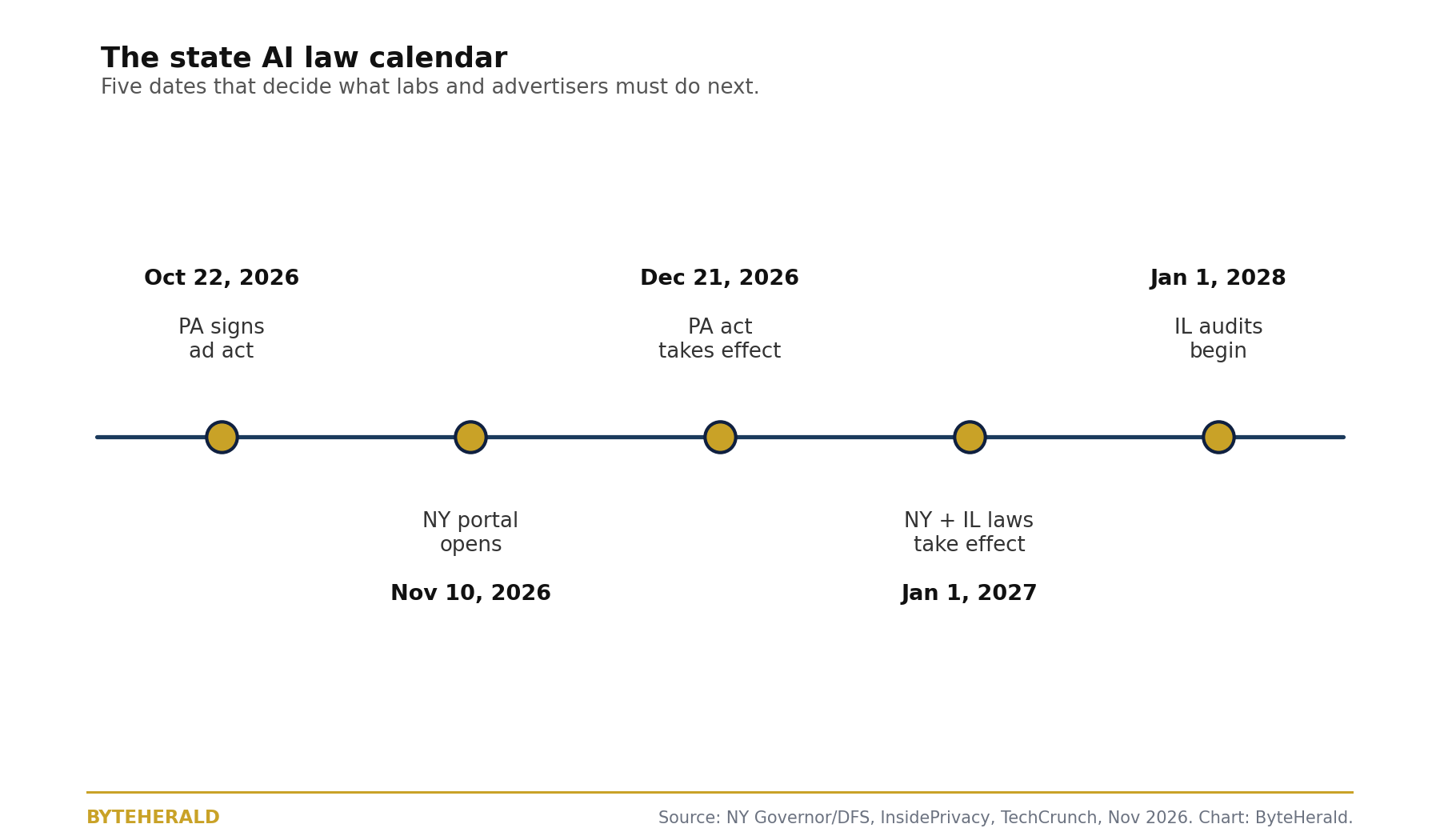
New York opened the registration portal for its AI safety law on Tuesday, November 10, 2026, and the same week Pennsylvania's new law on AI in advertising moved toward taking effect. Two states, two different AI laws, one direction: the rules for frontier AI labs and for AI-generated ads are now being written in state capitals, not in Washington. New York's law, the Responsible AI Safety and Education Act, known as the RAISE Act, takes effect on January 1, 2027. Pennsylvania's Artificial Intelligence Deceptive Advertising Act takes effect on December 21, 2026.
What New York now requires
New York is gearing up to enforce one of the country's most significant AI safety laws, and the first step is a list. The state opened a registration portal on November 10, and large frontier AI developers, including Anthropic and OpenAI, must register by January 1, 2027. The threshold, as TechCrunch reports it, is companies with more than 500 million dollars in annual revenue. Once the law takes effect, those developers must publish safety frameworks on their websites, report critical safety incidents within 72 hours, and issue public model transparency reports. They must also file quarterly assessments of catastrophic risks and file a disclosure statement at least every other year, and pay assessments that fund the oversight program. A new office, the Office of Digital Innovation, Governance, Integrity, and Trust, known as DIGIT, inside the Department of Financial Services, will implement the law and oversee the labs. Penalties can reach 1 million dollars for one violation and 3 million dollars for subsequent violations, and the state can bring enforcement actions against companies that fail to register, though a spokesperson declined to give specifics. The same day, Governor Kathy Hochul launched a statewide AI safety testing network, the New York Center for AI Responsibility and Research at Binghamton University, with more than 80 researchers, to independently test advanced AI systems. The center can supply expertise and evidence to DIGIT at the state's request, and will review developers' published safety frameworks and suggest ways to strengthen them.
Four states, four laws
| State and law | Who it covers | Core duty | Key dates | Penalty |
| New York, RAISE Act | Large frontier developers, over 500 million dollars revenue | Publish safety frameworks, report critical incidents in 72 hours, publish transparency reports | Registration by Jan 1, 2027; law effective Jan 1, 2027 | Up to 1 million dollars first violation, 3 million dollars after |
| Pennsylvania, Deceptive Advertising Act | Advertisers using synthetic content | Disclose AI-modified or AI-generated ad content, clearly and conspicuously | Signed Oct 22, 2026; effective Dec 21, 2026 | Civil fines up to 3,000 dollars; no private right of action |
| California, SB 53 | Large frontier developers, over 500 million dollars revenue | Publish safety frameworks, report critical incidents, publish transparency reports | In force since Jan 1, 2026 | Up to 1 million dollars per violation |
| Illinois, SB 315 | Large frontier developers, over 500 million dollars revenue | Safety frameworks and incident reporting, plus independent third-party audits | Approved July 6, 2026; effective Jan 1, 2027; audits from Jan 1, 2028 | Up to 1 million dollars first violation, 3 million dollars after |
The three frontier safety laws share a template. Each uses the same two thresholds to decide who is covered: a model trained with more than 10 to the 26th power operations, and a developer with more than 500 million dollars in annual revenue. None of the three creates a private right of action for the safety duties. Illinois is the one that goes further: starting January 1, 2028, or 90 days after a developer first qualifies if that is later, a large frontier developer must retain an independent auditor each year, making Illinois the first state to require independent third-party audits of frontier AI models. Pennsylvania's law is a different kind of rule. It does not regulate model developers. It regulates advertisers, and it reaches further than the New York and California advertising rules, because it is not limited to ads using a synthetic performer.
What Pennsylvania bans
Pennsylvania's governor signed the Artificial Intelligence Deceptive Advertising Act, Senate Bill 806, into law on October 22, 2026, and it takes effect 60 days later, on December 21, 2026. The law prohibits advertisers from creating or disseminating an ad that uses synthetic content in a way that creates a false consumer perception about the nature, origin, or authenticity of the advertised goods or services, unless the ad carries a clear and conspicuous disclosure. Synthetic content is defined broadly as information, including an image, video, audio clip, or text, that has been significantly modified or generated by AI. The disclosure must state that the ad contains content modified or generated using AI, must appear when the synthetic content is first presented to the consumer, must be in the same medium as the synthetic content, and must, to the extent technically feasible, be permanent or extraordinarily difficult to remove. It must be readily noticeable, readable, understandable, and capable of being heard, and presented in the language the consumer used to interact with the content. The law excludes content that is evidently fictional, parody, satire, commentary, or criticism, and content limited to text. Enforcement sits with the Pennsylvania Attorney General and district attorneys, who can seek injunctions and bring civil actions. Courts can impose civil fines of up to 3,000 dollars and award attorneys' fees and court costs. The law provides no private right of action, so consumers cannot sue under it directly.
The pattern: states are writing the rulebook
New York is not the first state to do this, and it will not be the last. California's frontier AI safety law has been in force since January 1, 2026. Illinois approved its version on July 6, 2026. New York's governor signed the RAISE Act on December 19, 2025, then signed a chapter amendment on March 27, 2026, that pulled the New York text toward California's, adopting the same compute and revenue thresholds. The three laws now read like one template with three enforcers, and the industry has noticed. OpenAI endorsed the Illinois law, calling it one of the strongest frontier AI safety laws in the country, and said the three states are beginning to create a de facto national framework. The reason states can move first is that no federal statute from the current Congress generally preempts or pauses state AI laws, and no court has challenged any of the three frontier statutes, according to a comparison by x9m8 of the laws published in November. We mapped every government AI ban in October and found 18 bans in 15 countries, and the same map is now filling with a different kind of rule: not bans on use, but duties on the companies that build the models and the advertisers that use them.
What it means for the labs
The practical test starts in January. New York's registration deadline of January 1, 2027, gives large labs a fixed date to comply, and the 72-hour incident window is the most demanding piece: a lab that discovers a critical safety incident has three days to tell the state. What counts as a critical incident, and what form the filings take, is still open. The state's September announcement of the implementation plan did not provide detailed guidance on the form or substance of the required submissions, and the portal that opened on November 10 is the first operational piece. The safety frameworks the law requires are not new as a concept. We compared every major lab's AI safety framework in October, when publishing one was a voluntary choice. From January, in New York, California, and Illinois, it is a legal duty, and the framework a lab publishes on its website is the same document the state can now ask it to defend. For advertisers, the test is simpler and closer: from December 21, any Pennsylvania ad that uses AI to change what a product looks like, sounds like, or claims to be must say so, in the ad itself, where the customer can see it first.
By ByteHerald Staff. TechCrunch reported on November 10, 2026, that New York opened a registration portal for large frontier AI developers, who must register by January 1, 2027, publish safety frameworks, report critical safety incidents within 72 hours, and issue public model transparency reports, with penalties up to 1 million dollars for one violation and 3 million dollars for subsequent violations, and that Governor Hochul signed a separate chatbot safety law for minors in October that takes effect June 1, 2027. The New York governor's office announced on September 21, 2026, that large frontier developers would be directed to register starting in November, with compliance beginning in January 2027 through the new DIGIT office inside the Department of Financial Services. Unite.ai reported on November 10, 2026, that Hochul launched the New York Center for AI Responsibility and Research at Binghamton University with more than 80 researchers to independently test advanced AI systems. Inside Privacy reported on November 9, 2026, that Pennsylvania's governor signed the Artificial Intelligence Deceptive Advertising Act, Senate Bill 806, on October 22, 2026, effective December 21, 2026, with civil fines up to 3,000 dollars and no private right of action. A comparison by x9m8 of the California, New York, and Illinois frontier AI safety laws, published in November 2026, found the three share a model trained with more than 10 to the 26th power operations and a developer with more than 500 million dollars in annual revenue, that California's law has been in force since January 1, 2026, that Illinois approved SB 315 on July 6, 2026, and that Illinois is the first state to require independent third-party audits, from January 1, 2028.
Comments
Post a Comment