The United States cleared New Matrix, a 17-month-old Chinese company, to assemble Nvidia's H200 AI chips into servers, and The New York Times found its listed Beijing office empty, its owners tied to a fund Washington blacklisted in 2024. The investigation, published November 7, 2026, found a second cleared firm with a deserted office and two more tied to suppliers of the Chinese military. Nobody has shown that a chip reached a restricted end user through any of them. The finding is narrower and more damaging than that: the screening process meant to keep advanced chips away from blacklisted entities cleared companies that barely appear to exist.
The office that does not exist
New Matrix is on the list of Chinese firms approved to handle Nvidia's H200 chips, the advanced processors used to train and run large AI models. According to the Times, the company was created 17 months ago, and there is scant information about it online. At the address it lists, in an industrial park on the northwest edge of Beijing, reporters found a hollow gray shell with wires dangling from the ceiling where lights should be. The building directory does not include the firm, and staff at the nearby property management agency said they had no record of it. The license New Matrix holds is to assemble H200 chips into AI servers for other customers, not to buy them for its own use, which makes the empty office stranger: a company that mounts GPUs inside servers needs floor space, test benches, and staff, and the investigation found none of that at the declared address. Chinese corporate records tie two of New Matrix's main owners to companies connected with Wise Road Capital, a private equity fund the United States placed on its trade blacklist in 2024 for allegedly helping Beijing acquire strategically sensitive semiconductor companies.
The ledger: four firms, one pattern
The Times reports the New Matrix case as a pattern, not a one-off, and the table below is the ledger its investigation supports. Each row is a firm the Commerce Department cleared, what it was cleared to do, what reporters found, and the blacklisted link the investigation documents. Two of the four had offices reporters could visit and found empty. The other two were tied to military suppliers through their owners.
| Firm | Cleared to do | What the Times found | Blacklisted link |
|---|---|---|---|
| New Matrix | Assemble H200 chips into AI servers | Listed Beijing office empty; no directory listing, no property record | Owners tied to Wise Road Capital, on the Entity List since 2024 |
| Maginfra | Assemble H200 chips into AI servers | Office visited September 2026: locked room, a few chairs and empty desks | Shares staff and patents with Inspur, on the Entity List for military work |
| Zhejiang Yindun Cloud Technology | Buy or handle H200 chips | Not visited in the reporting | Owners tied to companies serving the Chinese military |
| Shanghai Jiatang | Buy or handle H200 chips | Not visited in the reporting | Owners tied to companies serving the Chinese military |
The roster
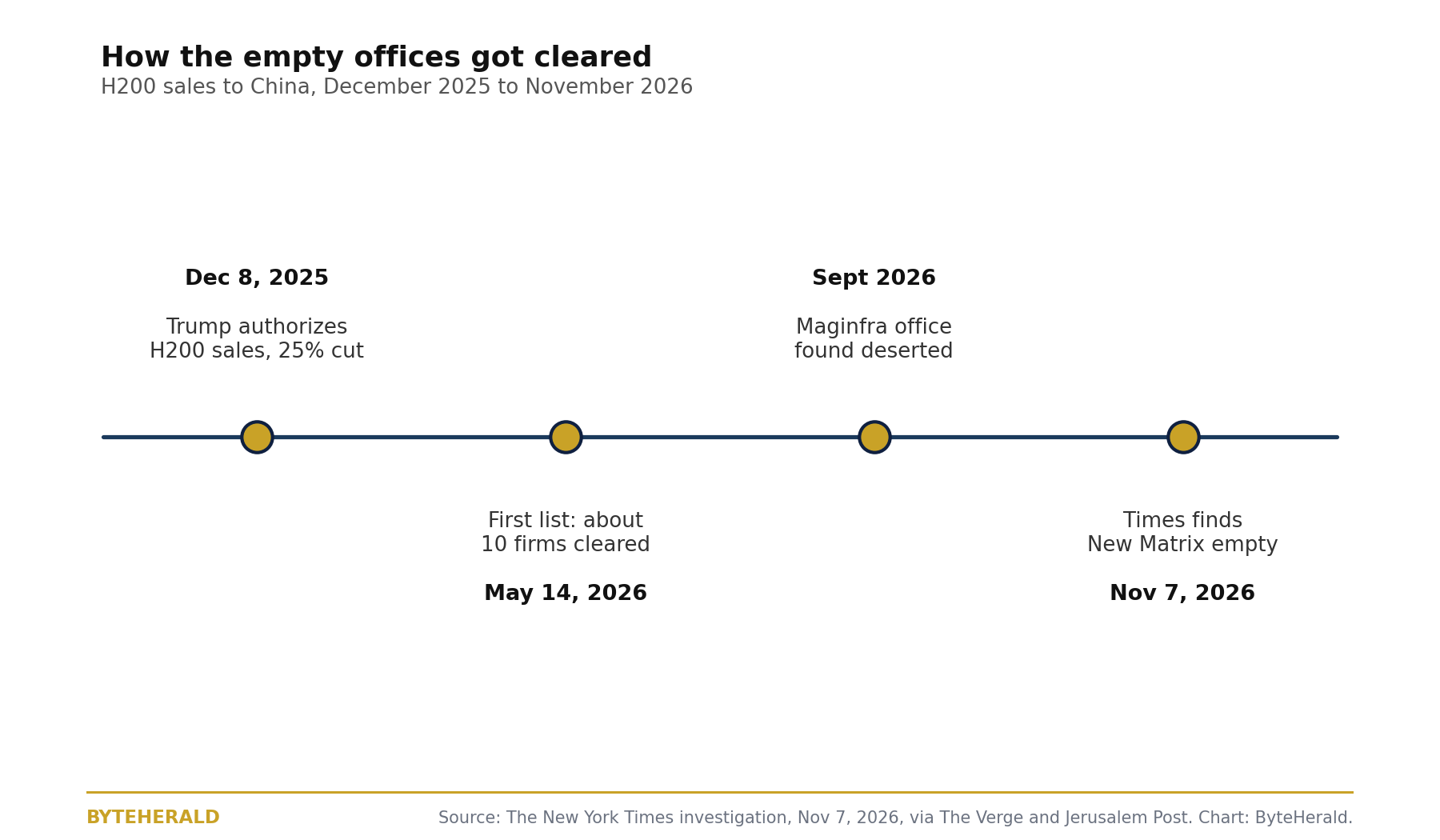
The Commerce Department has cleared roughly two dozen Chinese companies to buy or handle H200 processors, according to the Times. The first list landed on May 14, 2026, covering about 10 companies, among them Alibaba, Tencent, ByteDance, and JD.com, plus distributors such as Lenovo and Foxconn. The roster now also includes major corporations such as Baidu, BYD, and Tesla Shanghai. The commercial stakes for Nvidia today are small: H200 shipments to China were less than 1 percent of the company's data-center revenue in the quarter ending July 2026. That is the point the investigation makes hardest to ignore. The program is not moving much money, and it is not moving many chips, yet the vetting still cleared firms whose offices do not exist and whose owners trace to blacklisted funds. A small program with weak screening is still a weak screen.
How the door opened
Nvidia was restricted from selling its most advanced AI chips to China during the Biden administration. The Trump administration changed course: on December 8, 2025, the president announced on Truth Social that Nvidia could sell H200 processors to approved Chinese customers, with the United States government taking 25 percent of the revenue from the sales, collected as a tariff as the chips, manufactured in Taiwan, pass through the United States before reaching China. The Commerce Department was required to review buyers for national security risk before the chips could move. New Matrix passed that review. The review is run by the Bureau of Industry and Security, which defended its licensing process, saying it carefully reviews applications for national security risks, but gave no comment on the two cases specifically. Nvidia spokesman John Rizzo commented to the Times, saying it makes no sense for the Chinese military to depend on American technology. New Matrix did not respond to requests for comment. The gap between the defense of the process and the emptiness of the offices is part of the story: the only account of how the review works in practice comes from the reporters who visited the offices.
What the finding does and does not prove
The honest limits matter here, because the story will be overstated by others. No published report shows an H200 reaching a restricted end user through New Matrix, and the claim that the firm is a front for Wise Road-linked companies rests on corporate records and the reading of two analysts the Times consulted, not on a shipment or a seizure. New Matrix could prove to be a sloppily documented assembler rather than a conduit. What the investigation does establish is narrower: a firm with no working office and owners tied to a blacklisted fund passed a national-security review that was supposed to catch exactly that. The controls themselves are a patchwork of thresholds, with the former US order setting a compute threshold, China setting its own, and the European Union setting another, and a threshold only works if the list of who may buy is real. The export-control map we published in October showed the two sides of that system: American chip curbs on one side, Chinese export controls on model weights and source code on the other. This investigation shows the American side has a hole, and the hole is not in the rules. It is in the vetting.
By ByteHerald Staff. The New York Times published an investigation on November 7, 2026, reported by The Verge and the Jerusalem Post the same day, finding that New Matrix, a 17-month-old Chinese company cleared to assemble Nvidia H200 chips, has an empty listed office in Beijing and owners tied to Wise Road Capital, which the United States placed on its trade blacklist in 2024. The Jerusalem Post reported on November 7, 2026 that the Commerce Department has approved approximately two dozen Chinese companies to purchase or handle H200 processors, including Baidu, BYD, and Tesla Shanghai, and that Maginfra, another cleared firm, had a deserted office when reporters visited. The Verge reported on November 7, 2026 that the Trump administration authorized Nvidia to sell H200 processors to China in December 2025, reversing earlier restrictions. Business Times reported on December 9, 2025 that a White House official confirmed the United States would take 25 percent of the revenue from H200 sales to China, higher than the 15 percent proposed in August 2025. H200 shipments to China were less than 1 percent of Nvidia's data-center revenue in the quarter ending July 2026, according to the Times investigation as reported on November 7, 2026.
Comments
Post a Comment