OpenAI said on November 4, 2026, that it will acquire Pierre Computer Company, Inc., and fold the startup's Git-based Code Storage service into Codex, its coding agent. The deal has not closed, no price was disclosed, and it does not by itself make Codex a replacement for GitHub, even though Axios framed it that way. What OpenAI is buying, in plain terms, is storage built for software that writes code, not a public code hosting service.
What OpenAI announced, and what it did not
According to OpenAI's announcement, reported on November 4, 2026, Pierre is the company behind Code Storage and a set of open-source developer tools. Its Trees and Diffs libraries already power file browsing and change review inside the Codex app, so anyone who has browsed files or reviewed a change in Codex has already used Pierre's work. The plan is to bring Code Storage features into Codex, while Code Storage customers can keep using the service after the deal closes. OpenAI says Pierre's open-source projects, Trees, Diffs, and DiffsHub, will remain open source, and that it will keep contributing to them.
The announcement leaves the questions a developer would actually ask unanswered. There is no price, no closing date, and no product timeline for when Code Storage features appear inside Codex. Closing is subject to customary conditions, including regulatory approvals, and until then OpenAI and Pierre remain separate companies. A reader who treats an announced acquisition as a shipped product is ahead of the facts by at least one regulatory step and one integration step.
Why buy technology that is already inside Codex
The obvious question is why OpenAI would buy a company whose libraries it already uses. The answer is the difference between using a library and owning the storage layer underneath it. A library helps an app display files and diffs. Code Storage is the system that holds the code itself, with a Git-based distributed store and an application programming interface designed for machines rather than for people signing in through a browser. Pierre describes its customers as applications, not individual developers, and names Lovable, Poke, Anything, Bolt, Amp, and Parahelp among the services using Code Storage. For those services, the point of machine Git infrastructure is that an agent can create a repository, push code, and roll back to a snapshot without waiting on rate limits or sign-in steps built for humans.
That distinction is also the honest limit of the GitHub framing. Axios reported the deal as OpenAI taking aim at Microsoft's GitHub, and GitHub is the dominant place where developers store and collaborate on code. OpenAI's announcement does not name GitHub at all, and Microsoft is also a major OpenAI partner and investor, which makes a simple rivalry story incomplete. GitHub offers public repositories, pull requests, permissions, and a social layer around code. Code Storage, as described, offers the plumbing underneath that kind of product. Buying plumbing is a step toward building a rival, not the rival itself.
The Pando test: OpenAI already built its own Git backend
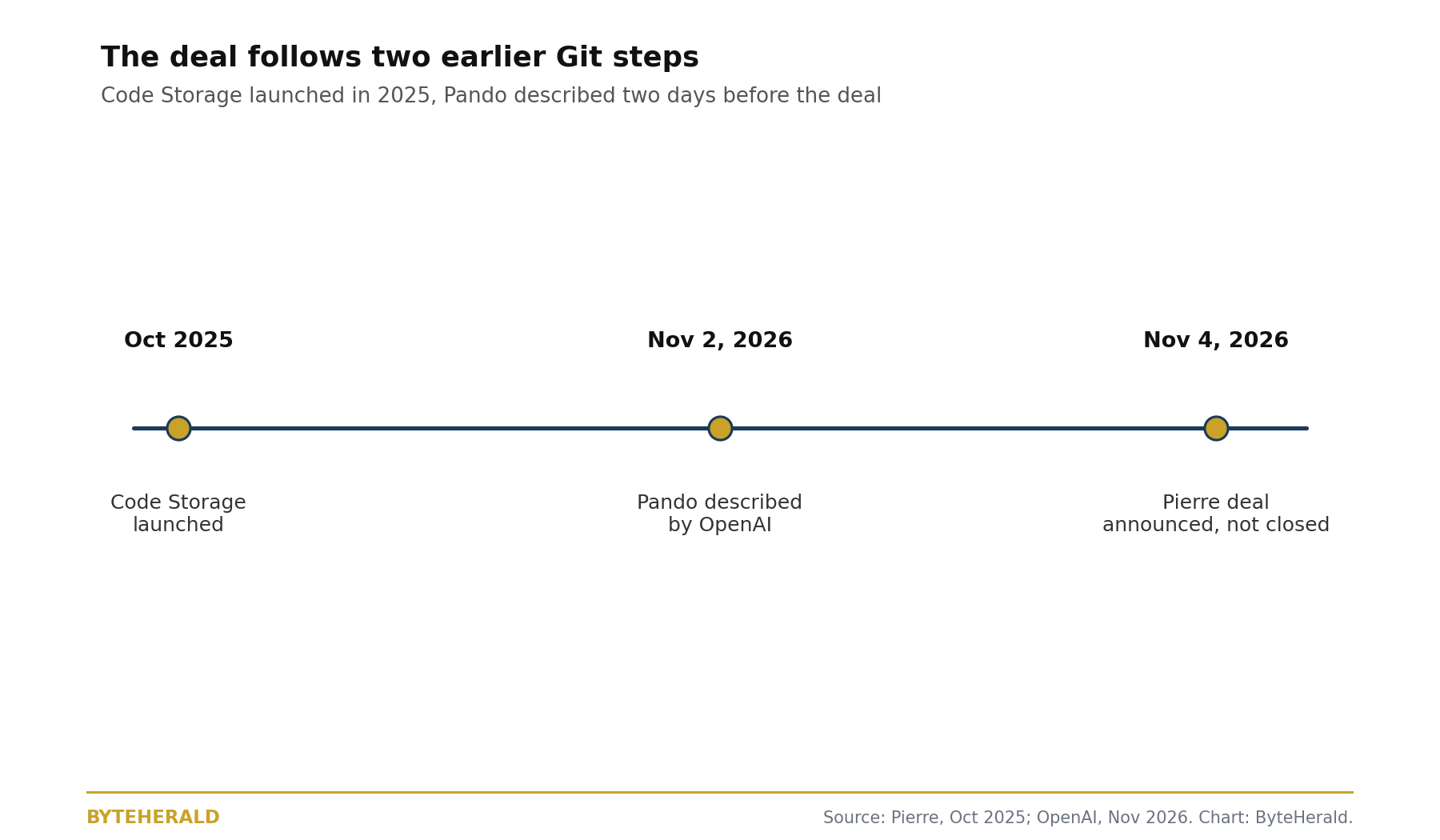
Two days before the Pierre announcement, on November 2, 2026, OpenAI described Pando, its own backend for Git repositories, which powers development in its internal monorepo, the shared repository holding its code. OpenAI said Pando moved from kickoff to production in 10 weeks with Codex doing the building, began serving production traffic in April 2026, cut median code-push latency by nearly 80 percent, and delivers nearly one petabyte of Git data daily. Those are OpenAI's own reported figures for its internal system.
Put Pando beside Pierre and the deal reads differently. Pando solves OpenAI's internal problem: many agents working in parallel inside one company repository. Pierre solves an external problem: other applications that need Git storage for their own agents, with existing workloads already running on it. Buying Pierre gives OpenAI a product with customers outside OpenAI, plus the team that built the libraries already inside Codex. It does not prove OpenAI failed at Git internally, because Pando is evidence to the contrary, and it does not prove OpenAI will merge the two systems into one public service, because neither announcement says that. A developer should therefore judge the deal on two separate tests: does Codex get better file and review tools, which Pierre already improves, and does OpenAI ever ship a public hosting layer, which no announcement has promised.
What Git storage for agents actually means
For readers who do not live in Git daily, the durable idea is this. Traditional Git hosting assumes a human who clones a repository, edits, commits, and pushes, with a sign-in and a web page in the loop. Agent workloads break that assumption in three ways. First, volume: an agent can spin up dozens of branches for experiments that no human will ever look at. Second, speed: an agent needs to create, snapshot, and roll back repositories through an API call, not through clicks. Third, provenance: when code is generated, the useful record is not just the final file, but which branch, which prompt run, and which snapshot produced it, so a bad generation can be reverted exactly. Storage built for agents therefore competes on API ergonomics, latency, and snapshot handling, not on the social features that made GitHub popular with humans. That is the market Pierre was selling into when it launched Code Storage in October 2025, before OpenAI announced this deal.
None of that changes what a Codex user should do this week. Codex users already have Pierre's file and review libraries, and the December change to shared usage limits across ChatGPT and Codex, reported here when OpenAI changed the Codex usage rules, is a better guide to near-term Codex planning than an unclosed acquisition. Teams evaluating Codex as a GitHub replacement should ask for the missing pieces by name: public and private hosting with permissions, pull-request style review across teams, and a migration path for existing repositories. Until OpenAI announces those, Codex with Pierre inside is a stronger coding agent with better storage plumbing, not a new home for a team's code.
Confirmed, promised, and not yet shown
| Claim | Status | Why it matters |
|---|---|---|
| OpenAI will acquire Pierre Computer | Announced Nov 4, 2026, not closed | Regulatory approvals are still pending |
| Code Storage features move into Codex | Planned, no date given | Users cannot plan a migration on it yet |
| Trees and Diffs already in the Codex app | Confirmed by OpenAI | The visible benefit already exists |
| Open-source projects stay open source | Promised by OpenAI | Existing users are not cut off on announcement |
| Code Storage customers keep using it after close | Promised by OpenAI | Existing workloads are not forced to move at once |
| Purchase price | Not disclosed | Size of the bet cannot be judged |
| Codex becomes a GitHub replacement | Not announced | Axios framing, not OpenAI's claim |
By ByteHerald Staff. Axios, November 4, 2026, reported that OpenAI will acquire Pierre Computer, a developer-tools startup whose technology is already used in Codex, with financial terms undisclosed and the deal framed as a challenge to Microsoft's GitHub. OpenAI, November 4, 2026, announced it will acquire Pierre Computer Company, Inc., will bring Code Storage features into Codex, will keep Pierre's open-source projects open source, and said closing is subject to regulatory approvals with the companies independent until then. OpenAI, November 2, 2026, described Pando, its internal Git repository backend, as moving from kickoff to production in 10 weeks, serving production traffic from April 2026, cutting median code-push latency by nearly 80 percent, and delivering nearly one petabyte of Git data daily. Pierre Computer, October 2025, launched Code Storage as Git infrastructure for applications, naming Lovable, Poke, Anything, Bolt, Amp, and Parahelp among its users.
Comments
Post a Comment