OpenAI disbanded its standalone robotics team on November 13, 2026, and told Fortune the reason in plain terms: its general-purpose models, led by GPT-6 Astra, can now run robots directly, so a separate team building robot-specific models is no longer the fastest way forward. The researchers moved into the company's main research group. The hardware staff moved into its Applied organization. Robotics, the company insists, is not being abandoned. The team that did it is simply gone, for the second time.
What changed, and where the people went
OpenAI confirmed the reorganization when Fortune asked about it, as Fortune's exclusive report describes it. The company has published no blog post of its own about the change, and it has not said how many people were affected. According to Fortune's report, the robotics research team now sits inside the main research team, reporting to Chief Research Officer Mark Chen. The applied robotics and hardware teams moved into the larger Applied organization, which reports to President Greg Brockman. A company spokesperson told Fortune that robotics remains a core part of OpenAI's long-term vision, and that splitting the team up is the fastest way to get there.
The timing underlines how recent the decision was. OpenAI had already registered a booth at CoRL, a leading academic robotics conference in Austin, Texas, this week. When Fortune's reporter visited booth 208, it was empty. The company is still committed to bringing general-purpose robots into the world, the spokesperson said, and chief executive Sam Altman is targeting a first public demonstration of a humanoid robot in 2027, according to Fortune. That date is now the test of the reorganization: a demo in 2027 would show the new structure works, and a slip would invite the obvious question about what the dedicated team was for.
The number behind the decision: 74.8 against 51.0
The evidence OpenAI pointed to is a single benchmark result from an Nvidia study. Researchers gave GPT-6 Astra camera images, robot state information, and a control interface, and let the general-purpose model command a robot on RoboLab-120, a simulated pick-and-place benchmark. The Astra-powered agent reached a 74.8 percent success rate. The best specialized robot models on the same leaderboard scored 51.0 percent. That gap, 23.8 points on a simulated task, is the whole public case for dissolving the team, as the independent summary of Fortune's reporting carries the same figures.
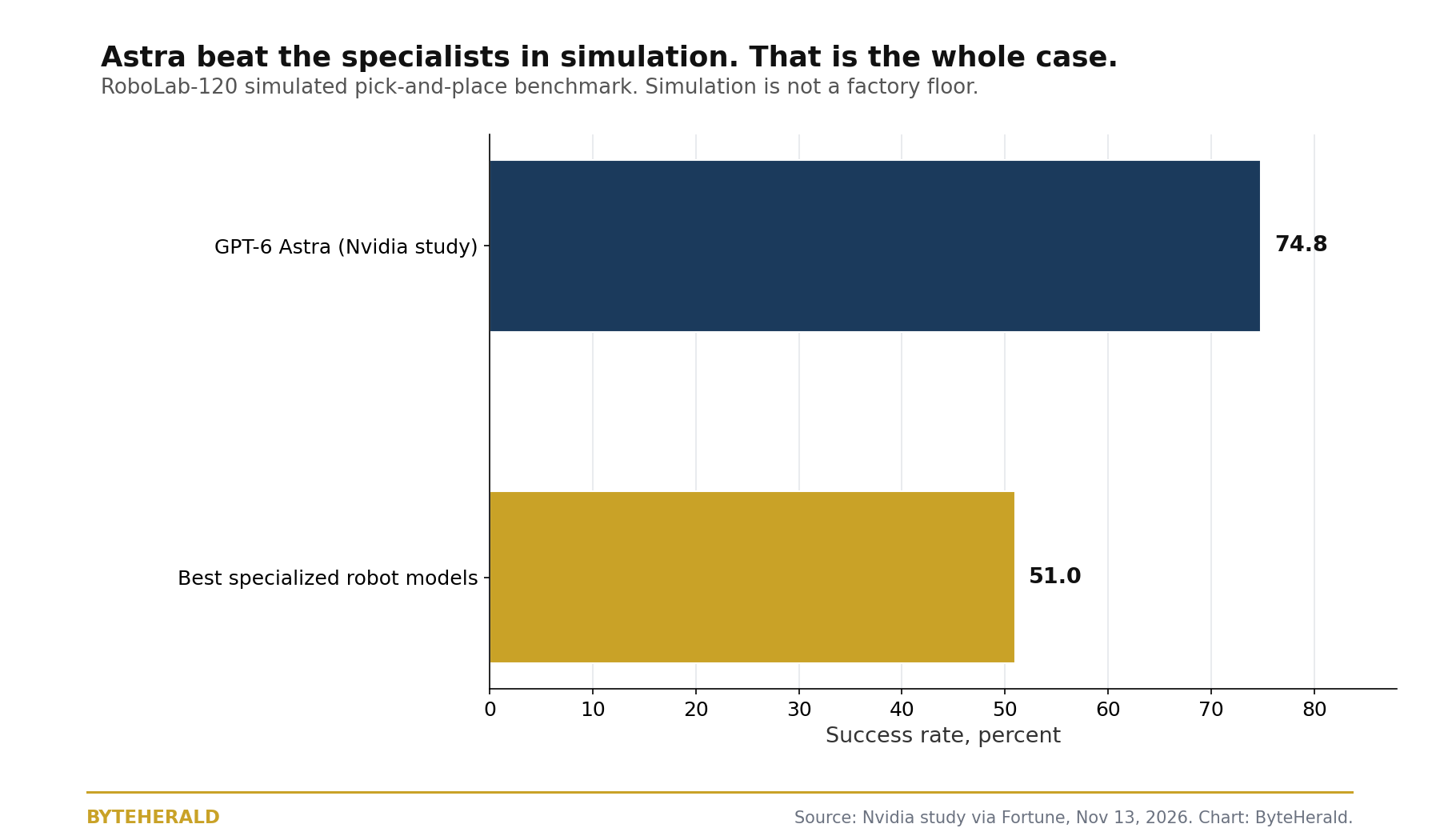
The number deserves a careful reading, because a simulated score is not a factory floor. RoboLab-120 runs in simulation, where the lighting never changes, the objects never slip in an unmodelled way, and the network never drops. A general model that wins in simulation still has to survive the physical world, and the people who build robots for a living keep pointing at the gap. Guanya Shi, an assistant professor at Carnegie Mellon University's Robotics Institute, told Fortune he reads the move as a signal that OpenAI sees robotics as no longer a special problem, but he also noted that cloud-hosted language models remain slow and need a constant network connection, so robots still need smaller specialized models that can run on onboard computers, as Oossa's account of the Fortune report also records. That is the counter-argument in one sentence: the brain can live in the cloud, but the body cannot wait for it.
There is a second caveat the benchmark cannot answer. The method behind the 74.8 percent figure, the number of trials, and the exact task mix cannot be checked from the coverage we could read. A 23.8 point lead on one simulated benchmark is a reason to reorganize a team only if the benchmark predicts real deployments, and no public evidence in the reporting shows that it does. Readers should treat the figure as OpenAI's stated reason, not as proof that general models have solved robotics.
The second time OpenAI has done this
This is the second time OpenAI has broken up a robotics team, and the pattern matters more than the announcement. The first team ran from the company's early years, taught a robotic hand to solve a Rubik's Cube, and was wound down in 2020 and 2021. Cofounder Wojciech Zaremba later said the root cause was a data bottleneck: physical-interaction data is scarce, expensive to collect, and slow to iterate, while internet text and images are vast. OpenAI rebuilt a standalone team in 2024 and announced a partnership with the humanoid startup Figure to develop AI models for humanoid robots. That partnership ended in February 2025, when Figure said it would develop its own robot AI. The team that survived that split is the one that has now been dissolved.
| Chapter | What happened |
|---|---|
| 2016 to 2020 | First robotics team; Dactyl hand solves a Rubik's Cube in 2019 |
| 2020 to 2021 | Team wound down; Zaremba cites limited robot data and a better path to AGI through other methods |
| 2024 | Standalone team rebuilt; partnership with Figure announced |
| February 2025 | Figure ends the partnership to build its own robot AI |
| June 2026 | Altman posts that OpenAI is building robots; OpenAI Robotics hiring opens |
| November 13, 2026 | Standalone team disbanded; staff split between research and Applied |
The history cuts both ways. OpenAI walked away from robotics once before and came back, so a disbandment is not an exit. But the company also keeps concluding that a dedicated robotics team is not the best vehicle, and each time the reason is the same: the general model is supposed to absorb the special case. The 2020 version of that argument was about data. The 2026 version is about capability. The difference is that this time there is a benchmark number attached, and the number is simulated. Our own scoreboard of what robotics companies have actually shipped, published in October, found the industry still measures deployments in the tens of thousands of units, not millions, which is why a simulated win deserves the scrutiny in the section above: Robotics Has No ChatGPT Moment. The Data Says Why.
What a general model still cannot do on a robot
Running a robot from a general model has three practical problems that a benchmark score does not capture. The first is latency: a cloud model that takes seconds to answer cannot catch a falling object, so time-critical control still needs to run on the robot itself. The second is connectivity: a robot that stops working when the network drops is not a product, so the onboard model matters even when the cloud model is smarter. The third is data: every deployment site has its own layout, lighting, and failure modes, and the site-specific data that tunes a robot to one warehouse does not come from a general model's training set. That third problem is the one OpenAI's own history keeps naming. Collecting physical interaction data is the slow, expensive work the 2020 team ran into, and it is the work that still has to happen somewhere, whether or not a standalone team does it. Readers who want the fullest side of that problem, who collects the footage and who pays for it, should read our account of the human data pipeline behind physical AI.
None of this means the reorganization is wrong. General models really are getting better at spatial reasoning, and the early-2026 theory inside OpenAI, reported by Fortune, was that Sora, its video generator, was the route to robotics, because creating realistic video requires some understanding of how the physical world works. If that theory holds, folding robotics researchers into the main research team puts them next to the model builders instead of behind a wall. The question is whether the 74.8 percent figure survives contact with real hardware, and the answer will arrive in the form of a demo, not a press release.
What would prove the bet right
The verdict arrives in four places. First, the 2027 humanoid demonstration Altman has targeted: a public demo on schedule would validate the new structure, and a delay would revive the 2020 comparison. Second, whether robot capability shows up inside a general model release, rather than as a separate robotics announcement, which is what the reorganization predicts. Third, what Figure, 1X, and the other humanoid builders do with the opening, since OpenAI's retreat from a dedicated team is their invitation to lead. And fourth, the money: Fortune's report also noted that OpenAI is working to curb operating losses reported at 10.9 billion dollars on an adjusted operating basis in the most recent quarter, ahead of a possible public offering in early 2027, and the same week the company reportedly raised 15 billion dollars at a 1.25 trillion dollar valuation. A company under that kind of financial pressure does not keep a team it believes is redundant, which is consistent with both readings of the move: the bet that general models can do the job, and the need to stop paying for two ways of doing it.
By ByteHerald Staff. Fortune reported on November 13, 2026, that OpenAI disbanded its standalone robotics team, moving its researchers to the main research team under Chief Research Officer Mark Chen and its applied robotics and hardware staff to the Applied organization under President Greg Brockman, and that an Nvidia study had an Astra-powered agent reach a 74.8 percent success rate on the simulated RoboLab-120 manipulation benchmark, against 51.0 percent for the best specialized robot models. Fortune also reported that OpenAI had a robotics team in its early years that was wound down in 2020, that it rebuilt a standalone team in 2024 with a partnership with Figure that ended in February 2025, and that chief executive Sam Altman is targeting a first public demonstration of a humanoid robot in 2027. Fortune's report also noted operating losses of 10.9 billion dollars on an adjusted operating basis in the most recent quarter, and Carnegie Mellon University assistant professor Guanya Shi told Fortune that cloud-hosted language models remain slow and require a constant network connection, so robots still need smaller specialized models on board computers.
Comments
Post a Comment