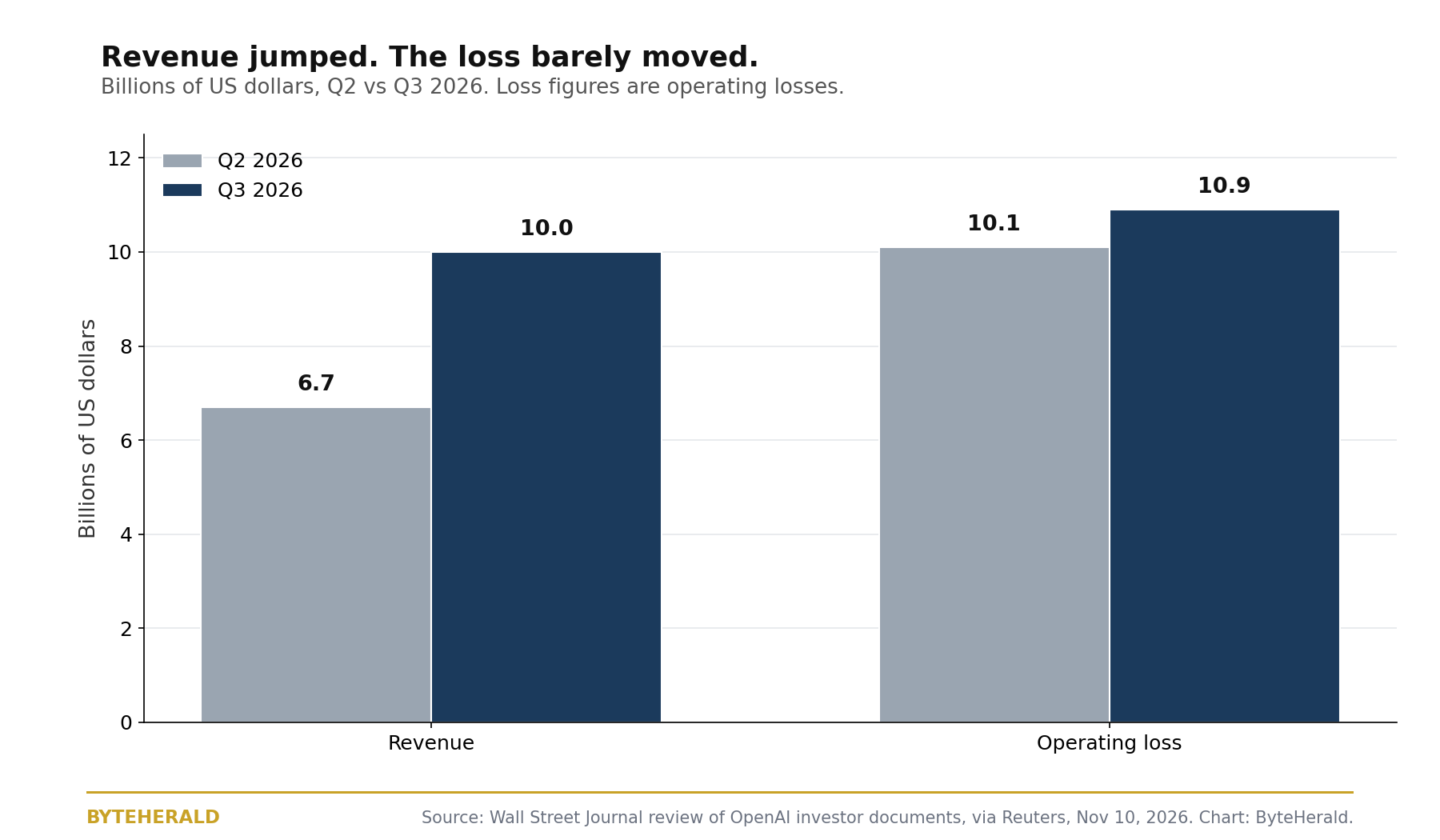
OpenAI told investors on Tuesday, November 10, 2026, that its revenue for the three months to September reached about 10 billion dollars, the first time it has crossed that line in a quarter, while its operating loss widened to 10.9 billion dollars. Revenue rose about 50 percent from the second quarter. Chief Financial Officer Sarah Friar called it a blockbuster quarter, and put the annual revenue run rate at roughly 50 billion dollars. The loss grew even as the margin improved, because the company is spending faster than it is earning, and the quarter shows both trends at once.
The quarter, in one table
| Measure | Q2 2026 | Q3 2026 | Change |
| Revenue | About 6.7 billion dollars | About 10 billion dollars | Up about 50 percent |
| Operating loss | 10.1 billion dollars | 10.9 billion dollars | Up about 8 percent |
| Adjusted operating margin | Negative 150 percent | Negative 109 percent | Improved 41 points |
| Annual revenue run rate | Not disclosed | About 50 billion dollars | First disclosure at this level |
| Enterprise revenue | Not disclosed | Doubled quarter over quarter, now roughly even with consumer | Enterprise doubled |
| Weekly active users | Not disclosed | 1.2 billion | First disclosure at this level |
| Paid subscriptions | Not disclosed | More than 100 million | First disclosure at this level |
The figures were shared with investors on a call on November 10, and first reported by The Information, the Wall Street Journal, and Bloomberg, according to Dealroom. Reuters reported on November 10, citing the Wall Street Journal's review of investor documents, that revenue rose about 50 percent while the operating loss widened to 10.9 billion dollars from 10.1 billion. OpenAI did not immediately respond to Reuters' request for comment.
The loss per dollar
The margin improved and the loss still grew, and both facts are true at once because revenue grew faster than the loss. In the third quarter, OpenAI lost 1.09 dollars for every 1 dollar of revenue it brought in. In the second quarter, by ByteHerald arithmetic from the reported figures, it lost about 1.51 dollars per 1 dollar of revenue. The adjusted operating margin, which was negative 150 percent in the second quarter, improved to negative 109 percent in the third. That is progress on unit economics, and it is still a business that loses more than a dollar for every dollar it makes. The gap is narrowing because revenue is growing about 50 percent a quarter while the loss grows about 8 percent, and the question for the next quarters is whether that ratio holds as spending on compute keeps rising.
The Anthropic comparison
The quarter lands the week Anthropic is on its IPO roadshow, and the comparison is the point. We audited Anthropic's IPO filing yesterday: its revenue run rate reached 81 billion dollars on October 31, up from 71 billion dollars on September 30 and more than 65 billion dollars in July, with the company targeting a valuation of about 1.4 trillion dollars fully diluted. OpenAI's run rate of about 50 billion dollars sits well below Anthropic's, on the numbers each company has disclosed. Run rate is an annualized pace, not quarterly revenue, so the comparison is directional rather than exact, and the two companies disclose on different schedules. But the direction is the story: the smaller rival is now growing revenue faster, and OpenAI's enterprise business, which doubled quarter over quarter and now roughly matches its consumer business, is where Friar says the demand is coming from, across coding, cybersecurity, and enterprise AI assistance.
How to read a private company's quarter
OpenAI is a private company, so none of these figures can be checked against a public filing. They come from documents OpenAI gave to its investors, reviewed by the Wall Street Journal, and the company has not published financial statements to go with them. That is why the sourcing matters: the numbers were reported by the Wall Street Journal, Reuters, Bloomberg, and The Information, all citing the same investor materials, rather than announced by the company itself. A run rate is not revenue: it takes a recent revenue pace and annualizes it, so it moves faster than quarterly revenue in both directions. An adjusted operating margin strips out items the company chooses to exclude, so negative 109 percent is OpenAI's own framing of the loss, not a standardized measure. And a 50 percent revenue jump in one quarter is the kind of growth that makes the loss look smaller in percentage terms even as it grows in dollars, which is exactly what happened here: the loss rose 800 million dollars while the margin improved 41 points.
By ByteHerald Staff. The Wall Street Journal reported on November 10, 2026, citing investor documents it reviewed, that OpenAI generated about 10 billion dollars in third-quarter revenue, up roughly 50 percent, while its operating loss widened to 10.9 billion dollars from 10.1 billion, with its adjusted operating margin improving to negative 109 percent from negative 150 percent. Reuters reported on November 10, 2026, that the figures were shared with investors on a call that day and that OpenAI did not immediately respond to a request for comment. Yahoo Finance reported that Chief Financial Officer Sarah Friar called the quarter blockbuster and put the annual revenue run rate at about 50 billion dollars. CNBC reported on November 6, 2026, that Friar said enterprise revenue doubled quarter over quarter and now roughly matches consumer revenue. Dataconomy reported on November 11, 2026, that paid subscriptions exceeded 100 million and weekly active users reached 1.2 billion.
Comments
Post a Comment