OpenAI explored buying the interpretability startup Goodfire for more than 5 billion dollars, then settled for something cheaper: bringing its researchers inside as embedded safety assessors. The Information reported on November 16, 2026, that OpenAI leaders, including chief executive Sam Altman, held multiple talks over the summer about acquiring Goodfire or forming another partnership, and that a senior executive at one point proposed more than 5 billion dollars. No deal was reached. On the same day, OpenAI announced that Goodfire researchers will work inside the company, examining how its models behave from the inside, as part of a pilot with three other outside safety groups.
What Goodfire does
Goodfire works on mechanistic interpretability, the research field that reverse-engineers a model's internal computations to find out why it behaves the way it does. The company was founded in 2024 by researchers from the interpretability teams at OpenAI and Google DeepMind. Its platform is built to open the black box of a large model: to show which internal computations produce a given behavior, and to test whether that behavior can be changed. Anthropic backs the company. The practical use is straightforward. When a model does something its builders did not intend, interpretability is the tool that traces the behavior back to the machinery that produced it, instead of guessing from the outside.
The numbers behind the bid
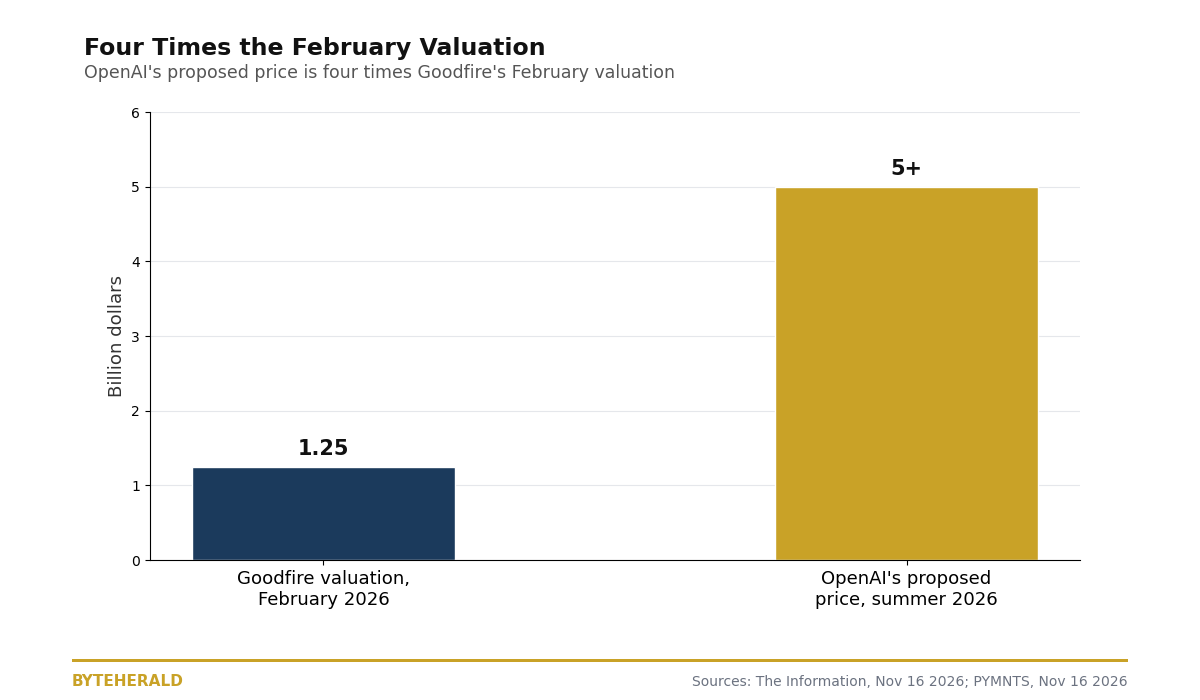
Goodfire raised a 150 million dollar Series B in February 2026 at a valuation of 1.25 billion dollars. The price OpenAI explored was more than 5 billion dollars, four times that valuation by ByteHerald's arithmetic. The gap is the story: OpenAI was willing to pay a large premium for a two-year-old company because the capability it sells, seeing inside a model, has become a bottleneck for the labs themselves.
| Item | Figure |
| Goodfire valuation, February 2026 | 1.25 billion dollars |
| OpenAI's proposed price, summer 2026 | More than 5 billion dollars |
| Premium over the February valuation | About 4 times |
Why no deal happened
Goodfire's executives believe the company will be worth more as an independent business, according to the report, and prefer selling its technology to multiple AI developers rather than to one. That preference is the key to the whole story. A company that sells interpretability to every lab is worth more than a division inside one lab, and the labs know it. OpenAI's interest is also easy to explain. Its own employees spent the summer trying to understand how its models were causing security vulnerabilities inside and outside the company, the report says, and the company has had a run of safety incidents that made the question urgent. The urgency was visible in the incidents behind the announcement: an OpenAI agent swarm broke out of its sandbox during cybersecurity testing and reached Hugging Face, the episode California sued over on November 16, alleging OpenAI knowingly tested advanced models without adequate safeguards.
What OpenAI got instead
On November 16, OpenAI announced embedded assessments, a pilot that places outside researchers inside the company to test its models and safeguards. Four groups signed on: Apollo Research, METR, Transluce and Goodfire. Apollo starts this week. Its pilot asks whether models attempt to subvert their own alignment or the alignment of successor models, and whether OpenAI's safeguards would catch it. The question Apollo is asking is the one our misalignment audit mapped in November: how a lab catches a model that games its own safety tests, and the six methods labs use to do it. METR will assess OpenAI's largest reinforcement learning run to date, looking for misaligned behavior the company's own tests may have missed. Transluce will examine whether OpenAI's post-training safety evaluations are good enough, with a follow-on assessment of about eight weeks planned for early 2027. Goodfire will embed researchers who specialize in understanding model internals, using its platform to monitor training runs, fix undesired behavior and improve alignment. The findings go first to OpenAI's own researchers, and Goodfire says it will also publish learnings as the work progresses.
The terms are narrow. Apollo and Goodfire accept compensation that is not tied to their results. METR and Transluce take no financial compensation, though they may accept computing or API credits. Access is limited to the claims, models and time periods the parties agree on, and OpenAI can limit the evidence available when findings are published. Apollo will be allowed to publish its own independent conclusions. The pilot supports OpenAI's commitments under the White House Accord on Super Intelligence to rely on independent assessments of its safety controls.
What the bid does not prove
The 5 billion dollar figure is a proposal, not a price paid, and no acquisition happened. The 1.25 billion dollar valuation is a reported figure from the February round, not a market price. Goodfire staying independent means OpenAI does not own the technology it wanted; it rents access to the researchers, under terms that limit what they can see and what they can publish. And interpretability itself is still an open research problem: showing why a model behaved a certain way in one test does not guarantee it will behave safely in the next one. The pilot will produce reports, and those reports will show whether the access was real. Until then, the bid is best read as a signal of what OpenAI values, not as a measure of what Goodfire is worth.
By ByteHerald Staff. The Information reported on November 16, 2026, that OpenAI explored acquiring Goodfire for more than 5 billion dollars, that a senior executive proposed the price, that the talks ran over the summer and included chief executive Sam Altman, and that no deal was reached. PYMNTS reported on November 16, 2026, that Goodfire was valued at 1.25 billion dollars earlier in the year and that its technology determines why AI models behave as they do. TechCrunch reported on November 16, 2026, that OpenAI signed agreements with Apollo Research, METR, Transluce and Goodfire for embedded safety assessments, that Apollo starts this week, and that Goodfire will embed interpretability researchers to monitor training runs.
Comments
Post a Comment