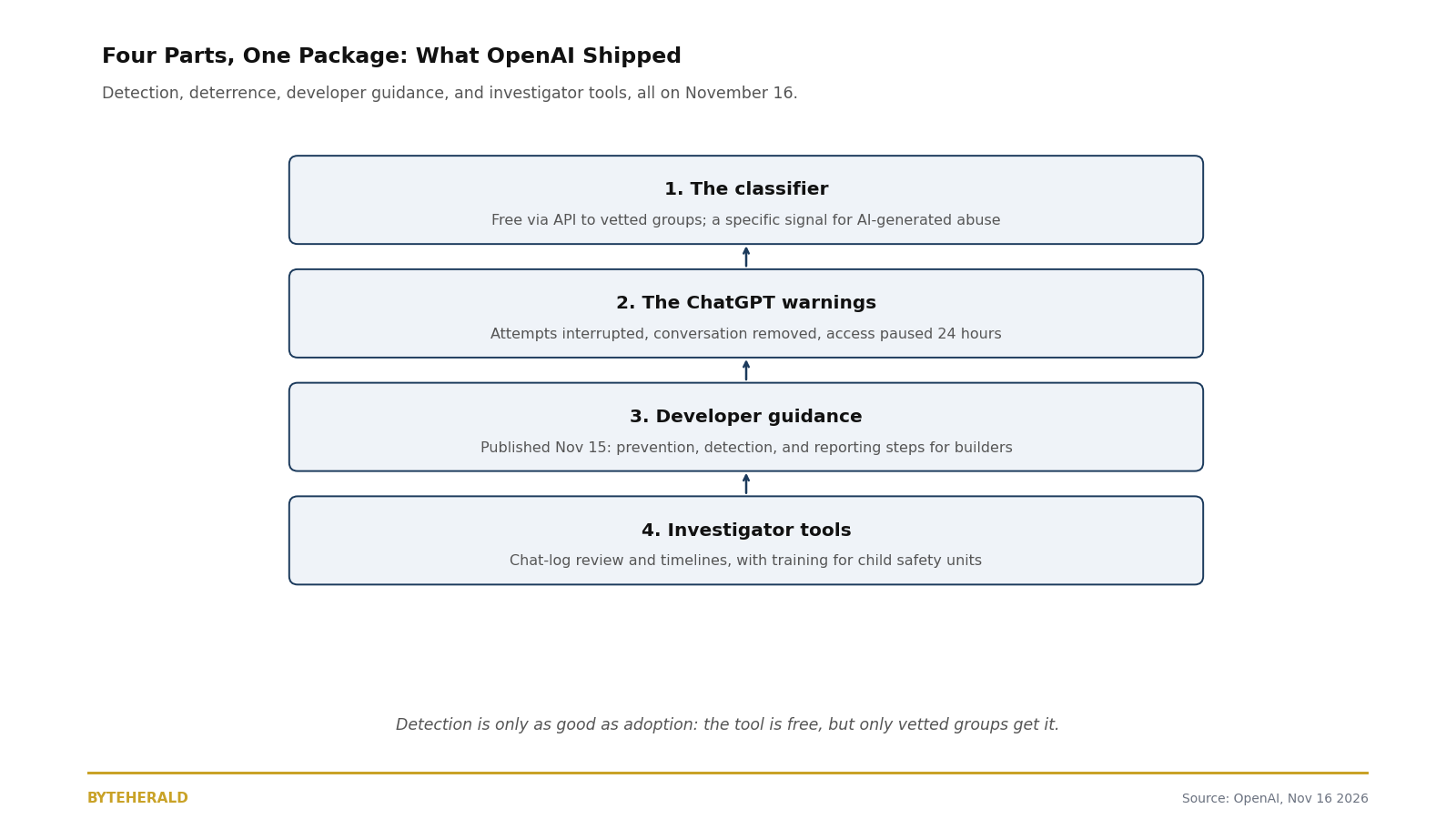
OpenAI released a four-part child safety package on November 16, 2026, built around a new image classifier that can detect child sexual abuse material, including material generated by AI, according to OpenAI's own announcement. The package also adds warnings inside ChatGPT that pause an account for 24 hours, new guidance for developers, and tools for child safety investigators. It is the company's most concrete child safety release of the year, and the numbers OpenAI published with it are specific enough to check.
What the classifier actually does
The classifier looks for visual signs of abuse in an image, rather than matching it against a database of images already identified. That distinction is the whole point. Hash matching, the standard tool until now, only catches images that have been seen before. AI-generated abuse is new every time, so it never matches anything. OpenAI says the new classifier returns scores that help reviewers decide which images need attention first, and that it carries a specific signal for whether the material may be AI-generated, the first such signal in a classifier with broad availability.
OpenAI built and evaluated the classifier with the National Center for Missing and Exploited Children, the nonprofit that runs the CyberTipline, the central reporting hub for online child exploitation in the United States. The company is offering access through its API at no cost to vetted organizations, and is working with the Tech Coalition and ROOST to share access with child safety groups of different sizes. It also joined the Tech Coalition's Lantern program, where companies share and receive signals about online child sexual exploitation, and says it supports tools built by others, including Thorn's Safer detection system.
| Test | What OpenAI reported | What it means |
| Review workload | 48% fewer images flagged, roughly the same number of abusive images found | Reviewers see about half the queue for the same catch |
| Flag quality | Flagged images about twice as likely to contain abuse | A flag is worth roughly double the attention it was |
| fal, production images | 72% of high-confidence flags confirmed as novel CSAM | Nearly three in four top flags were abuse nobody had catalogued |
| invideo AI | 1 in 4 flagged cases led to a ban | A quarter of flags ended in an account ban |
| SafetyKit, drawings and animations | 90% of cases detected | Abuse drawn or animated, not photographed, is mostly caught |
| SafetyKit, legal adult content | False positives below 1% | Legal adult material is almost never flagged |
The numbers come from OpenAI's own evaluation of user-uploaded images and from early partners testing the classifier on their own traffic. They are company-reported results, not an independent audit, and they describe relative efficiency, not real-world coverage. The test sizes and the number of partners are not disclosed.
The ChatGPT warnings
The second part of the package lives inside ChatGPT itself. When a user tries to find material that sexualizes children, ChatGPT now shows a warning that explains the harm, including when the requested material would be AI-generated, removes the flagged conversation, and pauses access for 24 hours, while keeping specialist support available. Repeated violations can lead to longer restrictions and ultimately account closure or reports to authorities. OpenAI already prohibited this material and trained its models to refuse requests for it. The warning is a deterrent step before the request, not just a block after it.
OpenAI developed the warning approach with Protect Children, the Lucy Faithfull Foundation, Dr. Caoilte O Ciardha of the University of Kent, and Joel Scanlan of the University of Tasmania, who independently evaluated a trial of deterrent messages. Scanlan called the result a best-practice example of how a platform can deter and disrupt harmful behavior, built through evidence-based co-design with external experts. Early coverage of the launch notes the warnings began a gradual rollout to personal accounts in mid-November and do not yet cover enterprise accounts, education accounts, or certain desktop interfaces.
Readers often ask whether OpenAI can see what users type into ChatGPT. The announcement describes human review for flagged material, not routine reading of ordinary conversations. When content is flagged, OpenAI says trained and authorized people should assess it before reports go to hotlines, and a separate tool built for law enforcement reviews chat logs and legal process returns to build timelines. The human eyes in this system sit at the flagging stage, after the classifier or the warning has already intervened.
What the numbers do not prove
The classifier's own model card is more cautious than the announcement. It says precision was substantially lower in the online evaluation than in the offline held-out test, because the held-out set contained a much higher proportion of abuse than real traffic does. When abusive material is rare, even a small fraction of non-abusive images flagged by mistake can outnumber the true detections, and those false positives inflate the flag count without adding true positives. Each round of training surfaced new patterns of false positives, which the card presents as a reason to keep reviewing flags from the current classifier rather than trusting it blindly.
Two limits follow from that. First, the 48 percent and twice-as-likely figures describe OpenAI's own traffic and its own test sets, and the company says the online estimates are the better guide to what a human reviewer would actually see. Second, the AI-generated signal indicates whether material may be AI-generated. It is a signal, not proof of origin, and it does not establish who made an image or how. A classifier that finds more abuse is a better net, not a verdict, and OpenAI's own card says trained and authorized people should assess flagged images before reports go to hotlines.
How detection worked before this
The standard defense against abusive imagery has been hash matching: every known abusive image gets a digital fingerprint, and platforms check uploads against the fingerprint list. It is fast and precise, and it is useless against anything new. A generated image has no fingerprint, because it has never existed before. That is why the AI-generated abuse problem grew faster than the defenses built for photographed abuse. A visual classifier is the answer to that specific gap, because it judges what an image shows rather than whether it has been seen.
The other two parts of the package fill the gaps around detection. The developer guidance, published on November 15, 2026, and written with the Tech Coalition, Thorn, NCMEC, and the Internet Watch Foundation, gives practical steps for preventing abuse, detecting it, and reporting it, including how safety identifiers connect misuse to individual users and how to support the people who review sensitive content. OpenAI also worked with Anthropic and Google on joint guidance, published by the Tech Coalition, on responding to disclosures of child sexual exploitation in AI systems. For investigators, the company is providing tools and training on using AI in investigations, starting with a tool that reviews lengthy chat logs and legal process returns, identifies connections, and builds timelines linked to source material.
The release lands in a year when OpenAI's child safety record has been under sustained pressure, including lawsuits from eight states over ChatGPT's safety for children, which our October accountability report catalogued in full. A free classifier and a warning screen do not settle those cases, and they do not answer the question of how much abuse the company's own systems missed before this tool existed. What they do is move the industry's best-known detection tool from a single company's platform to any vetted organization that asks for it, at no cost. That is the part of the package that will matter most if other companies actually pick it up, because the children in these images are not only on OpenAI's services. The safety frameworks the major labs publish promise exactly this kind of shared tooling. This is the first time one of them has shipped it free.
By ByteHerald Staff. OpenAI reported on November 16, 2026, in its announcement "Strengthening the fight against online child sexual abuse with new tools and support," that it released a new image classifier that detects child sexual abuse material including AI-generated material, that the classifier flagged 48 percent fewer images while finding roughly the same number of abusive images and that flagged images were about twice as likely to contain abuse, that early partners fal, invideo AI and SafetyKit reported 72 percent of high-confidence flags confirmed as novel CSAM, 1 in 4 flagged cases leading to a ban, and 90 percent detection on drawings and animations, that ChatGPT now shows warnings, removes the flagged conversation and pauses access for 24 hours, and that the classifier is offered free through the API to vetted organizations. OpenAI reported in the classifier's model card that precision was substantially lower in the online evaluation than in the offline held-out test, that false positives can outnumber true detections when abusive material is rare, and that each training round surfaced new patterns of false positives. TechCrunch reported on November 16, 2026, that OpenAI announced the classifier and the ChatGPT warnings, that access is offered at no cost through the API to select companies, and that the classifier was developed with the National Center for Missing and Exploited Children.
Comments
Post a Comment