Palo Alto Networks announced on November 18, 2026, that it has signed a definitive agreement to acquire Applied Compute, a platform for post-training and inference of open-weight AI models, in an all-stock transaction valued at $4.5 billion, subject to adjustments. The deal is expected to close in Palo Alto Networks' fiscal third quarter of 2027, which runs from February to April, subject to regulatory clearance and other customary conditions. Applied Compute co-founder and chief executive Yash Patil will become Palo Alto Networks' Co-Chief AI Officer when the transaction closes, and the startup's research team will join the company.
The deal math
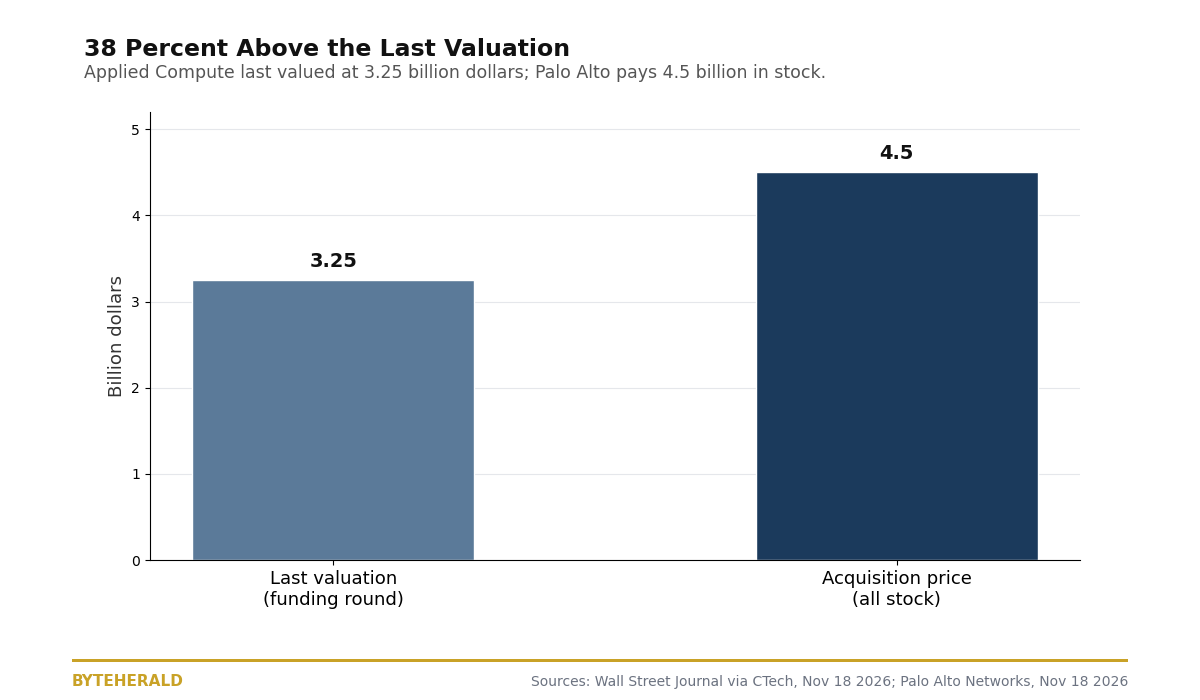
The headline price is only the start of the arithmetic. Applied Compute was recently valued at $3.25 billion in a funding round, according to the Wall Street Journal, as reported by CTech, which puts the acquisition price about 38 percent above that valuation. The startup has said its annualized revenue has topped $100 million, which means Palo Alto Networks is paying at most 45 times that revenue figure, and the $4.5 billion price is about 13 times the $350 million the company raised from investors including Nvidia, Blackstone, Kleiner Perkins and Lux Capital. The share count will be set from a reference price of $337.16, Palo Alto Networks' 15-trading-day volume-weighted average closing price through November 17.
| Figure | Value | What it is |
| Acquisition price | $4.5 billion | All stock, subject to adjustments |
| Last reported valuation | $3.25 billion | Recent funding round, per the Wall Street Journal via CTech |
| Premium over that valuation | About 38 percent | ByteHerald arithmetic from the two figures |
| Annualized revenue | More than $100 million | Company disclosure, within 18 months of founding |
| Price against that revenue | At most 45 times | ByteHerald arithmetic; the revenue figure is a floor, so the multiple is a ceiling |
| Total raised before the deal | $350 million | From Nvidia, Blackstone, Kleiner Perkins and Lux Capital |
| Reference share price | $337.16 | 15-trading-day volume-weighted average through November 17 |
The comparison that frames the price is the one Palo Alto Networks itself set earlier in the month. Two weeks before this deal, the company was reported to be in talks to buy agent-security startup Clutch for about $500 million, a startup approaching $10 million in annualized revenue, as we reported in Palo Alto to Pay 50x Revenue for Agent-Security Startup. Applied Compute is roughly nine times that price, for roughly ten times that revenue, which suggests Palo Alto Networks is paying a similar revenue multiple for a much larger asset rather than bidding up a small one. The startup also appeared in our November funding ranking, which tracked its $350 million round before the acquisition talks surfaced, in November's AI Funding, Ranked: $17.9B and One Winner.
What Palo Alto Networks is buying
Applied Compute works on the two stages of AI that come after a model is trained: post-training, where a general-purpose model is adapted to a company's own data and requirements, and inference, where the adapted model is served in production to answer requests. Its platform does that work for open-weight models, models whose weights are published so customers can download, adapt and run them on their own infrastructure, instead of renting access to a closed model through an API. Customers named in the coverage include Microsoft and DoorDash, and the company says its annualized revenue topped $100 million less than 18 months after it was founded.
The strategic claim, in the words of Palo Alto Networks chairman and chief executive Nikesh Arora, is that every enterprise will run a mix of open and closed models, and every one of those models needs to be secured. The company says no large provider is currently delivering open-weight models securely, and that Applied Compute lets it become that provider, with security built into training, adaptation and deployment, in the public cloud or in sovereign environments where data must stay inside a country's borders. Applied Compute will keep serving its existing customers, and Palo Alto Networks will bring the platform to its own customer base of more than 70,000 organizations. Arora said Palo Alto Networks had seen the platform firsthand as a prospective customer, and that its Unit 42 Frontier AI Assessment confirmed the startup's security foundations.
Why a security company wants to run models
The deal was announced alongside Palo Alto Networks' fiscal first-quarter 2027 results, and the quarter explains the confidence. Revenue was $3.44 billion, up 39 percent from a year earlier, next-generation security annual recurring revenue was $9.73 billion, up 66 percent, remaining performance obligations were $21.0 billion, up 35 percent, and adjusted earnings were $1.05 per share. The company raised its full-year outlook, and its shares rose sharply. Arora said on the earnings call that the AI business could eventually become bigger than the cybersecurity business, according to CTech, which is a striking claim from a company that defines itself as a cybersecurity leader.
Applied Compute is the second large AI acquisition in Palo Alto Networks' recent buying run, following the $25 billion purchase of CyberArk, which added identity security to the platform. The pattern is a security company buying its way into the AI stack itself: first identity, now the models. Whether that works depends on a question the announcement does not answer, which is whether enterprises that chose open-weight models precisely to avoid depending on one vendor will accept a security vendor as the company that trains, adapts and serves those models for them.
What could still stop it
Two things stand between the announcement and the close. The first is regulatory clearance, which the agreement requires, and which any $4.5 billion deal in AI infrastructure should expect to face. The second is the share price: because the deal is all stock, the value Applied Compute's investors ultimately receive moves with Palo Alto Networks' shares between now and the close, with the $337.16 reference price setting the share count rather than fixing the value. Palo Alto Networks said it will provide further details on its fiscal first-quarter 2027 earnings call, which was scheduled for November 18, 2026, at 1:30 p.m. Pacific time.
By ByteHerald Staff. Palo Alto Networks announced on November 18, 2026, in a press release, that it has entered into a definitive agreement to acquire Applied Compute in an all-stock transaction valued at $4.5 billion, subject to adjustments, that the transaction is expected to close in its fiscal third quarter of 2027 subject to regulatory clearance, that Applied Compute co-founder and chief executive Yash Patil will become Palo Alto Networks' Co-Chief AI Officer following the close, and that the acquisition will bring Applied Compute's platform and research team to Palo Alto Networks to help enterprises adopt AI securely. CTech reported on November 18, 2026, that Applied Compute was recently valued at $3.25 billion in a funding round according to the Wall Street Journal, that it had raised $350 million from investors including Nvidia, Blackstone, Kleiner Perkins and Lux Capital, and that chief executive Nikesh Arora said the AI business could become bigger than the cybersecurity business. The Economic Times reported on November 19, 2026, that Applied Compute was launched less than 18 months ago, counts Microsoft and DoorDash among its customers, and has said its annualized recurring revenue has topped $100 million. DefenseWorld reported on November 19, 2026, that Palo Alto Networks' fiscal first-quarter revenue rose 39 percent to $3.44 billion, with next-generation security annual recurring revenue of $9.73 billion, up 66 percent, and remaining performance obligations of $21.0 billion, up 35 percent. CSO Online reported on November 19, 2026, that the deal follows Palo Alto Networks' $25 billion purchase of CyberArk and that the transaction is expected to close in fiscal third-quarter 2027, which runs from February to April.
Comments
Post a Comment