Ring, the home-security company owned by Amazon, announced a robotics division on Tuesday, November 10, 2026, with two machines that patrol on their own: a flying indoor camera for homes and a wheeled robot for businesses. The drone, called Ring Drone Cam, costs 249.99 dollars and ships in the United States on January 27, 2027. The robot, called Ring Rover Cam, costs 999.99 dollars, is available for preorder now, and ships on December 16, 2026. Both run on the same Ring system, AI Pilot, and both arrive with the question that has followed Ring for years: who watches the watcher.
The two machines, side by side
| Device | Price | Ships | Video | Job |
| Ring Drone Cam | 249.99 dollars | January 27, 2027 | 2K | Flies patrol routes inside a home, investigates tripped alarms |
| Ring Rover Cam | 999.99 dollars | December 16, 2026 | Continuous 4K | Patrols a business floor after close, streams to a phone |
| Astro for Business (2023) | 2,349.99 dollars | Discontinued | Not stated | Amazon's first enterprise security robot, the Rover's predecessor |
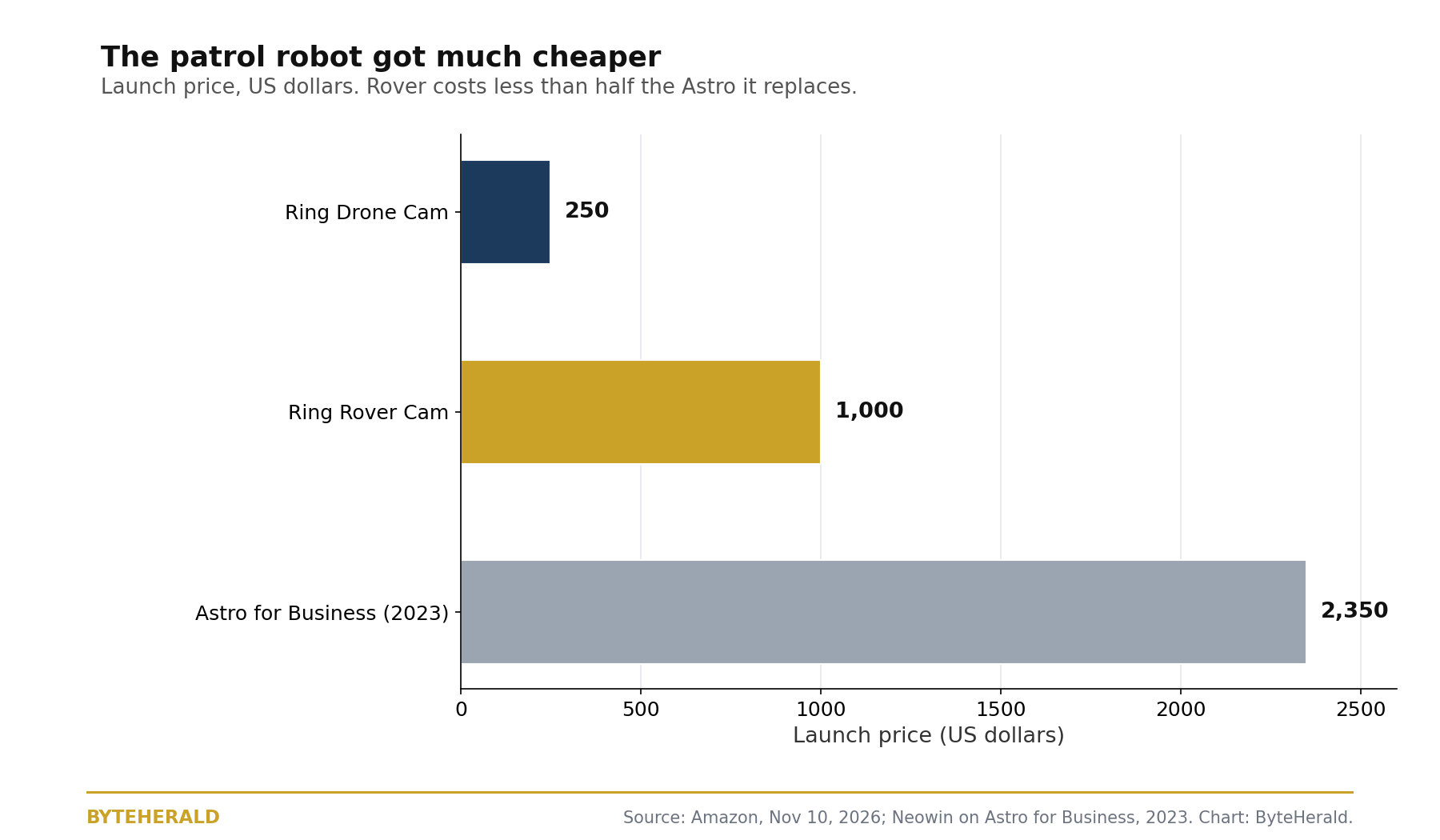
The price gap is the story. The Rover does the job Amazon tried with Astro for Business in 2023, a robot that cost 2,349.99 dollars, for less than half the money. Astro started in 2021 as a domestic helper, was repurposed as an enterprise security product, never took off, and Amazon discontinued it seven months into that repurposing, according to TechCrunch. Ring says the Rover was built from feedback from Astro customers. The drone is the older idea: Ring founder Jamie Siminoff said the company has been working on a drone concept since 2016, and Ring first showed a flying indoor camera, the Always Home Cam, in 2020 without ever selling it at scale. The Drone Cam is that concept rebuilt around a navigation system Ring is now willing to sell.
What the drone can and cannot do yet
The Drone Cam is a flying indoor security camera that lives in a docking bay when it is not working. Ring says it flies room to room on custom routes, inspects what is happening in a house, and alerts the owner if there is trouble. If a Ring alarm goes off at the back door, the drone flies to that location and investigates. It shoots video in 2K, carries LED lights for night and low-light recording, and can be controlled through Amazon's Alexa Home Map. Owners can schedule patrols for specific times, including while they are out for the night or on vacation. The catch is regulatory, not technical. Amazon's own announcement states that the Drone Cam has not been authorized as required by the rules of the Federal Communications Commission, and that the device is not, and may not be, offered for sale or lease until authorization is obtained. The January 27, 2027 ship date is therefore a plan, not a promise. A second catch is commercial: scheduled patrols and some recording features require a Ring Protect subscription, according to Neowin and Android Headlines, so the 249.99 dollar price is the entry cost, not the full cost of the patrol.
What the robot does after close
The Rover Cam is a purpose-built security robot for commercial spaces: offices, stores, and warehouses. It patrols specific routes at specific times, streams video in continuous 4K that the owner watches in Ring's mobile app, and can be set to record automatically if it detects a human. A periscope camera adjusts to see over obstacles, and two-way audio lets a remote user speak through the robot to a person in the store, whether an employee or a burglar. Ring's pitch is a night shift without a night shift worker: "Together, it's like having a guard on patrol who never clocks out," the company said, adding that the Rover can sweep a floor after close and investigate when a sensor trips at 2 a.m., streaming it all to the owner's phone. Unlike the drone, the Rover is ready to sell. It is available for preorder now and ships December 16, 2026.
The privacy catch
Both devices are powered by AI Pilot, Ring's proprietary system, which the company says uses specialized vision models, sensors, and cloud processing to see, think, and navigate on its own. Both build a detailed map of the house or office by exploring the space themselves. Ring says both devices were built with privacy and security baked in, and that videos are protected by TAKE, short for Throw Away the Key Encryption, which Ring calls its strongest default encryption yet. What Ring has not said is whether owners can store video locally. TechCrunch notes it is unclear whether a local storage option will exist, and that Ring cameras generally record to the cloud. That matters because a patrol robot films more than a doorbell ever did: the inside of a home, on a schedule, while the owner is away. Privacy concerns have followed Ring for years, with critics saying its cameras created unofficial surveillance networks that police departments can and routinely do tap into, and similar complaints are likely about the new products given how much more they see. Our 2026 AI security report card starts from the opposite assumption: that any connected system will eventually be breached, and judges vendors on what happens then. A flying camera that maps a home is the sharpest test of that assumption Ring has ever sold, and the encryption claim is only the first half of the answer. The second half is who holds the keys, how long the footage is kept, and who can ask for it.
How a patrol robot works
A patrol device is not a camera on wheels or wings. It is a small autonomous system with four jobs: map the space, follow a route, notice a change, and report it. The mapping comes first. AI Pilot builds a schematic of the home or office by exploring it, then the owner sets routes and schedules in the app: which rooms, which times, what happens when a sensor trips. The drone flies only along preset paths and only records during those flights, never while it sits in its dock. The robot drives its route and streams continuously. When a Ring sensor trips, either device goes to the location instead of waiting for a person to check a fixed camera feed. That is the whole pitch: one moving camera replaces several fixed ones, and the patrol happens whether anyone is watching or not. The trade is that the home or business must be mapped, the footage must go somewhere, and the patrol only works as well as the map. A door left open, a moved shelf, or a dead sensor changes what the robot sees, and the owner is the one who has to keep the map honest.
By ByteHerald Staff. Amazon announced Ring Robotics on November 10, 2026, launching the Ring Drone Cam at 249.99 dollars, shipping in the United States on January 27, 2027, and the Ring Rover Cam at 999.99 dollars, shipping on December 16, 2026, with the Drone Cam not yet authorized by the Federal Communications Commission and not offerable for sale until authorization is obtained. TechCrunch reported on November 10, 2026, that the Drone Cam shoots 2K video with LED lights and is controlled through Alexa Home Map, that the Rover Cam streams continuous 4K video with a periscope camera and two-way audio, that both run on Ring's AI Pilot system, and that Amazon's Astro robot, launched in 2021 and repurposed as an enterprise security product, never took off and was discontinued seven months into that repurposing. Reuters reported on November 10, 2026, that both devices use AI Pilot to map spaces and navigate around obstacles, and confirmed the ship dates and prices. Neowin reported on November 10, 2026, that Astro for Business cost 2,349.99 dollars in 2023 and that a Ring Protect subscription is required for scheduled patrols and certain recording features.
Comments
Post a Comment