The Securities and Exchange Commission has opened a civil probe into Nvidia over whether the company's disclosures misled investors, the Wall Street Journal reported on November 17, 2026. The probe landed on the same day that Jensen Huang, who resigned as chief executive on November 11, said publicly that he would be honored to return, the board made clear it is not considering bringing him back, acting chief executive Colette Kress said Nvidia will stop selling H200 chips in China, and Nvidia reported quarterly revenue of 115.8 billion dollars, up 103 percent from a year earlier.
What the SEC is looking at
The probe is civil, not criminal, and its full scope is not yet clear. According to the Journal, which cited people familiar with the matter, the investigation includes whether Nvidia's disclosures misled investors. The SEC declined to comment, and Nvidia did not immediately respond to a request for comment. The New York Post reported that the probe will likely examine the company's denial earlier this year that Huang was having an affair with Alice Huang, an executive at Singapore-based data company Megaspeed, who is not related to him. Huang confessed on November 8 to an affair with her, as reports surfaced of affairs with two Nvidia employees. The Commerce Department has been investigating Megaspeed since late 2024 over suspicion that the company diverted Nvidia chips to China, which would violate United States export laws.
A civil probe is an investigation, not a charge and not a finding. The SEC opens one to gather facts, and it can close it with no action, settle it, or bring an enforcement case. What is known so far is narrow: the subject is the company's disclosures, and the timing is the week after the chief executive resigned. Treasury Secretary Scott Bessent added pressure from another direction. Over the weekend he accused Nvidia of knowingly selling powerful chips to China to goose its revenues and its earnings, and he asked for answers from the board and its outside counsel within 10 days.
Huang asked to come back. The board said no.
In his first public statement since resigning, Huang said on Tuesday that he would be honored to return as Nvidia's chief executive if the board decided the move was in the best interests of shareholders and employees. He said he had seen an outpouring of calls from employees, investors, business partners and customers for him to return. The board is not considering reinstating him, three people with knowledge of the matter told Reuters on Monday.
The board has moved to govern without him. Longtime chief financial officer Colette Kress is interim chief executive while retaining her finance role, and director Harvey C. Jones, who has served on the board since 1993, is board chair. On Tuesday the board also set up a committee to oversee national security and export controls, chaired by director and former Goldman Sachs vice chair Suzanne Nora Johnson. The board's independent investigation into the allegations against Huang, opened on November 8, is being run by former federal prosecutor Joon H. Kim and the law firm Wachtell, Lipton, Rosen and Katz. Huang has agreed to sit for an interview with several House committees on December 1, and Congress has demanded that he answer questions about the affair and how it might have affected his stance that export restrictions should be loosened.
Nvidia is leaving China
Kress told the company's first earnings call since Huang stepped down that Nvidia will no longer sell its H200 chips in China, ending the company's participation in a controversial loophole in the United States ban on the sale of advanced chips to the country. The H200 arrangement was brokered by Huang and President Donald Trump. It required the chips to be shipped through the United States, allowing the government to collect a 25 percent tariff. Huang had long argued that it was more important for the United States to compete in China than to concede the market, telling podcaster Dwarkesh Patel in April that conceding the market would be a disservice to the country.
The exit coincides with new rules, issued on Monday, that bar advanced United States chips from foreign data centers that serve Chinese customers remotely. Investment bank Jefferies forecast that those rules might trim between 44 billion and 62 billion dollars from Nvidia's data center revenue next year. Kress said the backlog of demand for advanced chips like Vera Rubin means the rules would have no impact on the company's top-line revenue. The new rules build on the rent-a-chip loophole closure we covered on November 16, which stopped Chinese customers from renting Nvidia-powered capacity abroad.
The China exit is smaller than the headline suggests. China had largely refused to accept H200 deliveries anyway, preferring to generate demand for its domestic chip industry, according to Jacob Feldgoise, a researcher at Georgetown's Center for Security and Emerging Technology. Critics claim as much as 20 percent of Nvidia's revenue comes from demand linked to China. Annual revenue at its Singapore subsidiary hit 104 billion dollars in 2025, before Nvidia stopped disclosing those figures. At the same time, all of China's leading AI models show evidence of having been trained on Nvidia Grace Blackwell chips that are prohibited from being exported to China, probably at data centers outside the country. Under the new rules, large data centers that want to buy Nvidia chips will have to certify that they are not serving any Chinese customers.
The week in nine days
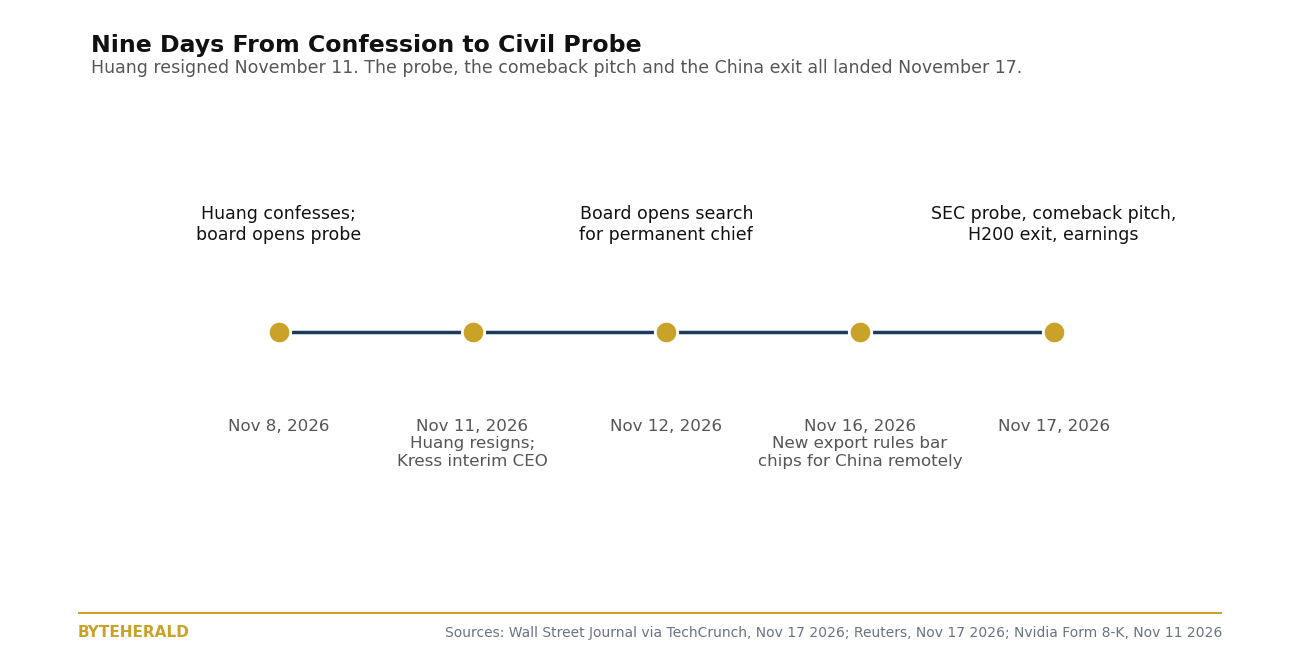
Nine days separate the confession from the probe. Each step changed what the next one could be.
| Date | Event |
| November 8, 2026 | Huang confesses to the affair; the board opens an independent investigation |
| November 11, 2026 | Huang resigns as president, chief executive and director, effective immediately (Form 8-K); Kress named interim chief executive, Jones named board chair |
| November 12, 2026 | Board announces a search for a permanent chief executive, considering internal and external candidates |
| November 16, 2026 | New export rules bar advanced chips from foreign data centers serving Chinese customers |
| November 17, 2026 | SEC civil probe reported; Huang offers to return; the board says no; Nvidia exits H200 sales in China; earnings reported |
What this does not establish
The probe does not establish that Nvidia misled anyone. Its scope is unclear, and the Journal's report is the only public account of it. Huang's offer to return is his wish, not a board decision, and the board's answer so far is no. The earnings beat does not settle the question either: revenue of 115.8 billion dollars, up 103 percent from a year earlier, arrived with the stock down more than 10 percent since Huang departed, which is a market verdict on uncertainty, not on the numbers. And the China exit does not end the export-control story, because the chips China cannot buy directly are still reaching its labs through data centers abroad, which is exactly what the new rules try to stop. We audited every claim about the exit itself on November 14, before this week's developments; the claims in this article are the ones that have changed since.
By ByteHerald Staff. TechCrunch reported on November 17, 2026, that the Securities and Exchange Commission is opening a civil probe into Nvidia over whether the company's disclosures misled investors, citing the Wall Street Journal, and that Nvidia reported revenue of 115.8 billion dollars, up 103 percent from a year earlier, with its stock down more than 10 percent since Huang departed. TechCrunch reported on November 17, 2026, that acting chief executive Colette Kress said Nvidia will no longer sell H200 chips in China, that new rules issued on Monday bar advanced United States chips from foreign data centers serving Chinese customers remotely, and that Jefferies forecast the rules might trim between 44 billion and 62 billion dollars from Nvidia's data center revenue next year. Reuters reported on November 17, 2026, that Huang said he would be honored to return as chief executive if the board decided it was in shareholders' and employees' best interests, that the board was not looking to reinstate him, and that the board set up a committee to oversee national security and export controls chaired by Suzanne Nora Johnson. The New York Post reported on November 17, 2026, that the probe will likely examine the company's earlier denial of an affair between Huang and Alice Huang of Megaspeed. ZeroHedge reported on November 17, 2026, that Huang agreed to sit for an interview with several House committees on December 1.
Comments
Post a Comment