Tencent launched Hy4 on November 4, 2026, as a vision-language model that can see a screen and click through it, and the company calls it open. The weights, the files a developer would actually download to run the model, are not downloadable yet. That gap matters more than the launch wording, because an open announcement without downloadable weights is a promise, not a product a developer can verify, run, or build on.
What changed since the August preview
Hy4 is not new as a name. Tencent previewed it in August 2026 as its next-generation vision-language model and said at the time that it would be open-sourced. The November launch is the first version described as available, with a demo page, a GitHub page, and an API. What changed is the usable surface: there is now a model to try through Tencent's own channels, and a set of reported benchmark numbers to judge it by. What did not change is the part that makes a model open in the sense developers use the word. Tencent's announcement and GitHub page describe weights as coming soon, and there is no downloadable model file listed for Hy4 as of this report. The August promise and the November launch therefore sit in the same state on the one question that counts: can anyone outside Tencent download and run it? Not yet.
For context, that distinction is standard in the field, even if it is not standard in press releases. A model can be open-weight, meaning the trained parameters are published for download; open-source, meaning the code and often the training details are also published; or simply available through an API, meaning a vendor runs it and a user sends prompts to it. Hy4 today is in the third bucket with a promise to move to the first. Its GitHub page says its weights will be released soon, and its page carries no weight download for Hy4 at launch. Tencent's own product page positions Hy4 for computer use and vision tasks, and offers a demo and an API, not a download. A reader who calls that open-sourced today is using the word for the intention, not the artifact.
What you can use today, and what is only promised
What is usable today is the demo and the API. Tencent's demo page presents Hy4 for computer use, and the announcement describes a model that can perceive screens and operate graphical interfaces. That is a real capability category, and it is the reason Hy4 is worth watching even before its weights appear: computer-use models are judged on whether they can complete multi-step tasks on a real desktop, not on whether they can answer a single question. What is not usable today is local inference, fine-tuning on your own data, or independent verification of the model's behavior on your own hardware. Those all require the weights, and they are all still pending. Any test that claims to have run Hy4 locally on launch day should be treated as suspect until a weight download exists to run.
The vendor benchmark, read with its label on
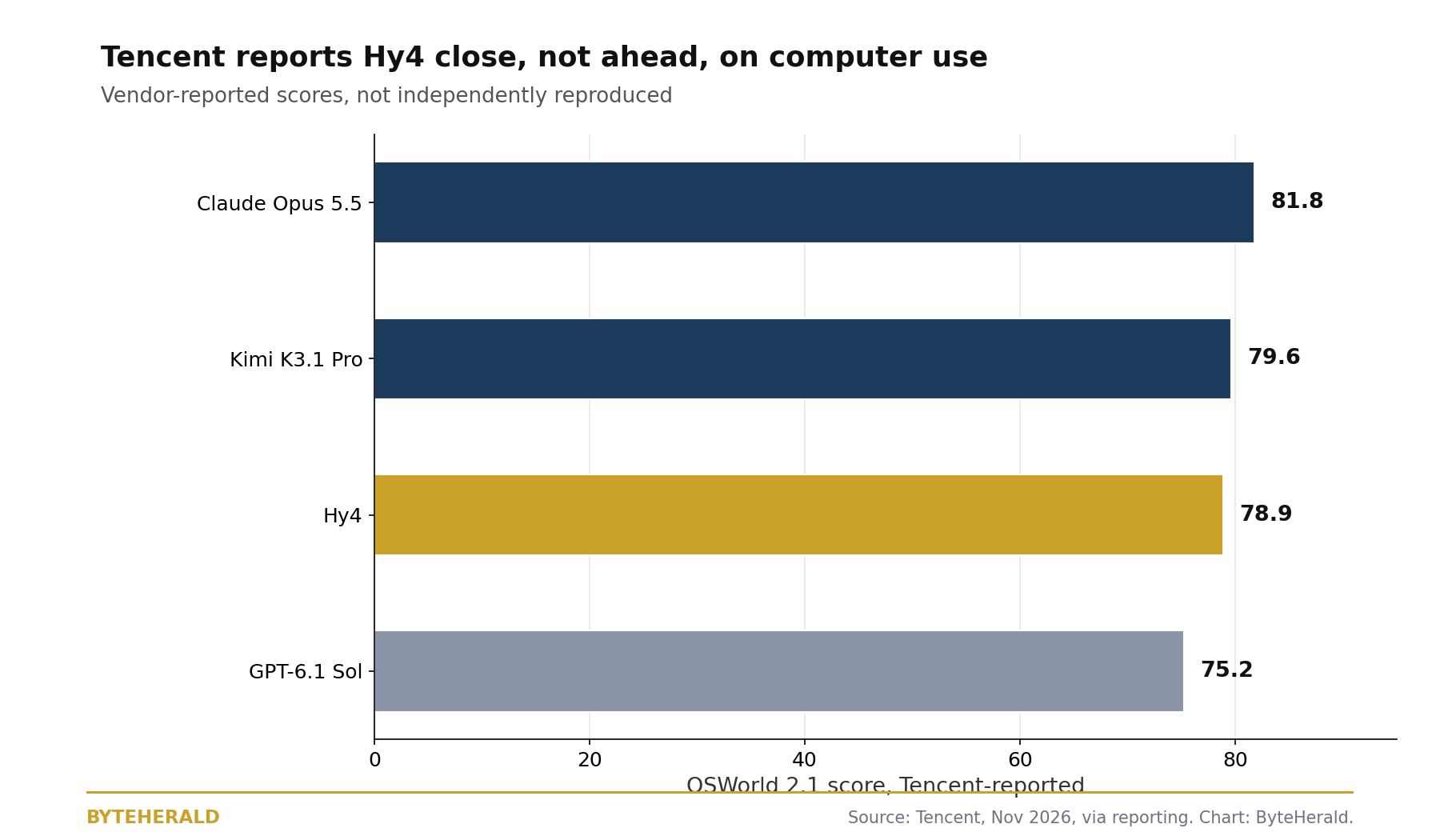
Tencent reports Hy4 at 78.9 on OSWorld 2.1, a benchmark of computer-use tasks, and places it below Claude Opus 5.5 at 81.8 and Kimi K3.1 Pro at 79.6, and above GPT-6.1 Sol at 75.2. Those are Tencent-reported figures, not an independent test, and the ranking is useful only with that label attached. A vendor benchmark is a claim to check, not a result to quote as settled, especially when the model cannot yet be downloaded and re-run by anyone else. The honest reading is narrower: Tencent's own numbers put Hy4 in the same band as its closest competitors on this task family, not ahead of them, and the gap to the leader is about three points on a scale where task completion is the thing being measured. Until weights are out, no outside lab can confirm whether that band holds on a fresh test set.
The Kimi control case: a promise kept on the same week
The reason the weights question is not pedantry is that a competitor answered it in the same week. Kimi, from Moonshot AI, shipped K3.1 Pro and published its weights for download on Hugging Face, a standard model-hosting site, in early November 2026. That is what a kept open-release promise looks like: a model page, a downloadable file, and a license a developer can read before deciding to use it. The contrast is instructive, because both companies used open language, and only one produced the artifact that makes the language true. A developer choosing between a model to build on today and a model to watch should therefore treat Kimi's release as the control case and Tencent's announcement as the test case still awaiting its own control. The same-week timing is not a coincidence to ignore: it shows the industry norm is to ship weights with the announcement, not after it.
That contrast also explains why the rest of this post's advice is practical rather than scolding. Vendors routinely announce before weights are ready, and sometimes the weights do follow within days. The correct response is not to dismiss Hy4, but to put it in the watch bucket and to set a simple trigger for moving it to the build bucket: a downloadable weight file on a public host, with a license and a model card describing training data and limits. Until that trigger fires, a team that builds a product on Hy4's API is building on a vendor service with vendor pricing and vendor uptime, not on an open model, and should plan accordingly.
How to tell an open model from an open announcement
| Test | Hy4 today | What would change the answer |
|---|---|---|
| Can you download the weights? | No, listed as coming soon | A public weight file on GitHub or Hugging Face |
| Can you run it on your own hardware? | No | Weights plus inference code and hardware requirements |
| Can you fine-tune it? | No | Weights plus a license that permits it |
| Can you independently reproduce its benchmark? | No, vendor-reported only | Weights plus the evaluation harness and test set |
| Can you try it through the vendor? | Yes, demo and API | Nothing, this part is already usable |
| Is it open-source, not just open-weight? | Not shown | Published training code and data details |
By ByteHerald Staff. Tencent, November 4, 2026, launched Hy4 as a vision-language model for computer use, with a demo and API, and described its weights as coming soon on its GitHub page, with no downloadable weight file at launch. Tencent, August 2026, previewed Hy4 as its next-generation vision-language model and said it would be open-sourced. Tencent, November 2026, reported Hy4 at 78.9 on OSWorld 2.1, with Claude Opus 5.5 at 81.8, Kimi K3.1 Pro at 79.6, and GPT-6.1 Sol at 75.2, as vendor-reported figures. Moonshot AI, early November 2026, published Kimi K3.1 Pro weights for download on Hugging Face.
Comments
Post a Comment