Marvell's $115 billion all-stock agreement to acquire Lumentum, announced November 2, 2026, is best understood as a bet on watts. The headline is about money, but the mechanism that makes the money work is about power: moving data between AI chips over copper traces wastes watts, and moving the same data over light, with the optics packaged next to the switch chip, wastes far fewer. That watt difference, multiplied across tens of thousands of ports in an AI cluster, is why a company that makes switch chips would pay $115 billion for a company that makes lasers. This article explains the watt math, the generations of co-packaged optics, and the decision guide for who should care, and who should wait.
What pluggable means, and what CPO changes
In a pluggable system, the switch chip sits on a board, and the optical module sits in a cage at the edge of that board, connected to the chip by copper traces on the board. Those traces are short, but at 800 gigabits per second and beyond, they are long enough to lose signal and waste power. The chip must drive the signal hard enough to survive the trace, and the module must clean it up again. That driving and cleaning is the waste. In a co-packaged optics system, the optics sit in the same package as the switch chip, or immediately next to it, and the copper trace is inches shorter, or gone altogether. The signal goes from chip to light with far less driving, and the power saved is the point. The tradeoff is that the optics can no longer be swapped independently: if a laser fails, or a generation changes, the package changes with it. That is why the industry has argued about CPO for a decade, and why the watt numbers are what finally moved it.
The watt table, with sources attached
The table below is the core of this article, and it is built the way ByteHerald's earlier arithmetic was built: vendor figures where they exist, ByteHerald arithmetic where the vendor figure stops, and a source attached to every row. The numbers are per port, at 800 gigabits per second, because that is the speed where the copper trace problem becomes unavoidable and where vendors publish comparable figures. The 10,000-port column is ByteHerald's multiplication, not a vendor claim, and it is there to show why a few watts per port is not a rounding error at cluster scale.
| Design | at 800 gigabits per second per port | Vendor figure, watts per port | 10,000 ports, ByteHerald arithmetic |
|---|---|---|---|
| Pluggable | 800 gigabits per second | About 25 watts, Broadcom's 2022 figure | 250 kilowatts |
| Co-packaged optics | 800 gigabits per second | About 9 watts, Broadcom's 2022 figure | 90 kilowatts |
| Linear pluggable optics, Broadcom's figure | 800 gigabits per second | About 18 watts, Broadcom's 2022 figure | 180 kilowatts |
| Linear pluggable optics, Nvidia's figure | 800 gigabits per second | About 12.5 watts, Nvidia's 2024 figure | 125 kilowatts |
| Linear pluggable optics, Marvell's figure | 800 gigabits per second | About 10 watts, Marvell's figure | 100 kilowatts |
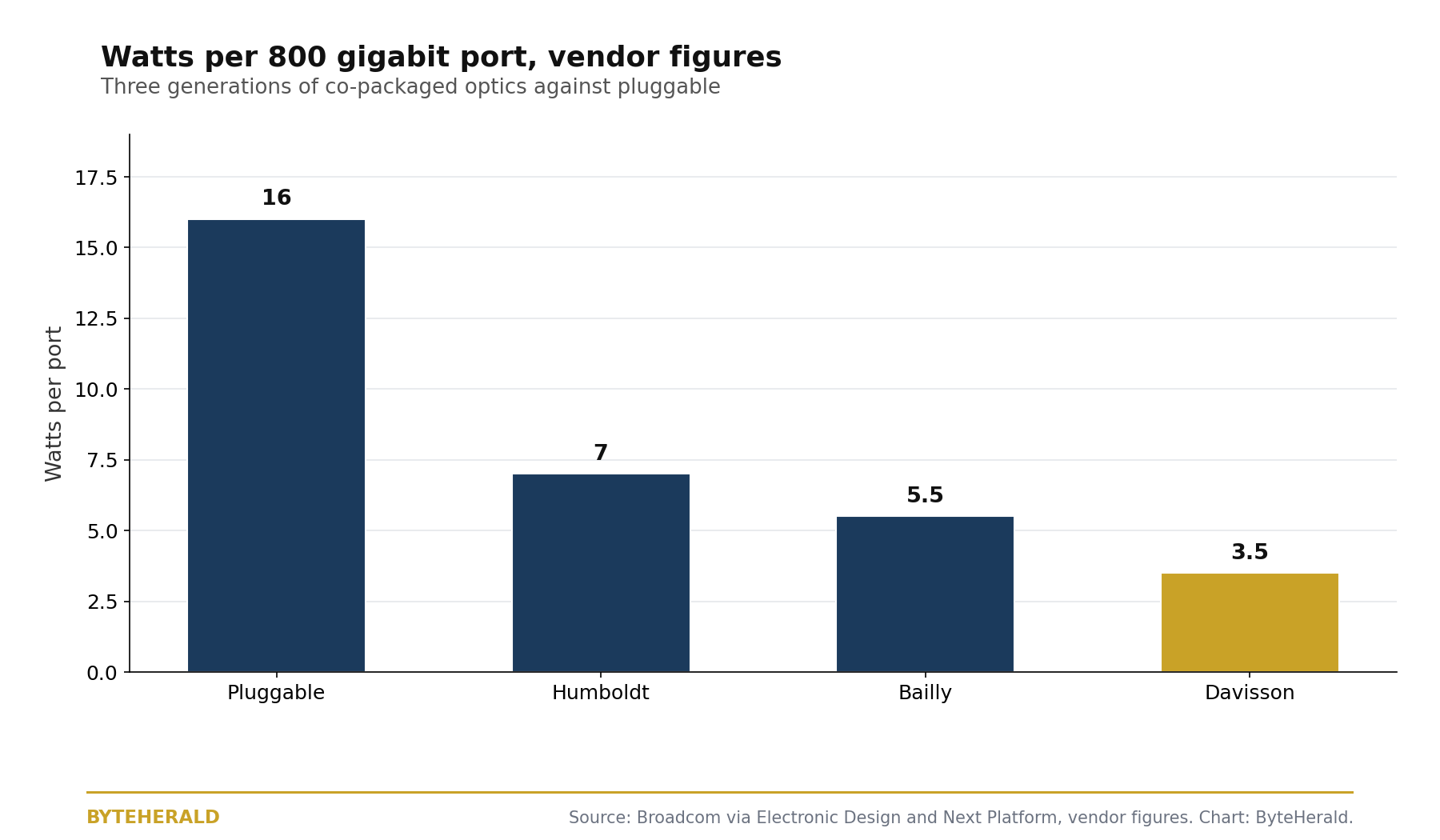
Read the table as a range, not a ranking. The pluggable figure of about 25 watts and the co-packaged figure of about 9 watts both come from Broadcom in 2022, and they are the cleanest comparison because they come from the same vendor, at the same speed, for the same generation. The difference is about 16 watts per port, which at 10,000 ports is about 160 kilowatts of power saved, before cooling. Cooling makes the saving larger, because every watt of electrical power that becomes heat must be removed, and removing it costs more power. A data center that saves 160 kilowatts at the port saves more than 160 kilowatts at the meter, though the exact multiplier depends on the cooling system and is not claimed here.
The linear pluggable rows show why the industry did not jump straight to co-packaged optics. Linear pluggable optics remove the digital signal processor from the module, which is the most power-hungry part of a traditional pluggable, and they get much of the saving without the packaging change. Broadcom's figure for linear pluggable is about 18 watts, Nvidia's is about 12.5 watts, and Marvell's is about 10 watts, and the spread between those three figures is itself informative: it reflects different assumptions about the host chip, the reach, and what is counted inside the module. ByteHerald reports all three, rather than picking the lowest, because a reader who only sees Marvell's 10 watts will think linear pluggable is almost as good as co-packaged, and a reader who only sees Broadcom's 18 watts will think it is barely better than pluggable. The truth, for a buyer, is that linear pluggable is a genuine middle step, and co-packaged is the larger step that requires a packaging commitment.
Who leads, and what Marvell is buying into
Broadcom is the reference point for co-packaged optics, because it has published the most complete figures and shipped the most generations. Its Bailly switch, announced in 2022, packaged optics with a 25.6 terabit per second switch, and its later generations moved to 51.2 terabits per second and beyond. Broadcom's claim, repeated in its own materials, is that co-packaged optics cut power by about 70 percent compared with pluggable at the same speed, and the 25-watt to 9-watt comparison in the table is the arithmetic behind that claim. Cisco has also shipped co-packaged systems, and Nvidia has taken a different path, building optics into its own switch and GPU systems rather than selling a standalone co-packaged switch. The point for a reader is not which vendor wins, but that the watt saving is not a single vendor's marketing claim: it appears, with different magnitudes, in every vendor's published figures.
Marvell's acquisition of Lumentum is a bet that the optics side of that package will be the scarce part. Lumentum makes the lasers, modulators, and optical components that go into transceivers and, increasingly, into co-packaged systems. Marvell already makes the digital signal processors and the switch chips that sit next to those lasers. Owning both sides lets Marvell sell a package, not just a chip, and it lets Marvell control the yield and the roadmap of the optical components that determine whether a co-packaged system ships on time. The $115 billion price, in all stock, reflects that control: Marvell is not buying a supplier, it is buying the part of the supply chain that has historically limited co-packaged optics, which is the optics themselves. Whether the price is right depends on whether co-packaged optics become the default for AI clusters, or remain a premium option for the largest builders. The watt table suggests the default case is strong, but the decision guide below explains why it is not yet universal.
What CPO does not fix
Co-packaged optics do not fix the power of the switch chip itself, or the power of the GPUs that feed it. They fix the interconnect between switches, and, in some designs, between switches and accelerators, which is a large part of a cluster's power, but not the whole cluster. A reader who sees a 70 percent saving at the port and applies it to the whole data center will overstate the saving by a wide margin. The saving applies to the optical interconnect portion of the power budget, which is significant at AI scale, and which grows as clusters get larger and as speeds increase, but it is not the total power bill. ByteHerald's datacenter resource ledger put the whole power and water bill in context, and the CPO saving should be read inside that larger budget, not instead of it.
Co-packaged optics also do not fix repairability, and that is the operational cost that buyers weigh against the watt saving. In a pluggable system, a failed module is swapped in minutes, by a technician, without touching the switch. In a co-packaged system, a failed laser may mean replacing the whole package, or at least taking the switch out of service for a longer repair. Vendors are working on designs that isolate failures, and on testing that catches weak lasers before they ship, but the repair story is still less mature than the pluggable story, which has decades of field practice behind it. That is why the largest builders, who can afford custom repair flows and who feel the watt saving most acutely, are the first adopters, and why smaller buyers are more likely to adopt linear pluggable first.
The decision guide, by situation
For a hyperscaler building a new AI cluster at 800 gigabits per second and beyond, with a power cap that limits how many racks can be built, co-packaged optics are the watt answer, and the repairability cost is a cost to engineer around, not a reason to stay on copper. For a cloud provider with an existing pluggable fleet and a refresh cycle that is not yet due, linear pluggable optics are the bridge: they cut watts substantially, they keep the module swappable, and they do not require a new switch package. For an enterprise buyer with a smaller cluster, where the power saving at 10,000 ports does not apply because the port count is in the hundreds, the watt math is less decisive, and the familiarity and repairability of pluggable optics may outweigh a saving that, at that scale, is measured in kilowatts rather than megawatts. For a vendor deciding where to invest, Marvell's acquisition is the signal: the optics, not just the switch, are where the next generation of AI networking will be won.
By ByteHerald Staff. Broadcom, 2022, published a pluggable figure of about 25 watts per port and a co-packaged optics figure of about 9 watts per port at 800 gigabits per second, and a linear pluggable optics figure of about 18 watts per port, which ByteHerald uses as the cleanest same-vendor comparison and multiplies by 10,000 ports to 250 kilowatts, 90 kilowatts, and 180 kilowatts respectively. Nvidia, 2024, published a linear pluggable optics figure of about 12.5 watts per port, multiplied by ByteHerald to 125 kilowatts at 10,000 ports. Marvell published a linear pluggable optics figure of about 10 watts per port, multiplied by ByteHerald to 100 kilowatts at 10,000 ports. Broadcom's Bailly co-packaged switch, announced in 2022, packaged optics with a 25.6 terabit per second switch, with later generations at 51.2 terabits per second and beyond, and Broadcom's materials claim about a 70 percent power reduction compared with pluggable at the same speed. Marvell, November 2, 2026, announced a $115 billion all-stock agreement to acquire Lumentum, the optics supplier whose lasers, modulators, and optical components go into transceivers and co-packaged systems.
Comments
Post a Comment