Ask a generative AI model a question in Bengali and it can use 15.3 times more energy than the same question in English. In Hindi, the figure is 7.9 times. The finding comes from University of Michigan researchers who measured three open-source models answering questions in 122 languages, and the reason is not the models' intelligence. It is their tokenizers, the part of the system that chops text into pieces before the model reads it.
The numbers
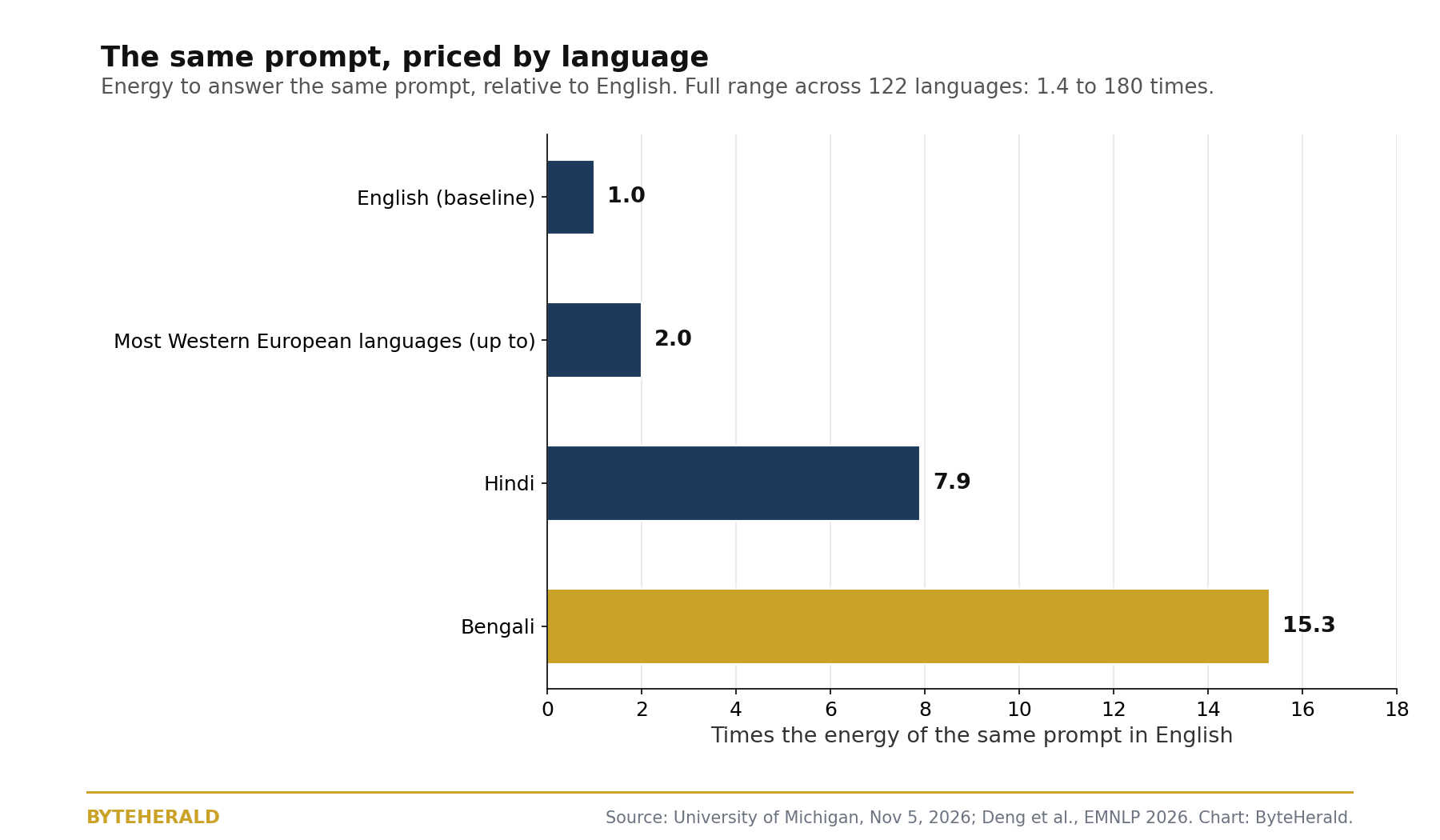
The study, "The Language-Energy Divide: Measuring Energy Costs of Multilingual LLM Inference," was presented at the 2026 Conference on Empirical Methods in Natural Language Processing. Across the languages studied, the models used 1.4 to 180 times more energy to generate non-English text than to generate equivalent English text. Most Western European languages came in at twice the energy of English or less. The gap widens sharply for languages that do not use Latin script and have less digital content available for training, and it is widest of all for the languages spoken by the most people outside the English-speaking world.
| Language group | Energy vs the same prompt in English |
|---|---|
| English | 1 time (the baseline) |
| Most Western European languages | Up to 2 times |
| Hindi | 7.9 times |
| Bengali | 15.3 times |
| Highest measured, any language studied | 180 times |
The researchers put a population number on the problem. Around 5.2 billion people have to use more than twice as much energy to generate text in their first language compared to English speakers, according to the researchers' measurements and demographic data from Ethnologue. Hindi and Bengali are each spoken by hundreds of millions of people. The penalty is not confined to rare languages. It falls hardest on some of the most widely spoken languages on earth, and the study's deck puts it plainly: some of the world's most widely spoken languages can require up to 15 times as much energy as English.
How they measured it
The researchers measured the energy used by three open-source models, Alibaba's Qwen 3, Google's Gemma 3, and Meta's Llama 3.1. They asked each model to answer multiple-choice questions from Belebele, a dataset for assessing the reading comprehension of AI models in 122 different languages, and measured the energy used to answer each question with the ML.Energy framework, developed at Michigan Engineering. The work ran on the University of Michigan's Great Lakes high-performance computing cluster, and the energy measured is inference energy only: the energy used to generate a response, not the energy used to train the model.
To check whether the gap held beyond reading comprehension, the researchers also asked the models to answer grade-school math word problems and open-ended user prompts from other benchmarking datasets, translating the English questions into seven other languages using Meta's No Language Left Behind translation tool. The disparity persisted at larger model sizes and across different types of computer processors. All the models used less energy for English text, on average. The study was partly funded by the National Science Foundation and the Defense Advanced Research Projects Agency, with additional funding from Ford, the Laude Institute, OpenAI, and the Survival and Flourishing Fund.
Why non-English costs more
The mechanism is tokenization. Before a model can process a prompt, it converts the text into tokens, the basic units of data the model works with. Non-English text breaks into more tokens, and less meaningful ones, than the same content in English. The Devanagari script used in Hindi, Nepali, and Marathi, and the Bengali script, have primary characters that change form and combine with accents to produce up to millions of unique characters, and a tokenizer trained mostly on English handles those characters inefficiently.
A higher number of tokens takes up more computer memory and burns more energy. With more memory consumed by tokens, the model has less available for processing information, so it processes the tokens in smaller batches, which uses more energy per token. The effect compounds: the token count is higher, and each token costs more to process. More tokens can also result in higher direct costs, since companies often price model access by the number of tokens generated. A user asking in Bengali can therefore pay more, in energy and in money, for the same answer.
There is a second penalty on top of the first. "The languages that typically consume more energy also tend to have lower accuracy in the model output," said Naihao Deng, a doctoral student in computer science and engineering from the U-M AI Lab and the first author of the study. The people who pay the most energy for AI also get the least reliable answers from it. Deng put the consequence in plain terms: "Most people will want to use AI models by asking questions in their native languages, and they may feel pressured to use it as it is incorporated into more parts of society, but the double penalty makes it more likely that certain people will be priced out of AI and that companies will be more reluctant to serve models in certain languages."
Who pays, and what fixes it
The fix the researchers recommend is not to tell five billion people to ask in English. It is to build systems that handle their languages efficiently: models optimized for specific languages, translation pipelines that convert a prompt to English before feeding it to a general model, provided the translation is reliable, and tokenizers with a more multilingual token vocabulary. They also recommend more efficient hardware and subsidized energy costs or fairer pricing. Rada Mihalcea, the director of the U-M AI Lab and the study's corresponding author, said AI developers should be creating more resources for the languages with an energy and cost disparity, including crowdsourcing native speakers to translate material and create resources to get enough training data.
The finding belongs next to the other energy number the industry watches. Our datacenter resource ledger counted the power and water the buildout consumes, and the industry's answer to that ledger has been efficiency: better hardware, better cooling, better scheduling. The language divide is the same problem at a different scale. The grid cost of AI is measured in gigawatts, but the user cost is measured in tokens, and the tokenizer decides who pays more. A model that answers in English for one unit of energy and in Bengali for fifteen is not a neutral piece of infrastructure. It is a pricing decision made by a tokenizer, and it is one the labs can change.
By ByteHerald Staff. The University of Michigan reported on November 5, 2026, that generative AI models use 1.4 to 180 times more energy to generate non-English text than equivalent English text, that most Western European languages come in at twice the energy expenditure or less, and that Hindi requires 7.9 times and Bengali 15.3 times more energy than an equivalent English prompt. The study, "The Language-Energy Divide: Measuring Energy Costs of Multilingual LLM Inference," by Naihao Deng and colleagues, was presented at the 2026 Conference on Empirical Methods in Natural Language Processing. The researchers measured three open-source models, Alibaba's Qwen 3, Google's Gemma 3, and Meta's Llama 3.1, on the Belebele dataset in 122 languages, using the ML.Energy framework on the University of Michigan's Great Lakes cluster. Around 5.2 billion people use more than twice as much energy to generate text in their first language compared to English speakers, according to the researchers' measurements and demographic data from Ethnologue. The National Science Foundation and the Defense Advanced Research Projects Agency partly funded the research.
Comments
Post a Comment