Cerebras published a recipe for serving a 3 trillion parameter model on October 22, 2026, and the recipe is more interesting than the headline. Using Moonshot AI's open source Kimi K3 as its worked example, the wafer scale chipmaker shows the model split across 59 of its WSE-3T wafers, running at a claimed 1,000 to 2,000 plus tokens per second, with the weights parked on chip and only activations moving between stages. The honest reading matters: Cerebras calls K3 an illustrative example, not a measured run, so this is a deployment design with arithmetic attached, not a benchmark result. The design still matters, because it states plainly what trillion parameter inference costs in hardware, and why the industry's next bottleneck is memory placement, not model size.
The arithmetic starts with a constraint. A single WSE-3T wafer holds 44 GB of on-chip memory, while a 3 trillion parameter model needs terabytes for its weights alone. At 4 bit quantization, the kind used in the Hugging Face implementation of Kimi K3, each parameter takes half a byte, so the raw weight payload is about 1.5 terabytes. Kimi K3 has 93 layers, which divides to about 16 GB per layer. That single division drives everything that follows, because a 16 GB layer fits comfortably inside a 44 GB wafer, with room left over for the working state each request needs.
The wafer math, step by step
Layer type decides how many layers share a wafer. Dense layers use full attention, which stores keys and values for every token in every active request, so each dense layer takes a whole wafer and leaves the remaining 28 GB of that wafer for its key value cache. Linear attention layers keep a small fixed size state per request regardless of context length, so two of them fit on one wafer, using 32 GB of the 44 GB available. Kimi K3 has 69 linear attention layers and 24 dense layers. Dividing 69 by two gives 35 wafers for the linear layers (34 full pairs plus one wafer holding the final single layer), and the 24 dense layers take 24 wafers. The total is 59 wafers, and the chart below shows the split.
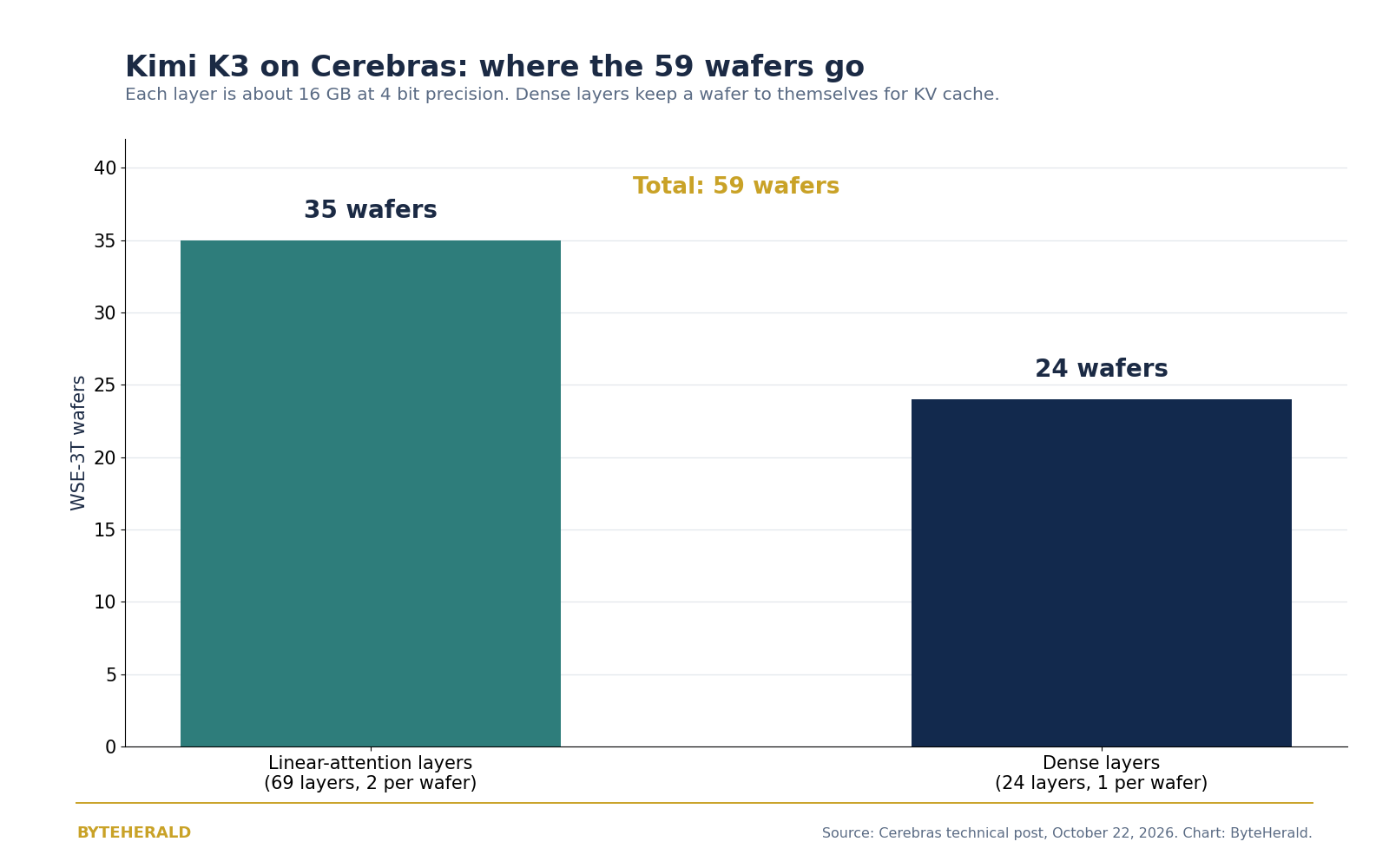
| Layer type | Layers in Kimi K3 | Layers per wafer | Wafers |
|---|---|---|---|
| Linear attention | 69 | 2 | 35 |
| Dense (full attention) | 24 | 1 | 24 |
| Total | 93 | Not applicable | 59 |
ByteHerald checked the division against the company's own figures, and the numbers close exactly: 35 plus 24 equals 59, and 93 layers at about 16 GB each equals roughly 1.5 terabytes, matching the 4 bit payload. Readers should note one rounding detail. The 16 GB figure is approximate, since 1.5 terabytes divided by 93 is 16.1 GB, and Cerebras rounds it in its post. The wafer count is unaffected by that rounding, because both layer types fit with headroom either way.
Why the pipeline, not the wafer count, is the point
Once mapped, the wafers run as an assembly line. Each wafer executes its assigned layers and passes only activations to the next stage, over RDMA on Ethernet at roughly 2 microseconds per hop. The weights never move, which is the whole trick: moving a 1.5 terabyte model for every request would swamp any interconnect, but moving a thin stream of activations between stages costs almost nothing by comparison. That is also why Cerebras can claim high throughput without claiming a single request finishes faster. A token still travels through all 59 stages in order, but every stage works on a different request at the same time, so the pipeline stays full instead of idling between tokens. Smaller micro batches make each request faster, larger ones raise total throughput, and the company says production systems use much finer grained stages than the one layer per stage simplification in the example.
That framing connects directly to a question ByteHerald covered in the hardware map for Meta's 816 billion parameter open model, which showed how memory math, not parameter count alone, decides whether a model runs locally at all. Cerebras is making the same argument at the other end of the scale: once a model passes a trillion parameters, the question stops being whether the model is smart enough and becomes whether its weights can sit still while requests flow past them.
What this does not prove
Three gaps keep this post in the recipe category rather than the result category. First, Cerebras does not say the Kimi K3 layout was actually run end to end, and it gives no measured tokens per second for that layout, only the general 1,000 to 2,000 plus figure for multi trillion parameter models. Second, the worked example assumes a 256,000 token average request size and an 8 bit key value cache, and the post does not publish the resulting concurrent request count in plain numbers, only the method for computing it from the remaining cache space. Third, Cerebras itself names the honest comparison metric, tokens per second per megawatt at matched output speed, and does not supply it for this layout. Until an independent party runs the layout and reports that figure, the 59 wafer design is a credible engineering claim awaiting a measurement, not a settled performance result.
There is also a useful contrast inside the company's own numbers. Cerebras cites Kimi K3 at 88.3 percent on Terminal-Bench 2.1, just behind GPT-5.6 Sol at 88.8 percent, and 91.2 percent on BrowseComp, ahead of Sol at 90.4 percent. Those are the model's reported capabilities, not Cerebras hardware results, and they explain why Kimi K3 was chosen as the example: it is an open model with frontier level coding and agent scores, so the deployment math describes a real workload rather than a synthetic one. The distinction matters for buyers, because a fast system serving a weak model is a different purchase from a fast system serving a strong one, and only the first half of that sentence has been demonstrated here.
The durable question behind the news
Strip away the wafer count and the lasting idea is about architecture choice. GPU clusters shard a giant model across many small chips and pay a communication tax every time weights or activations cross between them. Wafer scale computing pays a different tax instead: it buys enormous on chip memory and keeps the whole layer local, then accepts that a single model needs dozens of wafers wired as a pipeline. Neither approach is free, and the right one depends on whether a workload values raw throughput, low latency per request, or the ability to run on hardware a buyer already owns. For builders choosing an inference provider in 2026, the practical test follows from Cerebras's own metric: ask for tokens per second per megawatt at a stated output speed, on the model you actually plan to serve, measured by someone other than the vendor. A vendor that answers that question has a product. A vendor that answers with a wafer count has a diagram. Cerebras, to its credit, published the diagram and named the test in the same post, which is more than most hardware announcements manage.
For readers new to the mechanics, the visual explainer on how transformers work covers attention layers, the same building blocks whose linear and dense variants drive the wafer math above. The difference between a layer that stores every token and a layer that keeps a fixed state is the difference between one wafer and half a wafer, multiplied 93 times, and that multiplication is the whole story of this post.
By ByteHerald Staff. Cerebras, October 22, 2026, technical post on deploying trillion parameter models, with Kimi K3 as the illustrative example, 59 wafer layout, 44 GB per wafer, 4 bit weights, 8 bit key value cache, 2 microseconds per hop, and 1,000 to 2,000 plus tokens per second claim. Moonshot AI Kimi K3 model details as cited by Cerebras, including 69 linear attention layers, 24 dense layers, 93 layers total, Terminal-Bench 2.1 score of 88.3 percent, and BrowseComp score of 91.2 percent.
Comments
Post a Comment