Cloudera's State of Enterprise AI 2026 report, released October 26, 2026 and based on a September 2026 survey of 1,500 global IT leaders by Wakefield Research, found that 89 percent of respondents had already limited or redesigned AI use cases because of rising token consumption, and 98 percent had pulled back an AI deployment because of failure, hallucinations, or unexpected behavior. The quotable answer is this: enterprise AI has not failed, it has hit a scale trap, where the cost, governance, and control demands of running AI at full size force companies to redesign what they already built.
The six numbers, and what each one measures
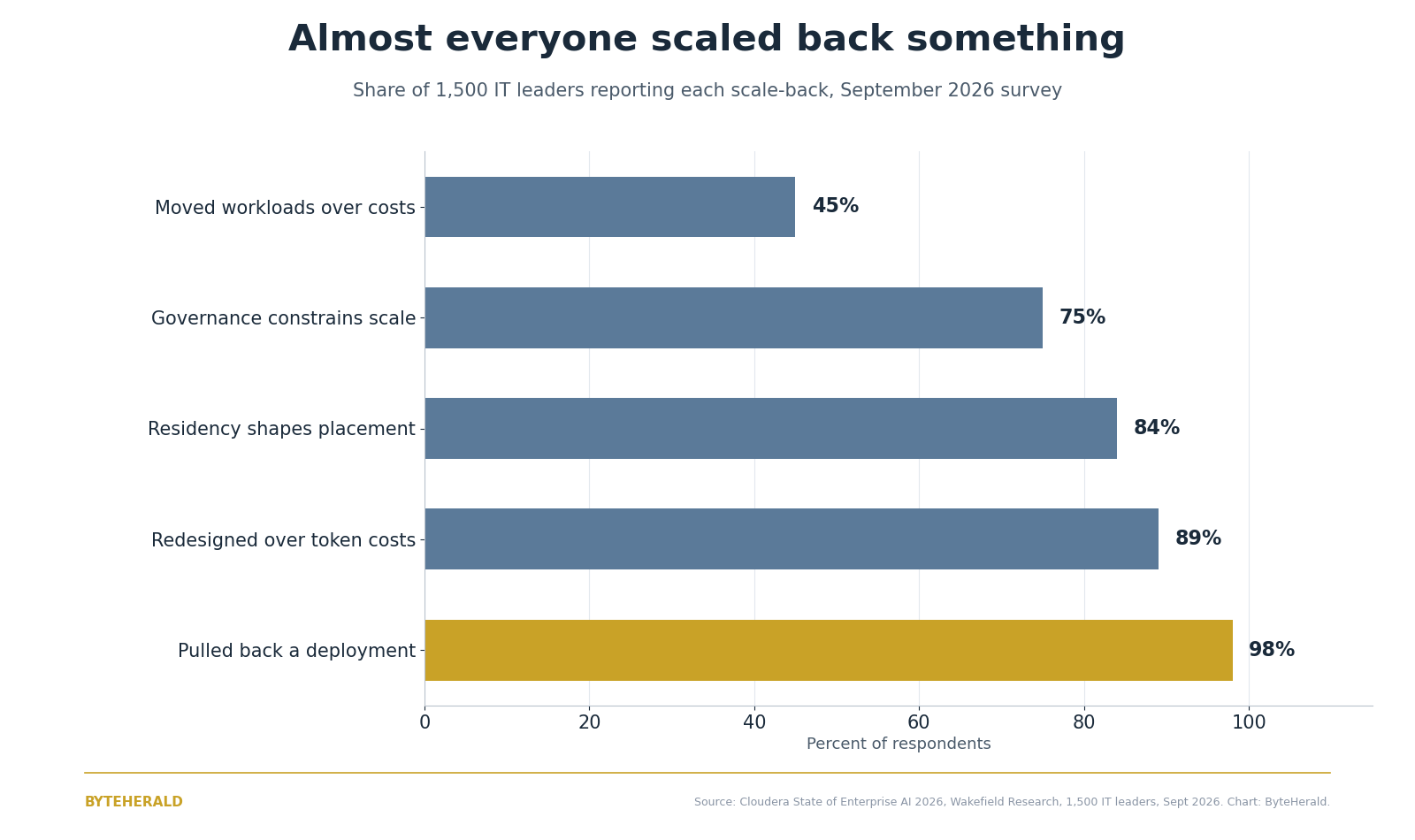
The survey's value is that it separates five different kinds of pullback, and each one has a different cause. Token consumption is the cost cause: 89 percent limited or redesigned use cases because tokens cost more than expected, and 45 percent moved AI workloads in response to higher or more volatile costs. Governance is the control cause: 75 percent cite governance and compliance as a constraint on scaling AI, and 55 percent report governance and compliance costs growing faster than expected. Deployment failure is the reliability cause: 98 percent pulled back a deployment over failure, hallucinations, or unexpected behavior, a figure so high it describes normal operations at scale, not rare accidents. Sovereignty is the placement cause: 84 percent say data residency, sovereignty, or jurisdiction-specific requirements influence where AI workloads are deployed. Read together, the six numbers describe a single mechanism: AI that works in a pilot gets more expensive, harder to govern, and harder to place as it grows, and companies respond by shrinking, moving, or redesigning it.
| Finding | Share | What it measures |
|---|---|---|
| Pulled back a deployment | 98 percent | Failure, hallucinations, or unexpected behavior in production |
| Limited or redesigned use cases | 89 percent | Rising token consumption forcing scope changes |
| Residency shapes placement | 84 percent | Data residency, sovereignty, or jurisdiction rules |
| Governance constrains scale | 75 percent | Compliance as a limit on how fast AI can grow |
| Governance costs growing faster | 55 percent | Compliance spending outpacing expectations |
| Moved workloads over costs | 45 percent | Relocating AI work in response to price volatility |
The counterpoint: deployment is still expanding underneath the pullbacks
A survey commissioned by a vendor that sells data platforms should be read with care, and the counterpoint comes from a different dataset. IoT Analytics, studying 1,533 real-world enterprise AI projects, found the share of projects executing multi-step tasks autonomously rose from 1.1 percent in 2025 to 17.8 percent in the first quarter of 2026, while output-only projects fell from 59.5 percent to 32.2 percent. The most common applications in that study were process optimization at 52.2 percent of projects, content creation at 30.1 percent, and inquiry handling at 22.2 percent. The two datasets do not contradict each other: companies are deploying more autonomous AI, in the same period that they are redesigning, moving, and pulling back deployments. Expansion and pullback are the same story at scale. A pilot that becomes autonomous also becomes expensive, governed, and placed under sovereignty rules, and the redesign is the price of keeping it.
The honest caveat cuts both ways. Cloudera commissioned the survey from Wakefield Research, and a vendor survey is not a neutral census: respondents are IT leaders, the sample is global but self-selected, and the questions measure reported behavior, not audited spending. The 98 percent figure in particular should be read as a sign that pullbacks are routine, not that 98 percent of AI is broken. A company that pulls back one deployment out of twenty counts the same as a company that pulls back all of them. What the survey proves, even with that caveat, is breadth: across 1,500 leaders, redesign, relocation, and governance friction are the normal experience of scaling AI, not the exception. That finding matches the budget evidence we tracked in our enterprise AI pullback survey, where only a minority of projects were delivering measurable value. The Cloudera numbers explain why: value leaks out through token bills, governance costs, and placement constraints before it reaches the profit line.
What the scale trap is, in plain terms
The scale trap has three jaws, and each one bites at a different stage. The first jaw is unit cost: a use case priced on a pilot's token volume becomes unaffordable at production volume, because token consumption grows with users, retries, and agent loops, not just with the first prompt. The second jaw is governance: a model that needs approval, audit trails, and data controls at enterprise scale carries a compliance cost that a pilot never paid, and that cost grows faster than the use case's value. The third jaw is placement: sovereignty and residency rules decide where a workload can legally run, which can force a move even when the current location is cheaper. Companies escape the trap in only three ways, and the survey shows all three in use: redesign the use case to use fewer tokens, move the workload to a cheaper or compliant location, or pull the deployment back until the economics and controls catch up. None of those moves is a retreat from AI. All three are what scaling actually looks like when the bill arrives.
The investment implication follows directly, and it connects to the largest financing numbers in AI. When nearly nine in ten enterprises redesign over token costs, the buyers of AI infrastructure are price-sensitive in a way the sellers' growth stories often ignore. Gartner's estimate that 3.5 trillion dollars of AI spending could face impairment by 2030, covered in our Gartner spending analysis, is the same warning from the seller side: spending that cannot show a return gets written down, not renewed. The scale trap is the mechanism behind that warning, measured from the buyer side. Enterprises are not waiting for the write-down to redesign. They are redesigning now, while the contracts are still live.
Five controls before you scale
Any team about to scale an AI use case can borrow the survey's lessons as a checklist, and the checklist works long after this report fades. First, cap token spend per use case before launch, with a hard budget and an alert, not a monthly surprise. Second, price the retry and agent-loop multipliers, not just the single-prompt cost: autonomy multiplies tokens, as the IoT Analytics shift from 1.1 percent to 17.8 percent autonomous projects shows. Third, put governance in the design, not after it: approval, audit, and data controls cost far less when built in than when retrofitted, and 75 percent of leaders say governance already constrains scale. Fourth, decide placement early: residency and sovereignty rules should choose the region before the workload is built, not force a move later, as 45 percent of respondents have already done. Fifth, define the pullback trigger in advance: the deployment, the metric, and the threshold that will pause it, so a pullback is a planned control, not a failure. The companies in this survey that pulled back deployments were not failing at AI. They were discovering, in public numbers for the first time, what scaling AI actually costs. The ones that scale next will be the ones that budgeted for all five controls before they needed them.
By ByteHerald Staff. Cloudera reported on October 26, 2026 that its State of Enterprise AI 2026 report, based on a survey commissioned by Cloudera and fielded by Wakefield Research of 1,500 global IT leaders and decision-makers in September 2026, found that 89 percent of respondents had already limited or redesigned AI use cases because of rising token consumption, that 84 percent said data residency, sovereignty, or jurisdiction-specific requirements influence where AI workloads are deployed, that 98 percent had pulled back an AI deployment due to failure, hallucinations, or unexpected behavior, that 75 percent cited governance and compliance as a constraint on scaling AI, that 55 percent reported faster-than-expected growth in governance and compliance costs, and that 45 percent had moved AI workloads in response to higher or more volatile costs. IoT Analytics reported in 2026 that across 1,533 real-world enterprise AI projects, the share executing multi-step tasks autonomously rose from 1.1 percent in 2025 to 17.8 percent in the first quarter of 2026, while output-only projects fell from 59.5 percent to 32.2 percent, and that the top applications were process optimization at 52.2 percent, content creation at 30.1 percent, and inquiry handling at 22.2 percent of projects. Gartner estimated, as covered by ByteHerald on October 18, 2026, that 3.5 trillion dollars of AI infrastructure spending could be at risk of impairment by 2030 if revenue fails to justify it.
Comments
Post a Comment