The University of Kentucky granted research administrator David Durman a religious accommodation on September 25, 2026, excusing him from personally using AI tools to complete his tasks, after finding that using them would conflict with his sincerely held humanist beliefs and that the accommodation imposed no undue burden on his department. The American Humanist Association, which helped him seek it, calls it the first AI exemption of its kind for a humanist, as Religion News Service reported on October 26, 2026.
What he asked for, and what he got
Durman, 45, supports academics with grant applications. In a request letter dated August 24, 2026, to the university's Office of Equal Opportunity, he asked to be excused from personally using AI for transcription, note-taking and decision-making, including tools introduced later. The tools in his office at the time included Microsoft Teams Copilot for meeting notes, suggested chatbot use including ChatGPT and Claude, and internal language-model tools under development. His argument, in his own words to Religion News Service, was that offloading that labor undercuts his ability to be a moral actor, because thinking through situations, work, ethics and how he handles other people is central to developing himself as a moral person.
| What he asked | What the September 25 approval says |
|---|---|
| Excusal from personal AI use for his own tasks | Granted: he is excused from personal use of AI to complete his tasks |
| Covering tools introduced later, not only current ones | The approval covers his tasks generally, and the university says accommodations may be reviewed as technology and duties evolve |
| An AI-free workplace around him | Not granted: he must still attend meetings where others use AI, cooperate with those colleagues, and submit materials through relevant systems |
The approval came after a mid-September meeting with the Office of Equal Opportunity, which determined the arrangement posed no undue burden on his department. Durman continues to perform all of his job duties without using AI, according to the American Humanist Association. A university spokesperson said requests for religious accommodations are reviewed individually, taking account of an employee's sincerely held beliefs, essential responsibilities and the circumstances.
The two-part test, in plain terms
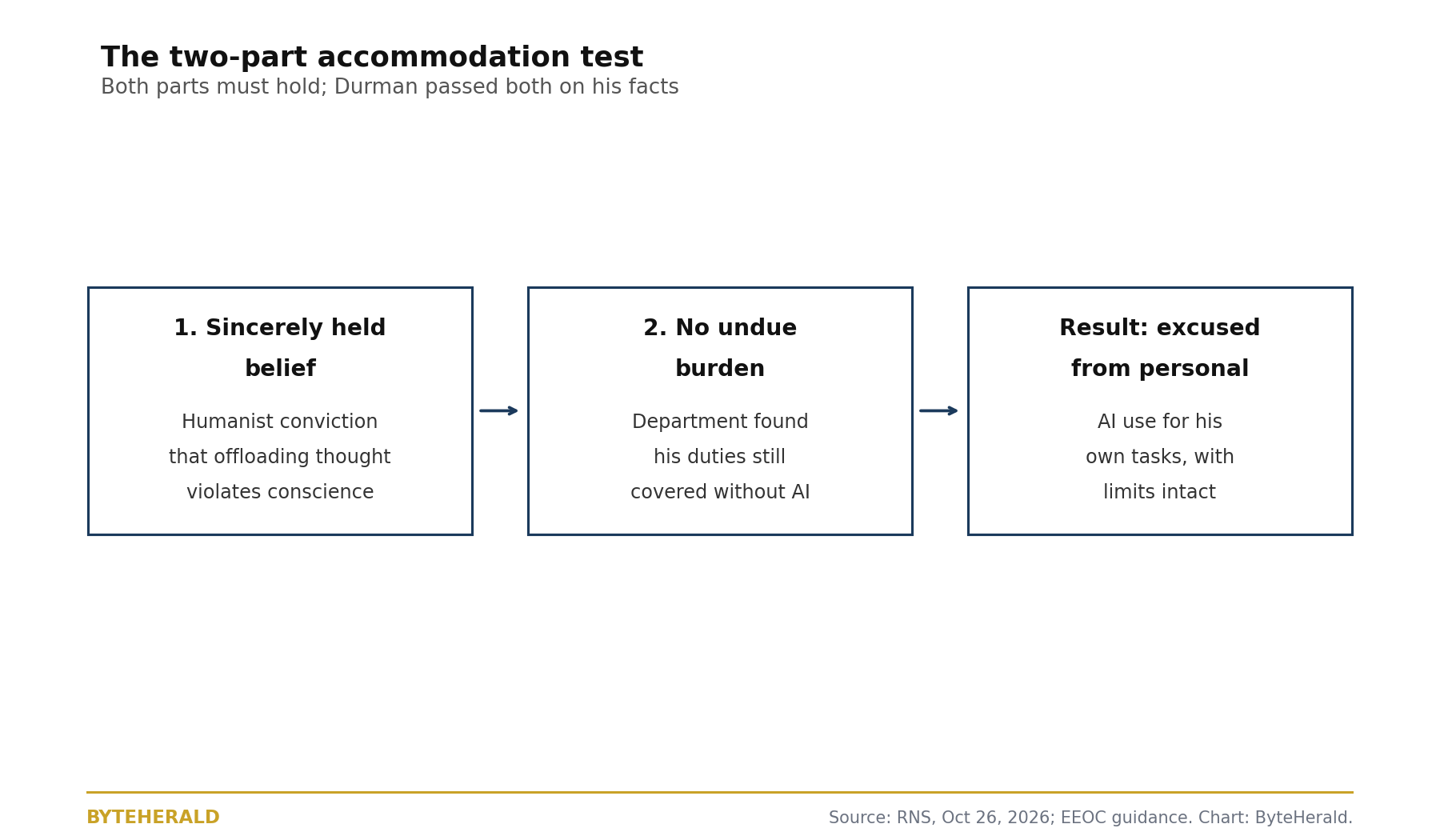
Title VII of the Civil Rights Act requires covered employers to reasonably accommodate sincerely held religious beliefs, and Equal Employment Opportunity Commission guidance explains that the protection can encompass sincerely held non-theistic moral or ethical beliefs held with the force of religious belief. Federal courts have treated humanism as qualifying in that sense, even though humanism is often described as a non-religious philosophy or worldview. That is the first part of the test: the belief must be sincere and held with religious force, not merely a preference about a tool.
The second part is the employer's side: the accommodation must not impose a substantial hardship on the business, the standard the Supreme Court clarified in its 2023 Groff v. DeJoy decision. The flip side of the same test is what protects the employee: Title VII bars an employer from firing someone for a sincerely held religious belief, so a refusal alone is not grounds for dismissal unless the employer can show the accommodation would cause substantial hardship. That is the general rule, not advice for any individual case. Durman's case passed that part on narrow facts. His work, grant administration, could still be done without personally using AI, and his department found no undue burden. Change either fact, a job that cannot be done without the tool, or a department that cannot cover the gap, and the same request could come out differently. That is why the case is a worked example of the test, not a general right to opt out of AI at work.
Where the exemption stops
The limits are the most quoted part of this story for a reason: they are what keep it from being misread as a ban on AI in Durman's workplace.
| Covered | Not covered |
|---|---|
| His personal use of AI tools for his own tasks | Meetings where colleagues use AI, which he must still attend |
| Transcription, note-taking and decision-making he would otherwise do himself | Cooperation with staff who use AI, and submitting materials through relevant systems |
| Tools introduced later, within his own tasks | Any AI-free workplace, any exemption for other employees, and any court precedent |
Durman's request was inspired in part by Erin Maus, a Unitarian Universalist software engineer who received an exemption from her employer over religious concerns about AI. The American Humanist Association's staff attorney Alexandria Huiskens told Religion News Service that this is the first of its kind at the association and for humanism generally, to exempt those who see AI use as flying in the face of their freedom of conscience. That first-of-its-kind claim belongs to the association, and this article reports it as the association's claim, not as an independently audited count of every accommodation ever granted.
The distinction between a rule and how people live under it is one ByteHerald has tracked before: our database of every forum and platform that banned AI content found six communities banning it and one reversing its ban, the same gap between writing a rule and making it match how people actually behave. Durman's case is the workplace version of that gap: a rule that says use AI, a person whose conscience says otherwise, and an accommodation that splits the difference instead of resolving it.
What this does not prove
Three limits keep this story honest. First, this was an accommodation granted by an employer, not a court ruling, so it establishes no entitlement for any other employee and no precedent a court must follow. Second, it is an individual assessment: the university weighed Durman's beliefs, his duties and his department's circumstances, and a different job or a different burden could produce a different answer. Third, the arrangement is reviewable: the university says accommodations may be reviewed as technology and job responsibilities evolve, so if AI becomes compulsory for a task Durman performs, the question reopens. Anyone who cites this case as proof that employees can generally refuse AI at work is ahead of the evidence, and anyone who dismisses it as a curiosity misses the test it demonstrates.
By ByteHerald Staff. Religion News Service reported on October 26, 2026, that David Durman, a 45-year-old research administrator at the University of Kentucky, received a religious accommodation in September 2026 excusing him from personally using AI to complete his work, with the American Humanist Association saying it believes the case is the first of its kind for a humanist. Tom's Hardware reported the same case, noting that Durman is a secular humanist, that the accommodation was granted under Title VII of the Civil Rights Act of 1964, and that he must still attend meetings and cooperate with colleagues who use AI. The University of Kentucky's Office of Equal Opportunity approved the request on September 25, 2026, after finding no undue burden on his department, following his August 24, 2026, request letter.
Comments
Post a Comment