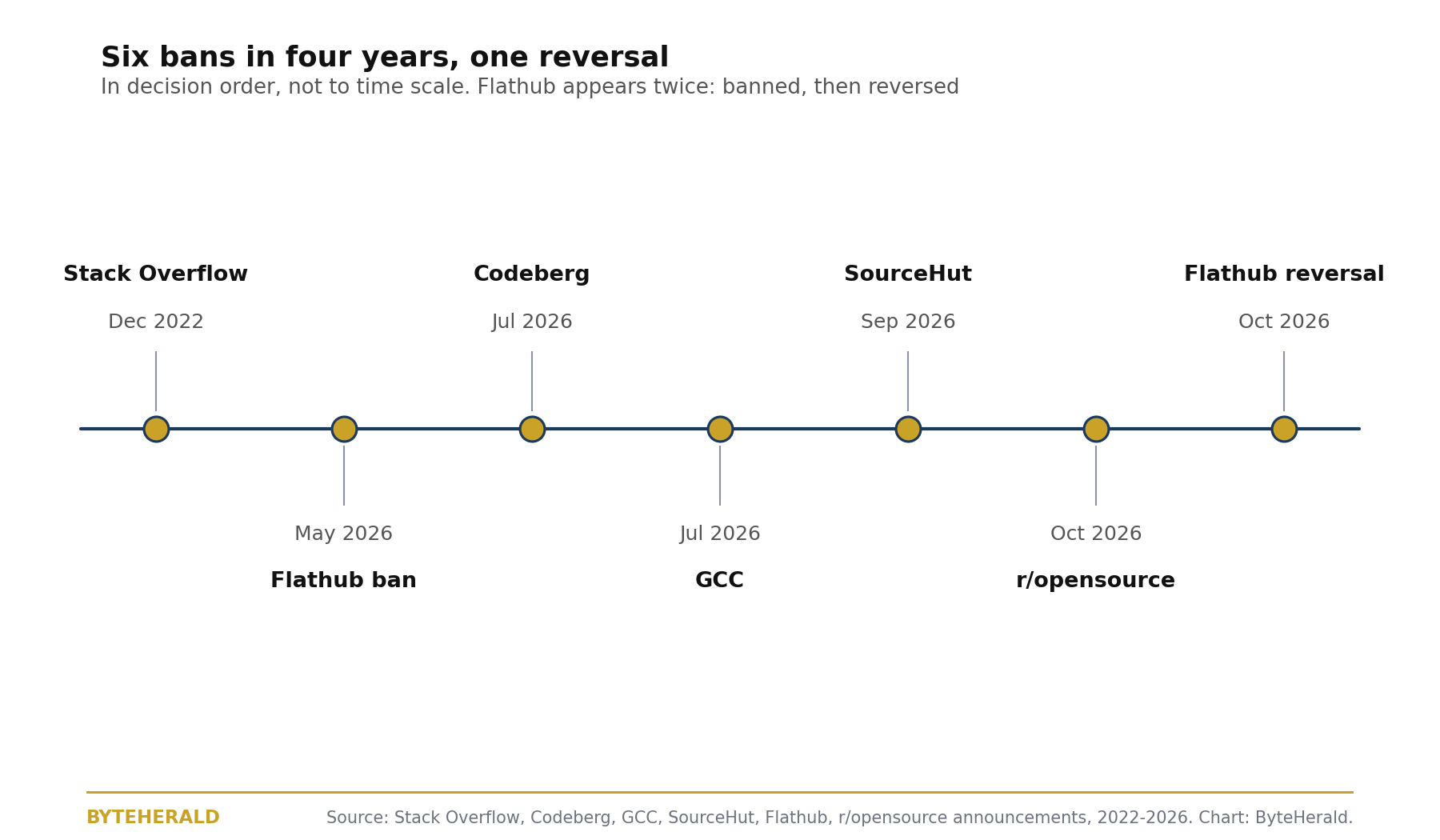
Six communities and platforms decided to ban AI-generated content between December 2022 and October 2026, one of them, Flathub, reversed its ban within five months, and the bans split by reason: accuracy, copyright, cost, and community identity. This is the full database, with what each community banned, what it still allows, and why it acted, so a developer can check the rule for the place they actually contribute to instead of assuming one open-source rule exists.
The database
Every row below was traced to the community's own announcement or to direct reporting of it. The r/programming April 2026 claim that circulated during research was checked and left out, because no primary source for it could be confirmed. A database that includes an unverified row is not a database, it is a rumor with a table around it.
| Community | When | What is banned | Still allowed | Why it acted |
|---|---|---|---|---|
| Stack Overflow | Dec 5, 2022, temporary policy | Answers created by ChatGPT and other generative AI tools | Human-written answers; the ban was framed as temporary pending a fuller policy discussion | Correct-answer rate too low, and plausible-looking wrong answers swamped volunteer curation; sanctions apply even if a post would otherwise be acceptable |
| Codeberg | Member vote closed July 22, 2026, announced July 23, 2026 | Projects that mostly consist of code written by generative AI tools, with Claude and OpenAI Codex named | Light AI assistance in an otherwise human-driven project; a second motion commits Codeberg to never train models on user data | Resource strain from AI-generated projects, copyright ambiguity, and security risk; the vote passed 358 to 144, with 14 abstentions, on about 50% turnout |
| GCC | July 29, 2026 | Legally significant contributions, around 15 lines of code or text, that include or derive from LLM-generated content, even if a human edited or rewrote the output | Legally insignificant edits if disclosed and meeting normal standards; legally significant AI-generated test cases as an exception; using LLMs for research, analysis, bug discovery, and patch review | Protecting the GPLv3 license chain, after the US Copyright Office January 2025 ruling that AI-generated code without meaningful human authorship is not eligible for copyright protection; review planned for early 2027 |
| SourceHut | Announced Aug 27, 2026, effective Sept 10, 2026, for new projects | Original content written with or facilitating LLMs or other generative AI technologies, including source code, assets, tickets, and emails, plus software that contains or enables generative AI features | Mirrors of codebases with more lenient policies, such as the Linux kernel; private LLM use for review or security analysis, discouraged but not prohibited | The announcement frames AI deployment costs, environmental, labor, and social, as outweighing the benefits of vibe coding for its community; violations are evaluated case by case, with exceptions possible |
| Flathub | Banned May 29, 2026, reversed October 2026 | Originally: applications containing AI-generated or AI-assisted code, documentation, manifests, metadata, build scripts, and submission pull requests | After reversal: AI-generated material allowed with disclosure of which parts are affected and roughly how much; manifests still cannot contain AI-generated content; agents cannot open or automate submissions; research and debugging use needs no disclosure | The original ban was among the strictest any major repository had adopted; the reversal replaced a ban with disclosure plus reviewer discretion, and hiding AI use can still mean rejection or a developer ban |
| r/opensource | Oct 24, 2026, moderator post | Projects that use AI, are made by AI, or are intended for AI, with model context protocols given as an example of the last category | Software with incidental AI features, such as automatic captioning, under selective enforcement, according to moderator Wolvereness | The moderators wrote that AI, as it exists today, is incongruent with the open-source community; the same post requires projects to be at least 1 year old, actively maintained, with multiple contributors, and English only |
Three reasons, not one movement
Reading the rows together, the first pattern is that there is no single reason. Stack Overflow banned on accuracy: answers that look right but are wrong, produced in volume, break a volunteer system that must read each one to tell. GCC banned on copyright: if a contribution has no human author to hold the copyright, the license chain that lets free software stay free has nothing to attach to, and the 15-line threshold is where that problem becomes legally significant. Codeberg banned on cost: a donation-funded forge cannot absorb storage and review load from projects that are mostly machine output, and its members said so with a vote, not a press release. SourceHut and r/opensource banned on values: a community deciding what kind of work it exists to host. A developer who treats all six as one anti-AI wave will misread every one of them.
The r/opensource row deserves a fuller telling, because it is the row most likely to be quoted carelessly. ByteHerald covered it in depth in Reddit's Open-Source Forum Banned AI, Solo Devs, Translators, and the database row above is a summary of that reporting, not a replacement for it. The moderator post, titled Your tokens aren't valuable: No more AI, drew immediate backlash, a rival community, r/TrueOpenSource, formed within days, and a fellow moderator publicly disagreed with both the rules and how they were announced. A ban that splits its own moderators is a different fact from a ban its community voted for, and the table keeps that distinction by naming the decision maker in every row: moderators, members, a steering committee, or a platform operator.
The detection problem nobody solved
The second pattern is that none of these communities can reliably detect what they banned. Codeberg bans projects that mostly consist of AI-written code, and mostly is a judgment, not a measurement. SourceHut evaluates violations case by case and leaves room for exceptions, which is honest about the limit and slow by design. GCC chose the sharpest line available, lineage: if a patch traces back to model output, it is out, even if a human rewrote it, and the cost of that sharpness is that honest contributors must now disclose assistance with an Assisted-by tag and accept the audit that follows. r/opensource chose the broadest line and the softest enforcement, selective enforcement with room for nuance, which means two similar projects can meet two different fates depending on which moderator reads them. Every ban in this database is, in practice, a statement of values enforced by trust, because the technology to prove authorship does not exist at the scale these communities operate.
The reversal is the most useful row
Flathub is the row that makes this database worth keeping. In May 2026 it adopted one of the strictest AI policies any major repository had tried, covering not just code but manifests, metadata, build scripts, documentation, and pull request text. In October 2026 it replaced the ban with disclosure: submitters must say which parts use AI-generated material and roughly how much, reviewers decide, and disclosure does not guarantee acceptance. The reversal does not prove bans fail, and it does not prove disclosure works. It proves bans are reversible, and that a community can move from prohibition to transparency without pretending the first decision never happened. The contrast cases point the same way. LLVM adopted a human-in-the-loop policy, disclose the tool, answer questions about the submission, and take full responsibility for the result. The Linux kernel's stance, as reported, is accountability rather than prohibition: AI-generated code is acceptable if the contributor stands behind it. Three models now exist side by side: ban it, disclose it, or own it. Which one a project chooses tells you more about that project than about AI.
What is not a ban
Two nearby stories are often filed with the bans, and filing them there corrupts the database. Reddit's primarily-logged-in test, starting in select markets outside the United States in the fourth quarter of 2026, is an access gate, not a content ban: it changes who can browse without an account after AI search cut referrals, and ByteHerald covered it in Reddit Is Closing Its Open Door After AI Search Cut Traffic. Wikipedia's cleanup project, WikiProject AI Cleanup, running since December 2023, detects and removes AI-generated text rather than banning contributors for using AI tools, and ByteHerald covered it in Wikipedia's Cleanup Ledger: How AI Slop Gets Caught. Gate, cleanup, and ban are three different instruments, and a community that confuses them will write a rule that punishes the wrong behavior.
How to use this database
For a developer, the practical rule is simple: read the policy of the place you are contributing to, on the day you contribute, and do not infer permission from another project. A project that is welcome on a human-in-the-loop forge can be unwelcome on Codeberg, and a contribution GCC declines can be acceptable to the kernel, because the rules differ by design. For a maintainer, the harder lesson is that a ban without an enforcement story is a values statement, not a policy: state what counts, state who decides, and state what disclosure earns. For everyone else, the open questions are dated and checkable. Debian ran a general resolution on LLM usage with a vote August 15 to 28, 2026, and confirming its published outcome against this database is the next check, alongside GCC's policy review in early 2027. This database will be updated when the Debian outcome is confirmed from a primary source and when GCC completes its early 2027 review, rather than replaced by a new post that competes with it.
By ByteHerald Staff. The Register reported on December 5, 2022, that Stack Overflow temporarily banned ChatGPT-generated answers as substantially harmful, because the average rate of correct answers was too low and the volume swamped volunteer curation. Codeberg announced on July 23, 2026, a member vote of 358 in favor, 144 against, and 14 abstentions barring projects mostly consisting of generative-AI-written code and committing to never train models on user data, with storage costs cited as about 700 euros per SSD a few years ago against about 3,700 euros now. LWN reported on July 30, 2026, that the GCC Steering Committee accepted an AI contributions policy declining legally significant LLM-derived contributions of around 15 lines or more, with test-case and trivial-edit exceptions. SourceHut announced on August 27, 2026, terms effective September 10, 2026, prohibiting original content written with or facilitating LLMs, with mirrors of lenient-policy codebases allowed. How-To Geek reported on October 28, 2026, that Flathub banned AI-generated and AI-assisted content on May 29, 2026, and reversed the ban in October 2026 in favor of disclosure plus reviewer discretion. The Verge reported on October 25, 2026, that r/opensource moderators posted rules on October 24, 2026, barring projects that use, are made by, or are intended for AI, with a 1-year, actively maintained, multiple-contributor, and English-only set of conditions. ByteHerald reported on October 26, 2026, the full r/opensource rule set and the formation of the rival r/TrueOpenSource community. ByteHerald reported on October 30, 2026, Reddit's primarily-logged-in test in select markets outside the United States in the fourth quarter of 2026. ByteHerald reported on October 27, 2026, Wikipedia's WikiProject AI Cleanup, running since December 2023, as a detection and cleanup effort rather than a ban.
Comments
Post a Comment