Moderators of Reddit's r/opensource community announced new rules on October 24, 2026 that ban any project that uses artificial intelligence, is made by artificial intelligence, or is intended for artificial intelligence, and that tell people who do not speak English to find another community. In short, the forum has decided that AI work and non-English posts are no longer welcome there, and the written rules reach far beyond AI projects.
The eight rules, as written
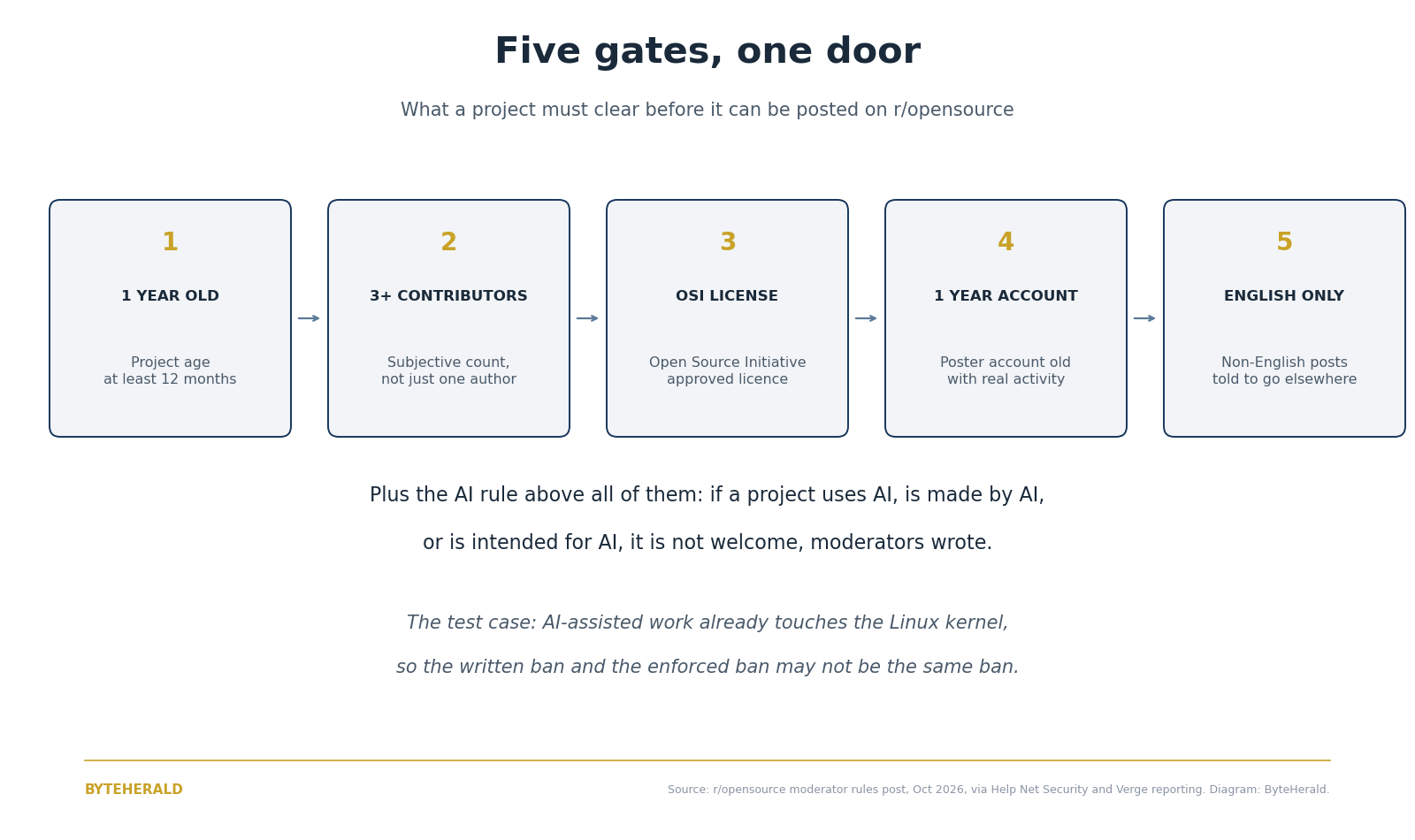
The moderator post, titled "Your Tokens Aren't Valuable: No More AI," sets out the policy in plain language: "If your project uses AI, is made by AI, or is intended for AI, it's not welcome on r/opensource." The same overhaul adds seven further gates for any project submission, and each one is worth reading exactly, because the controversy is about the combination, not only the AI clause.
The diagram below shows the five headline gates; the full table that follows lists all eight rules.
| Rule | What it requires | Who it catches |
|---|---|---|
| AI ban | No project that uses AI, is made by AI, or is intended for AI | AI tools, AI-assisted code, MCP servers named as an example |
| Project age | At least one year old and actively maintained | Every new project, however good |
| Contributors | Multiple contributors, described as subjectively 3 or more | Solo maintainers, however long they have maintained |
| Community | An existing user or contributor community | Projects still looking for their first users |
| License | An Open Source Initiative approved licence | Projects on non-OSI terms |
| Account age | Poster account at least one year old with significant contributions | Newcomers and quiet long-time readers |
| No help requests | No posts asking for maintainers or contributors | Projects trying to grow past one person |
| English only | Non-English speakers told to find another community | Developers posting through a translator |
Two further details sharpen the picture. Registered nonprofits, or their equivalents outside the US, can skip the project and account minimums if they get approval first. And, as reported by Help Net Security, anyone who writes to the moderators asking for an exception after trying to post gets a permanent ban, a rule tied to an estimate of about 20 such messages a day. Student-style projects such as note-taking apps, PDF viewers, and command-line music players are also out. The moderators link the AI ban and the language ban with one explanation: they cannot distinguish between AI-written and AI-translated text, and a poster who does not speak English cannot verify whether a translation is correct.
Who fails the test
The first casualty found in the comment thread was not an AI project at all. A developer wrote that a package they have maintained for nine years, with more than 300 GitHub stars and no AI involvement, no longer qualifies because they are its only contributor. The contributor rule, meant to filter low-effort submissions, filters a nine-year maintainer instead. More than a dozen commenters asked the same question about the Linux kernel: if Linus Torvalds uses AI in kernel work, does the world's most famous open-source project fall under the ban? One report concluded Linux appears likely to remain welcome despite its guidelines allowing AI-assisted development, which suggests the written ban and the enforced ban are already different documents.
The moderators are not united on the rules either. One moderator, ssddanbrown, wrote that they did not agree with the language rule, especially how it was said, and that they learned of the changes from moderation review notifications. The announcing moderator, Wolvereness, answered a question about enforcement directly: there is no objective way to implement the policy, and removals are left to moderator discretion. A rule that cannot be applied objectively, enforced by discretion, in a community built on transparent collaboration, is a contradiction the moderators have now made explicit, and it echoes the grading problem we audited in Who Grades the Graders: when the people grading the work also write the grading rules in private, the results deserve scrutiny no matter how confident the announcement sounds.
What open source means, and why the license gate matters
For readers outside software, the evergreen part is the license gate. Open source does not mean free to copy however you like. It means the code carries a licence approved by the Open Source Initiative, which guarantees rights to use, study, change, and share the software, with conditions that vary by licence. That licence is what lets a stranger trust, adopt, and improve someone else's work, and our comparison of 13 AI licenses, Open Weights, Closed Fine Print, shows how license terms, not forum rules, decide what anyone can actually do with a model. The r/opensource rules keep that gate and add seven more around it, which is why the overhaul reads less like quality control and more like a membership test: age, team size, community, licence, account history, language, and now AI abstinence.
The language clause deserves separate attention because it breaks with open-source history. Open source has always depended on people contributing in a second language, and on translators bridging the gap. Telling those contributors to go elsewhere, on the grounds that moderators cannot tell machine translation from machine writing, treats a detection problem as a membership problem. The sharpest objections in the comment thread came from that clause, and from inside the moderation team, which suggests the language rule may be the first part of the overhaul to be revisited.
What the ban gets right, and what it gets wrong
It is worth stating what the moderators are responding to, because dismissing it entirely would be unfair. Forums that accept project submissions are flooded with low-effort AI-generated projects, and volunteer moderators face a daily stream of exception requests. A community that large cannot review everything, and some gate is reasonable. The AI clause also names a real tension: if a project is generated wholesale by a model, with no human who understands it, the community gains a listing and loses a maintainer.
But the written rules overshoot that target in three ways, and each is our judgment, stated as such, not a moderator statement. First, they punish the wrong people: solo maintainers and translators are the easiest to identify and the least responsible for the flood. Second, they rely on discretion where they claim principle: a ban with selective enforcement for the kernel is not a ban, it is a reputation system. Third, they close the on-ramp they claim to protect: banning maintainer requests and new projects means a solo developer cannot grow into the multi-contributor project the rules demand. A rival community, r/TrueOpenSource, already exists for developers who want an AI-friendly forum, which is how open-source communities have always resolved schisms: by forking. The question is whether r/opensource remains the general forum after a fork, or becomes a club with a famous name.
By ByteHerald Staff. Help Net Security reported on October 26, 2026 that r/opensource barred any project using, made by, or intended for AI, required projects to be at least a year old with subjectively 3 or more contributors, told non-English speakers to find another community, and that a 9-year solo package with more than 300 stars no longer qualifies, more than a dozen commenters asked whether the Linux kernel falls under the ban, moderator ssddanbrown dissented, Wolvereness said there is no objective way to implement the policy, and the permanent-ban rule ties to about 20 messages a day. The Verge reported on October 26, 2026 that Reddit's r/opensource banned AI-made and AI-focused projects and non-English speakers, sparking backlash over Linux kernel contributions and solo developers. Mezha reported on October 26, 2026 that moderators introduced the rules in a post titled Your Tokens Aren't Valuable: No More AI, arguing that AI contradicts open-source values. Martin Cid Magazine reported on October 26, 2026 that MCP servers were named as an example of tools built for AI. TechTimes reported on October 26, 2026 that the restrictions were announced on October 24, 2026, that Linux appears likely to remain welcome, and that a rival community called r/TrueOpenSource was created.
Comments
Post a Comment