On the Cheeky Pint podcast, in an interview reported on October 30, 2026, OpenAI chief executive Sam Altman said it is, from a global allocation view, quite terrible for scarce DRAM to sit in personal computers used about 5% of the time, and that the memory does more good in data centers running near full use. The remark, given to Stripe cofounder John Collison, landed as a provocation because it came from the executive whose company helped create the shortage he was describing.
What Altman actually said
Collison asked about supply chain shortages, including the memory squeeze, and about local inference, the practice of running open-weight AI models on your own hardware instead of renting them from a cloud provider. Altman answered that many people assume capable local models will reduce the need for data centers, and he disagreed. In his words, from a global allocation perspective, it is quite terrible to have everybody have a bunch of the world's limited supply of DRAM sitting in their own computer, and being used 5% of the time. In a supply-constrained market, he argued, you want maximum utilization in the cloud, and he added that most people's intuition runs the other way.
Two qualifications belong with the quote, because both change how it should be read. First, Altman did not say local AI should go away, and he framed the point as a problem of this particular shortage, not as a permanent rule about personal computers. Second, he provided no supporting data for the 5% figure, a gap noted in coverage of the interview. The 5% number is Altman's estimate, and this article treats it as such everywhere it appears. The interview was reported by Polygon on October 30, 2026.
The utilization math, stated honestly
If a PC uses its memory 5% of the time and a busy data center server uses its memory near full use, the gap between them is roughly twentyfold. That arithmetic is ByteHerald's, from Altman's estimate and a full-use ceiling, and it is the strongest part of his case. A 32 gigabyte gaming rig spends most of its life idling, asleep, or switched off, while a server memory module in a busy inference cluster works almost all of the time. Measured only as useful work per unit of memory per hour, the data center wins easily.
But useful work per hour is not the only measure that matters, and it is not the measure anyone uses when buying a computer. The fact that memory sits idle most of the day is the price of having it there the moment you want it, much like a car that stays parked 95% of the time. Nobody buys memory to maximize global efficiency. They buy it so their work is there when they sit down, without asking a provider for permission, without sending their data elsewhere, and without depending on a connection. Altman's allocation argument is correct on its own terms and incomplete on the terms that actually decide a purchase.
Who is holding the memory
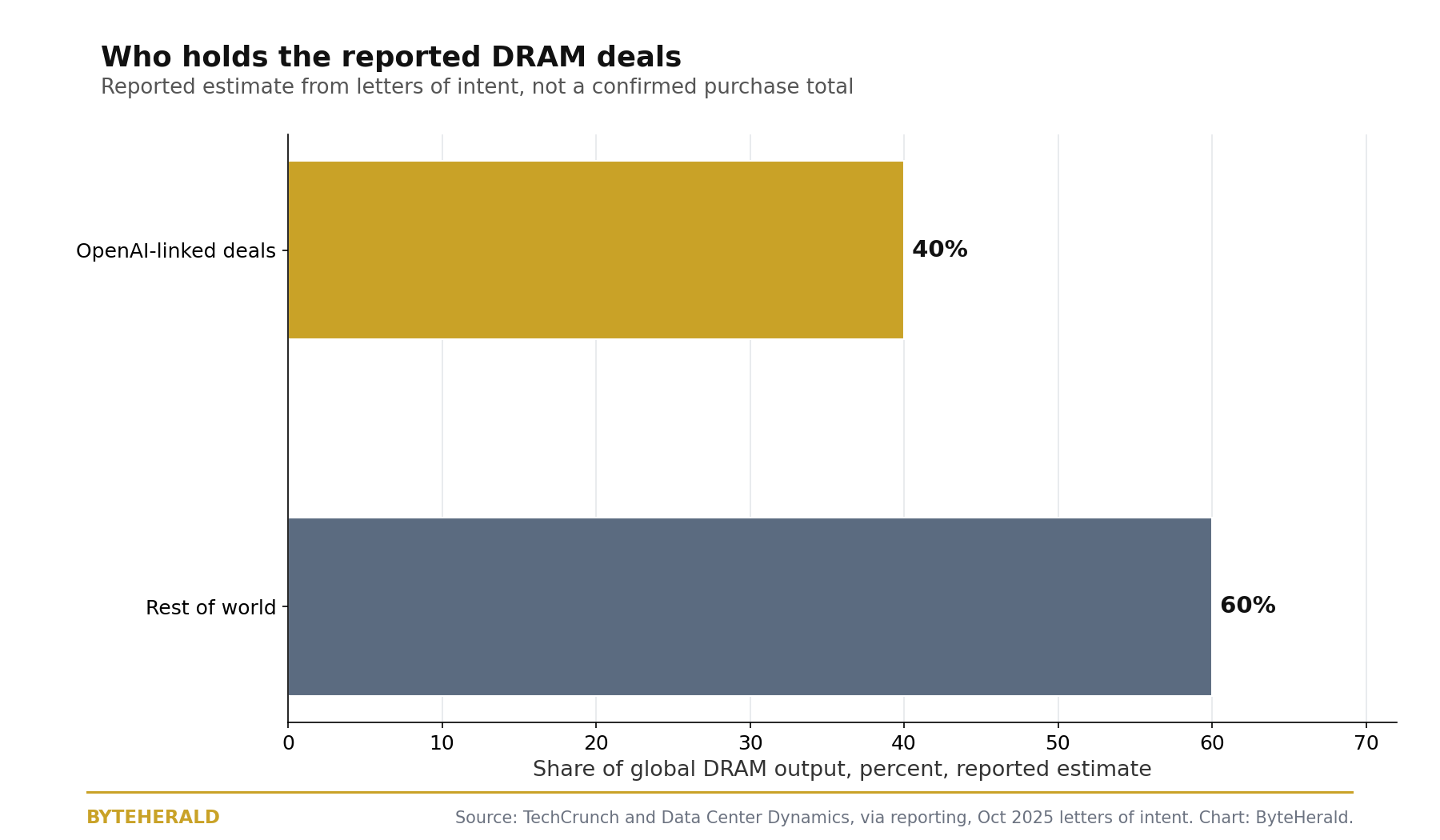
The shortage Altman describes did not arrive on its own. In October 2025, OpenAI signed letters of intent with Samsung and SK hynix covering up to 900,000 DRAM wafers a month for its Stargate data center buildout, a figure estimated at close to 40% of global DRAM output. Those figures come from TechCrunch and Data Center Dynamics reporting, as summarized by Hardware Busters, and OpenAI has not broken the numbers down publicly, so this article treats them as reported estimates, not as confirmed purchase totals.
The same spending pattern sits behind the wider market. ByteHerald added up the five-company capital spending ledger for 2026 in Five Companies, $828 Billion: The 2026 AI Capex Ledger, and memory is where that spending lands hardest, because Samsung, SK hynix, and Micron have shifted capacity toward high-bandwidth and server memory for AI accelerators, leaving less for the PC market. When the largest buyers reserve output years ahead, PC builders pay more for whatever is left, and no single PC owner can outbid a data center program.
What the price signals do and do not show
Three price signals are circulating with this story, and they measure different things, so they should not be merged into one trend. DRAM prices were up 171% year over year by May 2026, according to Park Place Technologies chief technology officer Chris Carreiro, as cited by State of AI. Samsung expects memory shortages to worsen in 2027, with supply constraints continuing into 2028, according to Wccftech's reporting. Manufacturers are reportedly expected to meet only 60% of worldwide demand by the end of 2027, also according to Wccftech, and that figure is labeled reportedly because it rests on unnamed supply expectations rather than a published forecast. SK hynix has said the shortage could last until 2030, according to Hardware Busters. Together they point one way, toward a longer squeeze, but none of them is a single DRAM price index, and this article does not present them as one.
The case for keeping memory local
Local inference has reasons that have nothing to do with global efficiency. Running a model on your own machine keeps your data on your own machine, works without a connection, avoids a recurring bill for every query, and cannot be withdrawn by a provider changing its terms. For a company handling sensitive documents, for a developer working offline, and for anyone who does not want their work routed through a third party, those reasons outweigh a utilization statistic. Altman's argument answers a question about where memory is used most intensively. It does not answer the question about who controls the machine, and for many buyers that second question decides the purchase.
The verdict
Altman is right that, in a shortage, idle memory is wasteful in aggregate, and the twentyfold gap between his 5% estimate and full use is real arithmetic. He is wrong if the remark is read as a general rule, because personal computers are not shared utilities and their owners never agreed to optimize global allocation. And the remark is awkward from its source: the company that signed letters of intent estimated at about 40% of global DRAM output is now arguing that other people's share of the remaining memory is the problem. The shortage is real, the allocation point is fair, and the messenger is part of the cause. All three can be true at once, and a reader who holds only one of them will misunderstand the story.
What happens next will not be decided by this interview. It will be decided by whether memory makers add capacity faster than data center orders absorb it, and by whether PC buyers keep paying higher prices or wait, buy less, or move their work to the cloud by default. If supply stays tight into 2028, as Samsung reportedly expects, Altman's allocation logic will keep gaining ground, not because it convinced anyone, but because the price will have made the decision for them.
By ByteHerald Staff. Polygon reported on October 30, 2026, on Sam Altman's Cheeky Pint interview, quoting his remark that it is quite terrible for the world's limited DRAM supply to sit in personal computers used 5% of the time, and that maximum utilization belongs in the cloud. Hardware Busters reported on October 31, 2026, the same interview and quote, the October 2025 letters of intent with Samsung and SK hynix covering up to 900,000 DRAM wafers a month and estimated at close to 40% of global output, and SK hynix's reported view that the shortage could last until 2030. State of AI reported on October 29, 2026, on the interview's full transcript, Altman's framing of the point as a shortage allocation problem, and DRAM prices up 171% year over year by May 2026 according to Park Place Technologies. Wccftech reported on October 31, 2026, that Altman gave no supporting data for the 5% figure, that Samsung expects shortages to worsen in 2027 with constraints into 2028, and that manufacturers are reportedly expected to meet only 60% of worldwide demand by the end of 2027.
Comments
Post a Comment