Five companies, Amazon, Alphabet, Meta, Microsoft, and SpaceX, spent 556.2 billion dollars on capital expenditure in the first three quarters of 2026, and are on pace to spend between 803 and 828 billion dollars for the full year, according to a Business Insider tally, as republished by DNYUZ, published on October 30, 2026. That range, not any single number, is the honest headline. It covers broad capital spending, not AI spending alone, and it depends on Meta and Alphabet landing at the low or high ends of their full-year ranges. What follows is the ledger behind the range, with every figure attributed and every gap labelled, so a reader can check the arithmetic instead of taking the headline on trust.
The ledger, company by company
The tally counts five companies because those five reported a jump in capital expenditure in their latest earnings reports and disclosed enough about the fourth quarter to imply a full-year total. Amazon was the biggest spender in the third quarter, reporting 75.9 billion dollars in cash capital expenditure, which chief financial officer Brian Olsavsky said was primarily related to AWS and AI. Amazon maintained its forecast of about 220 billion dollars in cash capital expenditure for the year, and chief executive Andy Jassy said Amazon expects to spend meaningfully more in 2027. Microsoft expects calendar-year capital expenditure of about 170 billion dollars, down from its prior outlook because of delays in third-party data-center capacity. Alphabet's full-year range was reported as 195 to 205 billion dollars, and its chief financial officer, Anat Ashkenazi, said the company continues to expect capital expenditure to increase significantly in 2027. Meta narrowed its 2026 capital spending range to 135 to 145 billion dollars, and its chief financial officer, Susan Li, said on October 21 that the company expects to continue investing aggressively while its 2027 budget is still being developed.
| Company | 2026 full-year figure, as reported | What was said about it |
|---|---|---|
| Amazon | About 220 billion dollars in cash capital expenditure | Third quarter cash capital expenditure of 75.9 billion dollars, primarily AWS and AI; 2027 spending meaningfully higher |
| Alphabet | 195 to 205 billion dollars | Capital expenditure to increase significantly in 2027 |
| Microsoft | About 170 billion dollars, calendar year | Down from the prior outlook on third-party data-center capacity delays |
| Meta | 135 to 145 billion dollars | Range narrowed in October; aggressive investment to continue in 2027 |
| SpaceX | Not disclosed as a full-year figure in the tally | 48.1 billion dollars spent so far in 2026, the smallest of the five; spending expected to ramp up next quarter |
SpaceX is the row that proves this ledger is honest rather than complete. The tally reports 48.1 billion dollars spent so far in 2026 for SpaceX, but no full-year guidance figure, so this article does not estimate one. Instead, the arithmetic gap is stated plainly. The four disclosed midpoints, Amazon at 220, Alphabet at 200, Microsoft at 170, and Meta at 140, sum to 730 billion dollars. The Business Insider full-year range of 803 to 828 billion dollars therefore implies 73 to 98 billion dollars from SpaceX's full-year total plus the effect of Alphabet and Meta landing above their midpoints. That derived gap is the part of the total a reader should press on, because it is where a private company's undisclosed spending and two public companies' range ends do the remaining work.
How the year built up, quarter by quarter
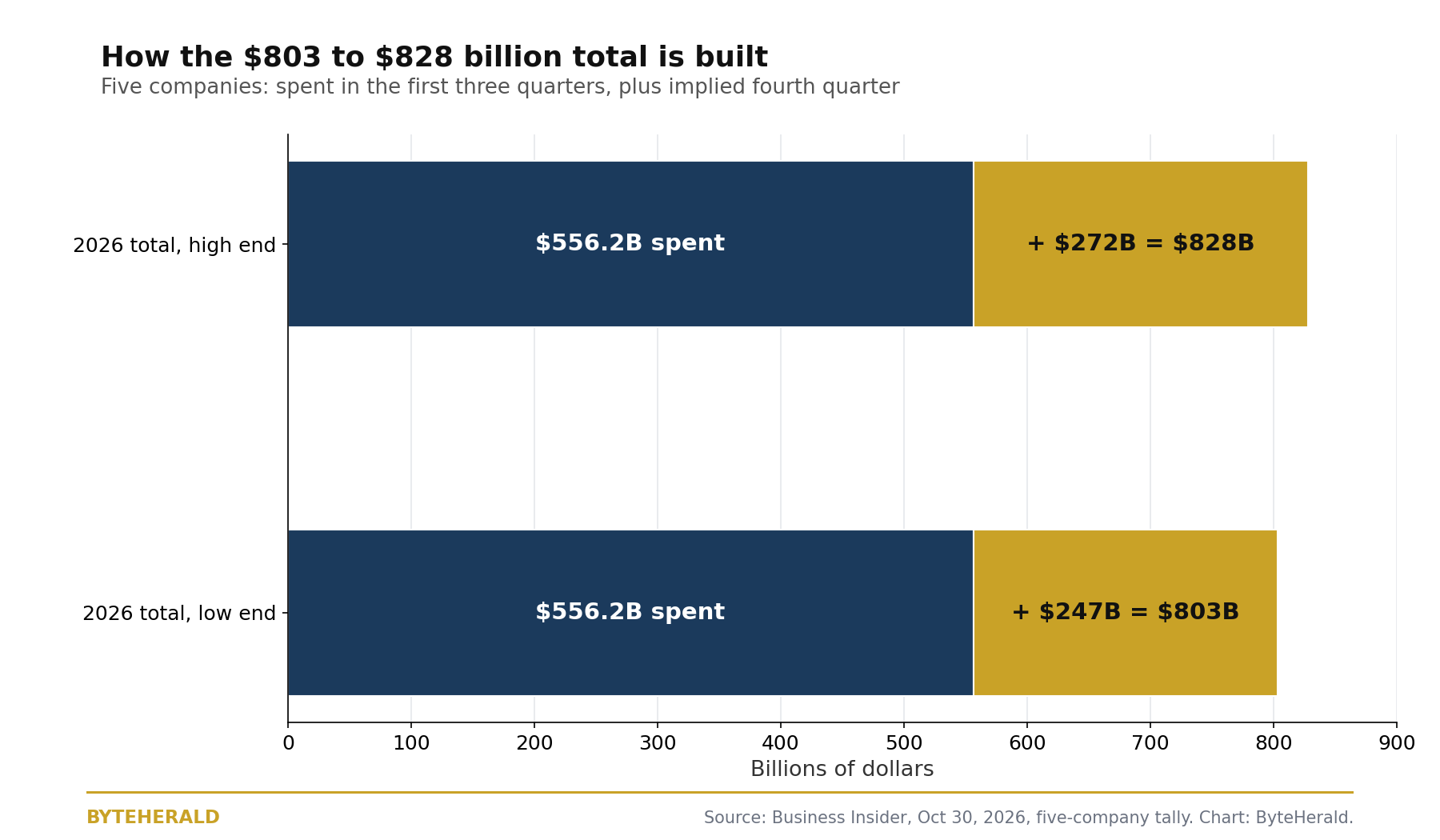
Across all five companies, third quarter spending was about 227 billion dollars, up about 20 percent from 188.5 billion dollars in the previous quarter. Adding the three quarters gives the 556.2 billion dollars spent so far in 2026. The implied fourth quarter, the full-year range minus the amount already spent, is 247 to 272 billion dollars. That implied fourth quarter would be larger than the third quarter, and Business Insider notes that Amazon is the only company whose spending would decline from its third-quarter level in that implied quarter. A reader checking the arithmetic will find it holds: 556.2 plus 247 equals 803.2, and 556.2 plus 272 equals 828.2, which rounds to the published 803 to 828 range.
That fourth quarter implication is also the first place to test the tally against reality when companies report again. If Meta and Alphabet land at the low ends of their ranges, the total lands near 803 billion dollars. If they land at the high ends, it lands near 828 billion dollars. If SpaceX ramps spending as its chief financial officer indicated, the total has a further upward push that the range already tries to accommodate. None of those outcomes would prove the tally wrong in advance, because the tally is a range built from guidance, not a forecast of a single outcome.
What the market did with the same numbers
The spending did not arrive in a calm market. Alphabet fell 12.64 percent on October 29, 2026, wiping about 500 billion dollars off its value, after search growth slowed to 12 percent from 17 percent in the second quarter while capital spending kept rising, as ByteHerald reported that morning. ServiceNow fell 27 percent the same day after guiding current remaining performance obligations below the prior quarter's rate, even though it beat on the quarter itself. Intel, covered in today's companion report, fell more than 20 percent in after-hours trading after guiding the fourth quarter well below expectations, even as its data center business grew 78 percent. The pattern across all three is consistent, and it is not "AI spending is falling." It is that investors are now pricing the spending itself as a risk, not just the revenue it might one day produce.
Readers who want the ServiceNow version of that pattern in full should read our report on ServiceNow's worst day ever, which shows how a beat can still crash a stock when guidance disappoints. Readers who want the industry-wide spending context should read our earlier report on Gartner's AI spending forecast, which puts the hyperscaler bill inside a much larger global total. This ledger is the bridge between those two stories: it shows what the biggest spenders are actually committing, in dollars, before anyone argues about whether the spending is wise.
What this total does not mean
Three cautions belong in the flow of the argument, not in a separate box, because each one changes how the total should be read. First, the tally covers broad capital spending, including buildings, land, power, and networking, not only chips and servers, and the companies themselves point to AI infrastructure as the main driver without breaking out an AI-only figure. Any article that calls 828 billion dollars "AI spending" without that qualifier is overstating what the tally measures. Second, the tally mixes definitions: Amazon's figure is cash capital expenditure, Microsoft's is calendar-year capital expenditure, and the other companies report on their own fiscal calendars, so the total is a compiled range, not an audited sum from a single accounting basis. Third, other tallies give different totals for good reasons: Goldman Sachs has projected hyperscaler capital expenditure between 600 and 820 billion dollars for 2026 on a different company set that includes Oracle and excludes SpaceX, and has discussed spending potentially topping 1 trillion dollars in 2027. A reader who compares those totals without checking the company set will manufacture a disagreement that does not exist.
The financing side sharpens the same caution. AI-related debt issuance for 2026 has been estimated at between 450 and 570 billion dollars, against the broader hyperscaler spending totals, in reporting that summarises Goldman Sachs estimates. That estimate covers a wider set of borrowers, including Oracle and chipmakers, and it is an estimate, not a reported total. It does not prove that the 803 to 828 billion dollar tally is debt-funded, and it does not prove the opposite. What it does show is why the market reaction in the previous section is rational to watch: when spending of this size is funded partly with borrowed money, the question shifts from "can they build it" to "what return, and by when, justifies the borrowing cost." That question has no answer in any earnings release quoted here, and this article does not invent one.
How to reuse this ledger
The citable part of this article is the table plus the derived gap, not the headline number alone. A journalist, analyst, or reader who wants to challenge the total can do so from the table: replace any company's figure with a newer guidance number, recompute the four-company midpoint sum, and see how far the implied SpaceX plus range-end gap moves. A reader who wants to track the story forward should watch three dates: Meta and Alphabet's next guidance updates, which will collapse the 803 to 828 range toward a single number, and Amazon's fourth quarter cash capital expenditure, which the tally expects to fall from its third quarter level even as the total rises. If those three updates move in the directions stated here, the ledger holds. If they do not, the ledger, not the headline, is what should be corrected, and ByteHerald will log that correction publicly.
By ByteHerald Staff. Business Insider published its hyperscaler capital expenditure tally on October 30, 2026, reporting that Amazon, Alphabet, Meta, Microsoft, and SpaceX spent about 227 billion dollars in the third quarter, 556.2 billion dollars in the first three quarters of 2026, and are on pace for 803 to 828 billion dollars for the full year, with Amazon reporting 75.9 billion dollars in third quarter cash capital expenditure, Microsoft expecting about 170 billion dollars in calendar-year capital expenditure, and SpaceX reporting 48.1 billion dollars spent so far in 2026. Alphabet's 195 to 205 billion dollar range and Meta's narrowed 135 to 145 billion dollar range were reported in October 2026 coverage of their earnings calls. Goldman Sachs estimates summarised in October 2026 reporting put hyperscaler capital expenditure between 600 and 820 billion dollars for 2026 on a different company set, and AI-related debt issuance for 2026 at between 450 and 570 billion dollars.
Comments
Post a Comment