ServiceNow reported third-quarter revenue of 4.11 billion dollars, up 20.5 percent, and raised its full-year subscription outlook, yet shares closed down 27 percent on October 29, 2026, their worst day on record, because guidance showed current remaining performance obligation growth slowing to 18.5 percent in the fourth quarter. The quarter was not a collapse. The forecast was the verdict.
What ServiceNow actually reported
ServiceNow announced third-quarter 2026 results on October 28, 2026, after the market close, and shares traded on them on October 29, 2026. The headline numbers look like a company still growing fast. Revenue reached 4.106 billion dollars, up 20.5 percent from a year earlier, just above the 4.10 billion dollars analysts polled by LSEG had expected. Subscription revenue, the line that matters most for a software company, reached 3,988 million dollars, up 21 percent. Remaining performance obligations, the contracted revenue still to be recognized, rose 22 percent to 29.7 billion dollars. The miss was narrow: adjusted earnings of 1.00 dollar per share against an expected 1.02 dollars, ending a run of six consecutive quarterly earnings beats.
| Measure, third quarter 2026 | Reported | Expected or prior |
|---|---|---|
| Revenue | 4.106 billion dollars, up 20.5 percent | 4.10 billion dollars expected (LSEG) |
| Adjusted earnings per share | 1.00 dollar | 1.02 dollars expected (LSEG) |
| Subscription revenue | 3,988 million dollars, up 21 percent | Prior-year growth in the same range |
| Remaining performance obligations | 29.7 billion dollars, up 22 percent | Contracted backlog, not yet recognized |
| Net new AI annual contract value | Up 65 percent | AI contract target raised to 1.7 billion dollars |
| Full-year subscription outlook | 15.78 to 15.79 billion dollars | Raised slightly from the prior outlook |
| Fourth-quarter subscription guide | 4.245 to 4.255 billion dollars | Below some market expectations |
Two details in the release explain why a two-cent miss carried so much weight. First, GAAP operating margin fell to 9.5 percent from 17 percent a year earlier, with lower interest income and added debt costs tied to the Armis acquisition cited in coverage of the results. Chairman and CEO Bill McDermott blamed the shortfall on interest expense tied to acquisitions closed in April, not on softening in the underlying business, and pointed to operating margin widening on an adjusted basis. Second, the company raised its full-year subscription outlook only slightly, to between 15.78 and 15.79 billion dollars, which read as caution rather than confidence on a day when investors wanted proof that AI spending converts into faster growth.
The number that crashed the stock
The decisive figure was not in the quarter just reported. It was in the quarter ahead. ServiceNow guided fourth-quarter growth in current remaining performance obligations, the contracted revenue expected over the next 12 months, to 18.5 percent, down from 20.5 percent growth in the third quarter and below a consensus of about 20 percent. Morgan Stanley analyst Adam Wood said the deceleration suggests AI adoption is not yet translating into better growth for the overall business, even though management cited strong AI momentum, including the raised 1.7 billion dollar annual contract value target. Raymond James analysts wrote that both subscription revenue and current remaining performance obligations came in below where they believed buy-side expectations sat, with the beat decelerating sequentially on both measures.
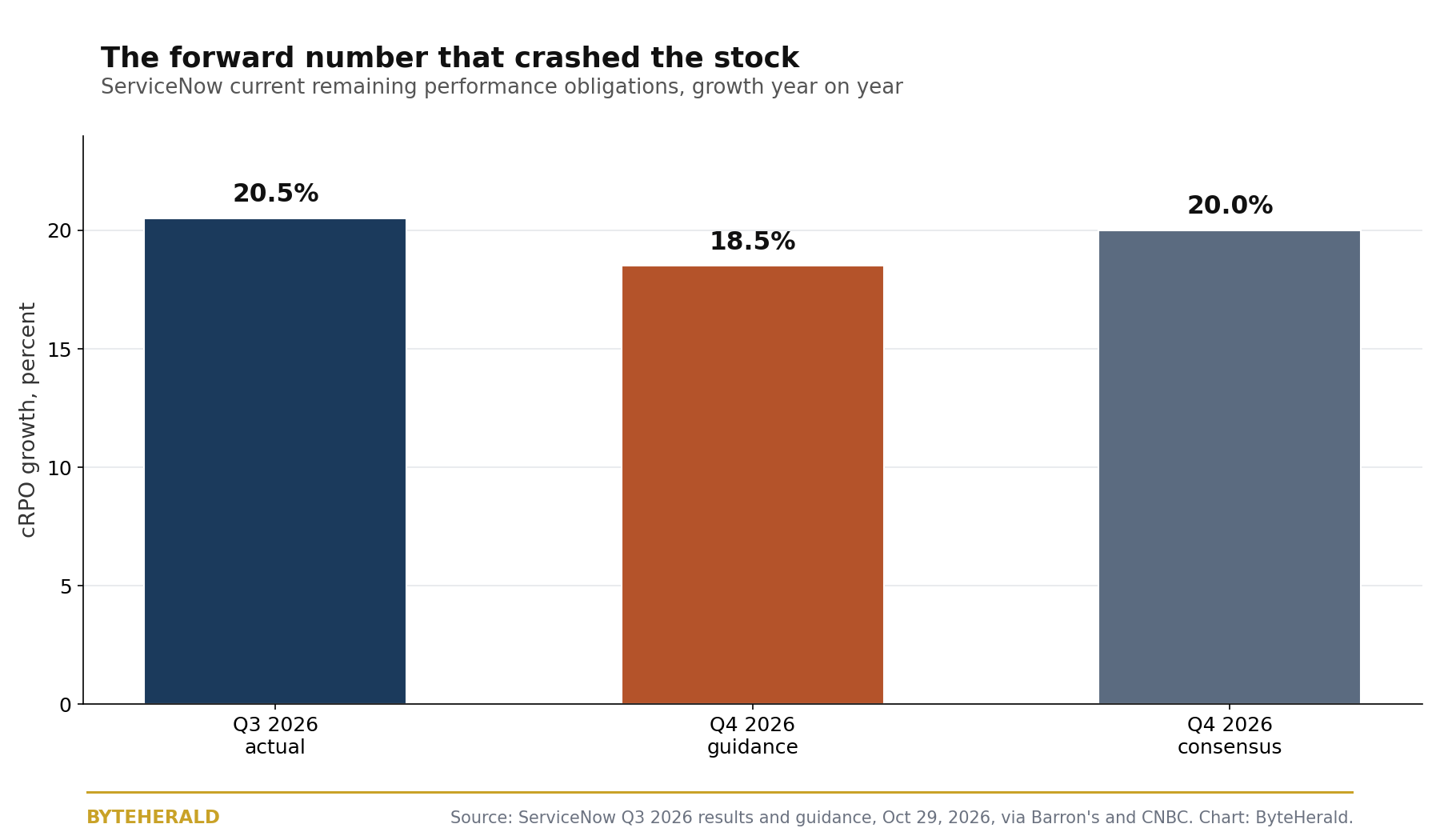
That distinction is the whole story. Current remaining performance obligations are a forward look, while revenue is a backward look. A company can beat the quarter it just closed and still lose a quarter of its value if the forward look bends down, because the stock price already assumes the bend goes the other way. ServiceNow closed down 27 percent at 109.67 dollars, its largest percentage decline on record according to Dow Jones Market Data, after trading as low as 108.68 dollars during the session, down 27.6 percent intraday. It was the worst performer in the S&P 500 on Thursday. Reports during the session put the drop at 25 to 27 percent as trading continued; the closing figure of 27 percent is the definitive one, and this article uses it.
AI momentum, meet the total business
ServiceNow's AI numbers, on their own, are strong. Net new AI annual contract value jumped 65 percent, and the company lifted its full-year AI annual contract value target to 1.7 billion dollars, up from 1.5 billion dollars in May. McDermott said AI token consumption jumped 13-fold year over year, and described the company as a capital-light model that can scale AI services without the chip and data-center spending burdening other AI players. He also cited a Rule of 57, combining 21 percent subscription growth with a 36 percent free cash flow margin, a figure he said he expects to eventually reach 60. Those are management claims, not audited results, and they sit next to the number investors actually traded on: total-business growth decelerating while AI momentum accelerates.
The gap between those two readings is the question facing every enterprise software company this earnings season. AI contract value measures new business tied to AI products. Current remaining performance obligations measure the whole contracted book. When the first grows 65 percent and the second decelerates, the market reads it as AI revenue that is real but not yet large enough, or not yet priced high enough, to lift the total. Citi analyst Tyler Radke called the limited upside uncharacteristic for ServiceNow, and said investors wanted earlier evidence of returns from a new forward-deployed engineering team that works inside enterprise customers on AI solutions. That impatience, rather than any single product failure, is what the 27 percent drop prices in.
The OpenAI deal says the opposite
ServiceNow did not spend the day denying the disruption thesis. It answered it with a partnership. The company expanded its agreement with OpenAI, adding a ChatGPT plugin that lets configured ServiceNow actions run through ChatGPT under organizational rules and permissions, a Codex integration inside its AI Workflow Factory, and voice-driven governance capabilities. OpenAI also joined ServiceNow's Control Tower Alliance, whose founding members include Anthropic, AWS, Cisco, NVIDIA, and OpenAI. The company separately cited a five-year deal with Hewlett Packard Enterprise and a tie-up with NVIDIA under which ServiceNow sets governance rules and NVIDIA OpenShell enforces them.
Read that deal two ways, because the market did. One reading: the company whose product AI was supposed to replace is now the governance layer that decides what an agent is allowed to do inside a business, which is a defensible position. The other reading: ServiceNow is binding itself more tightly to the very technology investors regard as a threat to software subscriptions, and paying for that position with a forward-deployed team whose returns have not shown up in the contracted book yet. The partnership answers the question of whether ServiceNow has an AI strategy. It does not answer the question the stock traded on, which is when that strategy shows up in total growth. For that distinction, the agent identity question matters: who verifies an agent, what credential it carries, and who is liable when it acts, as explained in our comparison of the emerging agent identity stack, because a governance layer is only valuable if its permissions are enforceable.
What the next software quarter has to prove
Three rules carry over from this report to the next software quarter. First, compare the forward measure, not just the reported one: current remaining performance obligations guide the next 12 months of contracted revenue, and a deceleration there outweighs a beat in the quarter just closed. Second, separate AI contract value from total growth: a 65 percent jump in a new line does not prove the total book is accelerating, and the size of the AI line relative to the total is the number to ask for. Third, treat management's preferred combination with care: a Rule of 57 adds a growth rate to a margin, which is a useful shorthand, but it is not a substitute for the two numbers separately, and a target of 60 is an aspiration, not a result. ServiceNow's quarter passed the backward test and failed the forward test. Until the forward test turns, the disruption discount stays.
The wider market read the same signal. Salesforce fell 6 percent and Workday fell 5 percent on Thursday, in a session where Alphabet's own earnings disappointment had already put technology stocks under pressure. ServiceNow's drop was the largest of the group, and the only one that set a company record. That record is the durable fact from October 29: a software leader can grow revenue more than 20 percent, raise its outlook, raise its AI target, announce an expanded OpenAI deal, and still lose more than a quarter of its value in a day, because the market no longer pays for AI momentum alone. It pays for momentum that shows up in the contracted book.
By ByteHerald Staff. ServiceNow's third-quarter 2026 results, announced October 28, 2026, gave revenue of 4.106 billion dollars up 20.5 percent, subscription revenue of 3,988 million dollars up 21 percent, current remaining performance obligations of 13.65 billion dollars up 20.5 percent, a full-year subscription outlook raised slightly to 15.78 to 15.79 billion dollars, net new AI annual contract value up 65 percent, and an AI annual contract value target of 1.7 billion dollars. CNBC reporting of the results, published October 29, 2026, gave adjusted earnings of 1.00 dollar against a 1.02 dollar LSEG expectation, noted that the miss ended a run of six consecutive quarterly earnings beats, and carried Citi analyst Tyler Radke's assessment that the limited upside was uncharacteristic for ServiceNow and that investors wanted earlier evidence of returns from its forward-deployed engineering team. ServiceNow's expanded OpenAI partnership announcement, published October 28, 2026, gave the ChatGPT plugin for configured ServiceNow actions, the Codex integration inside the AI Workflow Factory, and OpenAI's membership in the Control Tower Alliance alongside Anthropic, AWS, Cisco, and NVIDIA. Coverage of McDermott's remarks, published October 29, 2026, gave the five-year Hewlett Packard Enterprise deal and the NVIDIA OpenShell governance arrangement. Barron's coverage with Dow Jones Market Data, published October 29, 2026, gave the closing fall of 27 percent to 109.67 dollars as the largest percentage decline on record, the intraday low of 108.68 dollars down 27.6 percent, fourth-quarter current remaining performance obligation growth guided to 18.5 percent against 20.5 percent in the third quarter, and Morgan Stanley analyst Adam Wood's assessment that AI adoption is not yet translating into better overall growth. 24/7 Wall St. coverage, published October 29, 2026, gave Salesforce down 6 percent and Workday down 5 percent on the same day.
Comments
Post a Comment