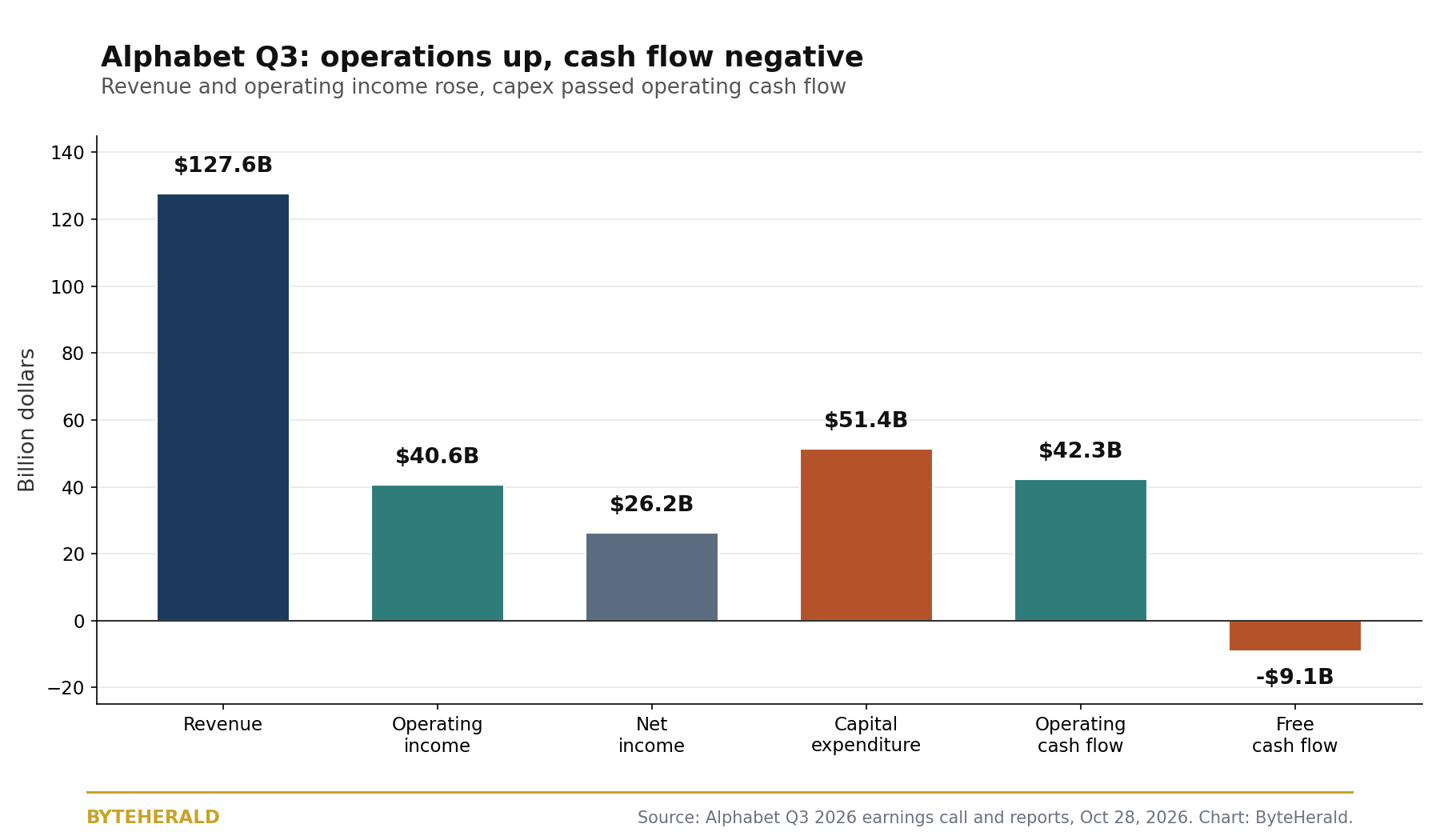
Alphabet reported third-quarter 2026 revenue of $127.6 billion on October 28, 2026, up 25 percent from a year earlier, and still missed Wall Street on both revenue and earnings while shares fell about 8 percent in after-hours trading. The direct answer is that the miss was not an operating failure: operating income rose 30 percent to $40.6 billion, while a paper loss on equity securities cut diluted earnings per share by $0.55 and capital spending of $51.4 billion pushed quarterly free cash flow to negative $9.07 billion.
The bridge from $40.6 billion to $26.2 billion
Start with the operating business, because that is where the quarter is strong. Google Cloud revenue climbed 103 percent to $30.7 billion, with Cloud operating income more than tripling to $11.1 billion, and Google Search and other revenue rose 12 percent to $63.35 billion. Google Services overall reached $96.3 billion, up 11 percent. Chief executive Sundar Pichai said Search query growth, including commercial queries, is running at its highest year-over-year rate in five years, that the Gemini app passed 1 billion users, and that first-party model APIs now process nearly 32 billion tokens per minute, up 40 percent on last quarter and more than four times a year earlier. The same earnings call that carried those figures also carried the Gemini 4 Carbon announcement, which ByteHerald covered the same day as an index-leading model almost nobody can yet use, so the product story and the earnings story arrived together.
Gemini 4 Carbon Leads the Index, but You Cannot Use It explains why that timing matters: the model news supports the frontier narrative Pichai sold on the call, while the gated rollout limits how much of it any customer can actually buy today.
Then the bridge breaks. Other income and expenses came in at negative $8.2 billion, which chief financial officer Anat Ashkenazi attributed on the call primarily to an unrealized loss from the investment in SpaceX after its stock price fell in the quarter. A filing read published the same day puts the equity-securities loss at $8.7 billion, against a $10.7 billion gain in the same quarter of 2025, and says the loss reduced net income by $6.7 billion and diluted earnings per share by $0.55. The release itself does not name the investee; the SpaceX attribution comes from the CFO's remarks. Net income landed at $26.2 billion, down from $34.9 billion a year earlier, and earnings per share at $2.12, down from $2.87 a year earlier and $0.90 below the $3.02 estimate. The $0.55 paper-loss piece explains more than half of that $0.90 gap, which is why calling this an earnings collapse misreads the quarter: the operations earned more, the portfolio marked down.
The miss was small on revenue, large on spending
Revenue missed the LSEG consensus of $128.22 billion by $0.64 billion, about 0.5 percent. That is a rounding-level miss on the top line, and it sits next to a spending number that is not rounding at all. Capital expenditure reached $51.4 billion in the quarter, up 114 percent from a year earlier, against operating cash flow of $42.3 billion. Subtract one from the other and free cash flow is negative $9.1 billion, matching the reported negative $9.07 billion within rounding, against an analyst expectation of a $36 million outflow. Full-year 2026 infrastructure spending is now guided at $195 billion to $205 billion. The market reaction follows from that gap, not from Search: investors were asked to fund a buildout larger than the quarter's operating cash flow, in the same week the company reported its fastest Search query growth in five years.
This is the same payoff question ByteHerald has tracked through the infrastructure cycle. The Gartner warning that trillions of AI spending may never pay off frames the risk from the demand side, and Alphabet's quarter is the first hard test of that frame from the supplier side: Cloud growing 103 percent is demand, but $51.4 billion in one quarter is the price of serving it. Readers who want the demand-side case should read that analysis next, because it sets the hurdle Alphabet's Cloud growth has to clear, quarter after quarter, for the spending to make sense.
Gartner: $3.5 Trillion of AI Spending May Never Pay Off lays out the revenue gap arithmetic behind the warning, and Alphabet's $195 billion to $205 billion full-year guide is the number to hold against it.
Who is paying for the buildout
A filing analysis of the first nine months of 2026 adds a financing layer the quarterly headlines skip. It reports $132.0 billion of capital spending against $147.2 billion raised from outside investors over the same period, through $42.9 billion of common stock, $19.1 billion of mandatory convertible preferred, and $85.2 billion of new debt, with long-term debt rising from $46.5 billion to $125.1 billion from the start of the year to September 30, and buybacks at $0 against $39.8 billion in the same period of 2025. Those figures are Tensorust's calculation from the filing, not Alphabet's own presentation, and they should be read as such. The direction, though, is corroborated by the quarter itself: negative free cash flow for a second consecutive quarter, after negative $5.9 billion in the second quarter, means the buildout is being carried by balance-sheet expansion while operations catch up.
Meta's financing plan, announced two days earlier, shows the same pressure from a different angle. Meta moved to raise up to $95 billion, including forward share sales and convertible preferred stock, because its own cash was not enough for its buildout. Alphabet has not announced an equivalent single plan, but the nine-month financing totals above describe the same reality: the AI race is now funded substantially by investors and lenders, not by quarterly operating cash alone. That is the sentence to carry into the next earnings cycle, because it reframes every future beat or miss: the question is no longer whether these companies can grow, but how long capital markets keep funding growth that outruns cash flow.
Meta Needs 95 Billion More. Even Its Own Cash Was Not Enough details the other side of that financing shift, with the instrument-by-instrument breakdown of Meta's plan and what it signals about the whole sector's funding model.
What to watch next
Three numbers decide whether this quarter reads, in hindsight, as a buying opportunity or as the start of a funding squeeze. First, Cloud growth: 103 percent cannot repeat forever, and the rate at which it decelerates sets the revenue base for the $195 billion to $205 billion guide. Second, the equity portfolio: a single investee's mark moved EPS by $0.55 this quarter, so the next quarter's EPS comparison carries the same volatility whether operations improve or not. Third, the cash gap: operating cash flow of $42.3 billion against $51.4 billion of capex is a $9.1 billion quarterly hole, and two consecutive negative free-cash-flow quarters mean the hole is now a pattern, not an event. None of these is a prediction about the share price, and none should be read as one. They are the three series to check before the next call, because they are the three series that moved this one.
By ByteHerald Staff. Google blog, published October 28, 2026, carried chief executive Sundar Pichai's Q3 remarks with revenue up 25 percent, a half-trillion-dollar annual run rate, Cloud revenue up 103 percent, Search query growth at a five-year high, Gemini app at 1 billion users, and first-party model APIs near 32 billion tokens per minute. MarketBeat, published October 28, 2026, transcribed the earnings call with consolidated revenue of $127.6 billion, operating income of $40.6 billion at a 31.8 percent margin, other income and expenses of negative $8.2 billion attributed by the CFO primarily to an unrealized SpaceX loss, and operating cash flow of $42.3 billion. ChosunBiz, published October 29, 2026, reported revenue of $127.577 billion against a $128.22 billion LSEG consensus, EPS of $2.12 against a $3.02 estimate, Cloud revenue of $30.709 billion, and Search revenue of $63.35 billion. TalkMarkets, published October 28, 2026, reported an 8 percent after-hours share fall, net income of $26.2 billion, capital expenditure of $51.4 billion up 114 percent, free cash flow of negative $9.07 billion, and a $195 billion to $205 billion full-year spending guide. FourWeekMBA, published October 28, 2026, reported the $8.7 billion equity-securities loss, the $6.7 billion net income effect, and the $0.55 EPS effect from the filing. Tensorust, published October 28, 2026, calculated nine-month capital spending of $132.0 billion against $147.2 billion raised from outside investors, with long-term debt rising from $46.5 billion to $125.1 billion.
Comments
Post a Comment