Meta Platforms said on October 26, 2026 that it plans to raise up to 95 billion dollars in new stock to pay for its artificial intelligence build-out. The plan has three pieces: about 35 billion dollars in offerings launched now, and a separate share sale program of up to 60 billion dollars that cannot start until early 2027. The quotable answer is simple: even a company that generated 97 billion dollars in operating cash in the first nine months of 2026 says it needs outside equity to keep building AI data centers.
The three pieces, and which one is real
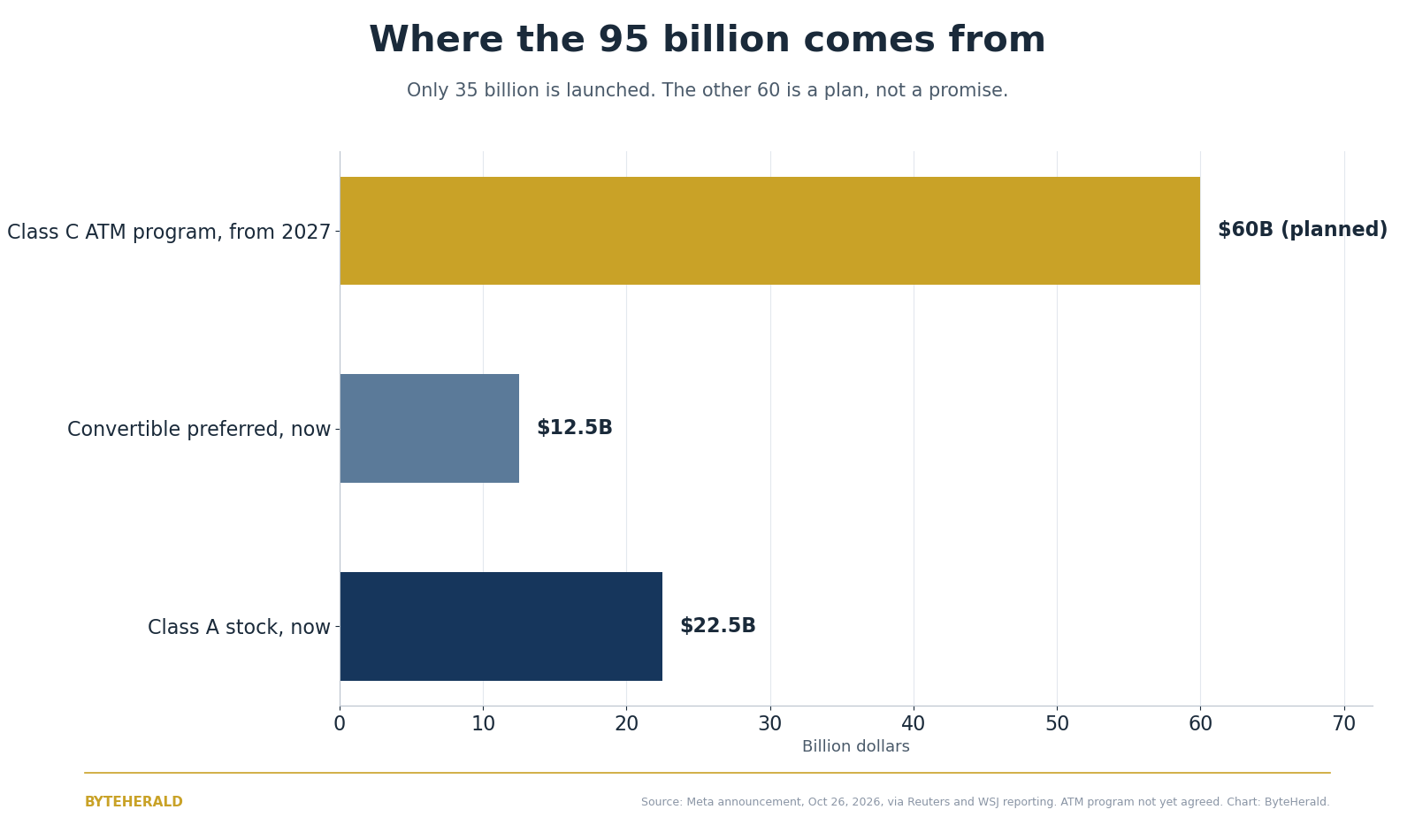
The launched part is 35 billion dollars, split into two offerings. The first is about 22.5 billion dollars of Class A common stock, sold through forward sale agreements with Morgan Stanley and Goldman Sachs. Meta does not receive that cash at once; it is paid when the agreements settle, on one or more dates on or before November 19, 2027. The second is about 12.5 billion dollars of mandatory convertible preferred stock, sold as 250 million depositary shares that Meta plans to list on Nasdaq under the symbol METAM. Those shares convert into common stock automatically around August 15, 2029, with the dividend rate and conversion terms to be set at pricing.
The third piece is the largest and the least certain. Meta plans an at-the-market program of approximately 60 billion dollars, under which it would sell new non-voting Class C shares gradually on the open market. That program is not expected to start until the first quarter of 2027, after the new Class C shares begin trading, and Meta says it has not signed any agreement for it yet. The company states plainly that there is no assurance the program will happen on the announced terms, or at all. Treat the 95 billion figure accordingly: 35 billion launched, 60 billion planned.
| Piece | Amount | Status | What it is |
|---|---|---|---|
| Class A common stock | About 22.5 billion dollars | Launched, forward sale | Cash on settlement, by November 19, 2027 |
| Mandatory convertible preferred | About 12.5 billion dollars | Launched | Converts to common stock around August 15, 2029 |
| Class C at-the-market program | Up to 60 billion dollars | Planned, not agreed | Gradual open-market sales from early 2027 |
| Chipmaker indications | Up to 5 billion dollars | Non-binding | Nvidia, AMD, and Broadcom interest, not commitments |
The Class C twist: new money, no votes
The governance detail is the part most coverage will skip, and it matters. Most of the new money is planned to come from Class C shares, which carry no votes. Class A shares carry one vote each, and Class B shares, held mostly by chief executive Mark Zuckerberg, carry ten votes each. Shareholders will receive one Class C share for every Class A or Class B share they own, with the charter change taking effect on January 19, 2027, and the payout date not yet set.
The design lets Meta sell tens of billions of dollars of stock without diluting Zuckerberg's voting control. Ordinary shareholders still pay a price: the prospectus warns that the new shares will have a dilutive effect on earnings per share and return on equity. Control is preserved; the claim on each dollar of earnings is not. That distinction is the whole story of the Class C structure, and it is why the raise should be read as a governance event as well as a financing event.
Why Meta needs the money at all
Meta raised the lower end of its 2026 capital spending forecast to between 135 billion and 145 billion dollars, from 130 billion to 145 billion dollars previously. It operates data centers across 23 US states and is building four superclusters, each with more than one gigawatt of capacity, and it expects to nearly double its total infrastructure capacity in 2026 compared with the previous year. The company has committed to spend about 825 billion dollars in the future, primarily on data centers, AI infrastructure, and cloud computing power.
Against that scale, the cash position looks less comfortable than the headline suggests. Meta held about 82.45 billion dollars in cash, cash equivalents, and marketable securities at September 30, 2026, slightly above its long-term debt of 80.92 billion dollars. It reported third-quarter revenue of 64.60 billion dollars, ahead of Wall Street estimates of 63.37 billion dollars, and projected fourth-quarter revenue between 73 billion and 76 billion dollars. But it also reported a 2.12 billion dollar cash burn in the third quarter, its first negative free cash flow in more than ten years, compared with positive cash flow of 10.63 billion dollars a year earlier. A company can be profitable, cash generative over nine months, and still short of the cash its building program demands in a single quarter. Meta is that company right now.
What this does not prove
Three readings of this raise are wrong, and each is worth naming. First, the raise does not prove Meta is in trouble. Companies with record quarterly revenue and investment-grade access to debt markets raise equity to fund growth, not only to survive. Second, the raise does not prove the AI build-out is a bubble about to pop. A financing plan is evidence that building costs more than current cash flow, not evidence that the assets being built are worthless. Third, the chipmaker interest does not prove Nvidia, AMD, and Broadcom are rescuing Meta. Their indications, up to 5 billion dollars combined, are non-binding, and all three sell Meta the chips the money will buy. A supplier buying its customer's stock is a relationship signal, not a bailout.
What the raise does prove is narrower and more useful: the AI build-out has outgrown even Big Tech's cash flow. When one of the richest companies in tech turns to shareholders as well as bond markets, the constraint on AI expansion is capital formation, not engineering ambition. That reading is ours: the numbers show the gap between spending and cash; what the gap means is interpretation, not a filing fact.
The evergreen question: how to read a tech stock sale
Every large tech financing can be read with the same four questions, and they work long after this week's headlines fade. First, how much is launched versus planned? Announced totals routinely exceed launched totals, and the gap is where disappointment lives. Second, who gets votes? Non-voting stock protects founders and dilutes everyone else's say, not just their earnings. Third, when does the cash actually arrive? Forward sales and at-the-market programs drip cash over quarters, while data center bills arrive monthly. Fourth, who else is buying, and why? Non-binding indications from suppliers are marketing as much as finance. Meta's plan answers all four questions in public filings, which is why it is a better teaching case than most: the structure is disclosed, the uncertainty is disclosed, and the reader can grade both.
The open question is whether shareholders will keep funding a build-out whose payoff date keeps moving. The larger test comes in early 2027, when the Class C program is supposed to begin. If it launches at scale, the market has accepted the deal. If it stalls, the 95 billion figure will be remembered as an announcement, not a raise. We covered the same justification problem from the buyer's side in our survey of the enterprise AI pullback, where CIO budgets, not stock sales, were the constraint. The two stories rhyme: in both, the money for AI is getting harder to justify, and the justification now has to be made in public, in numbers.
By ByteHerald Staff. Reuters reported on October 26, 2026 that Meta plans to raise up to 95 billion dollars in equity, with about 35 billion dollars in offerings launched now and up to 60 billion dollars in a separate program from early 2027, and that Nvidia, AMD, and Broadcom indicated interest in up to 5 billion dollars. The Wall Street Journal reported on October 26, 2026 that Meta's plan comprises 22.5 billion dollars of Class A stock and 12.5 billion dollars of convertible preferred stock, and that total AI infrastructure investment is projected at 10.3 trillion dollars from 2025 to 2032. Skimwire reported on October 26, 2026 that the Class A sale uses forward agreements settling by November 19, 2027, and that the preferred shares convert around August 15, 2029 under the symbol METAM. Analytics India Magazine reported on October 26, 2026 that Meta operates data centers across 23 US states, is building four superclusters of more than one gigawatt each, and expects to nearly double infrastructure capacity in 2026. A Meta prospectus summary reported on October 26, 2026 set the Class C charter change for January 19, 2027 and warned the new shares will dilute earnings per share and return on equity. Reuters reported on October 26, 2026 that Meta committed to spend about 825 billion dollars in the future, reported third-quarter revenue of 64.60 billion dollars against estimates of 63.37 billion dollars, projected fourth-quarter revenue between 73 billion and 76 billion dollars, expects capital expenditure between 135 billion and 145 billion dollars in 2026, and reported a 2.12 billion dollar third-quarter cash burn, its first negative free cash flow in over ten years. Analytics India Magazine reported on October 26, 2026 that Meta generated 97 billion dollars in operating cash flow in the first nine months of 2026. Meta's third-quarter 2026 filing, as reported by Reuters, showed 82.45 billion dollars in cash and securities against 80.92 billion dollars in long-term debt, and a 2.12 billion dollar third-quarter cash burn.
Comments
Post a Comment