America has lost more than 200,000 jobs in creative industries over the past four years, with roughly 50,000 of those disappearing in the last year alone. The losses cluster in digital creative work that AI can imitate, while in-person creative work keeps growing, which makes AI a serious suspect and not yet a proven verdict.
The figures come from Apricitas Economics, where economist Joseph Politano analyzed US Bureau of Labor Statistics data and called the stretch one of the worst for media employment in modern US history. The last comparable declines came during the recessions of 2001 and 2008. This time there is no generalized recession. Instead the job losses coincide with the rise of AI systems that can compose novels, photorealistic images, soundalike music, and practically every other form of digital art, in bulk and at very low cost.
Where the losses sit
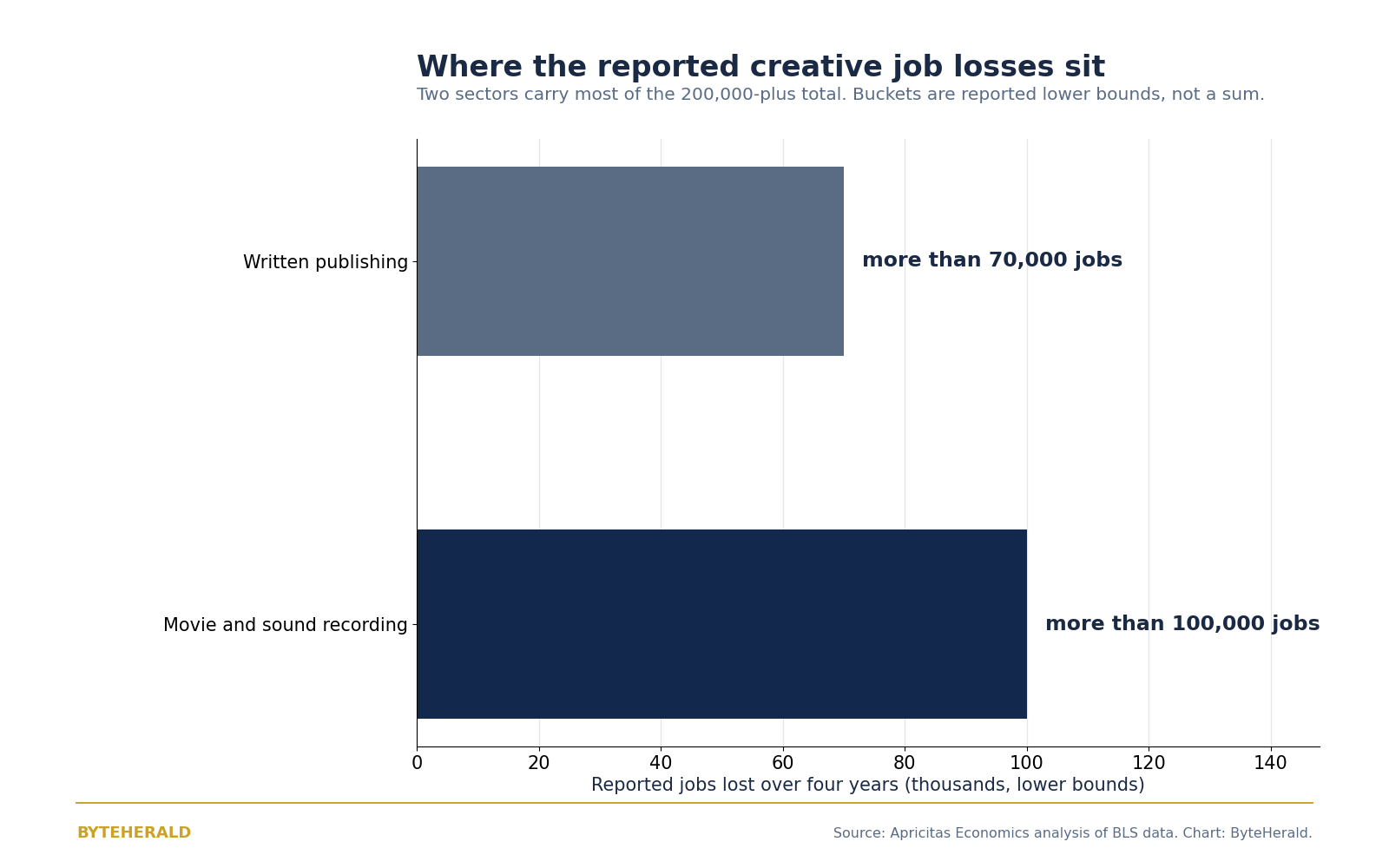
Two sectors carry most of the decline. Movie and sound recording, which includes Hollywood, lost more than 100,000 jobs, nearly one third of the sector, and at its summer low total employment sat below any point since the 2008 recession. Written publishing lost more than 70,000 jobs over the same period. The chart below shows those two reported lower bounds against the 200,000 plus total.
The pattern inside the total is what gives the AI question its force. Politano notes that every subsector of the digital arts lost jobs at some point, while in-person entertainment kept growing at a healthy pace. Graphic design, broadcasting, streaming, and publishing all sit on the losing side of that line. Museums and performing arts sit on the growing side. A shock that hits exactly the work AI can produce as a file, and spares exactly the work that must happen in a room with an audience, deserves investigation even before causation is proven.
A cross-check with different numbers
A separate Fortune review of BLS data, covering three creative sectors over slightly different windows, counted roughly 189,000 jobs lost: film and sound recording down 120,000 jobs, or 27 percent, between August 2022 and August 2026; broadcasting and content providers down about 29,000; publishers down about 40,000 between 2022 and 2025. The gap between 189,000 and more than 200,000 is not a contradiction. The two counts use different sector definitions and different windows, and both point the same direction. ByteHerald reports both counts with their definitions attached rather than picking the larger one for a headline.
Richard Florida, the urbanist who coined the term creative class in 2002, told Fortune he was not sure Politano's numbers were right, and argued AI would make certain kinds of creative work more valuable rather than eliminating the jobs. That is a testable claim, not a dismissal: if Florida is right, the growing in-person segment and the premium on work audiences trust should show up in wages and hiring for live, social, and entrepreneurial creative roles. If he is wrong, the digital losses will keep spreading into adjacent work. The data to settle it will arrive in hiring figures, not in predictions.
Why the AI share is so hard to pin down
Politano is explicit that proving the exact amount of AI driven job loss is extremely difficult, and the reasons are worth stating plainly. Media firms stay quiet about their AI use, partly to avoid public backlash and partly to protect the legal basis of their copyrights. Consolidation in Hollywood, offshoring of production, and the displacement of traditional media by social media creators all push the same numbers in the same direction at the same time. Some losses continue older trends: publishing has been shedding jobs to technological change for decades, while live broadcasting, streaming, and graphic design show an unusual downturn against previously calm years.
There is also a measurement trap. Roughly 32 percent of workers in arts, entertainment, and recreation report using generative AI to some extent, against a 62 percent average across all industries, according to St. Louis Fed figures cited by Apricitas. Low adoption inside the sector alongside heavy job losses cuts both ways: it suggests AI tools are not yet deeply embedded in most creative workplaces, and it suggests that even partial adoption, plus competition from AI assisted creators outside the industry, can move employment. Neither reading alone settles the question.
The Napster precedent, and what it warns
Politano reaches back to the first digital transition for the closest analogy, and it is a useful one. The music industry won its lawsuit against Napster and still lost its business model, as file sharing unbundled the album, streaming consolidated the catalog, and the song itself became a loss leader for concerts and merchandise. Newspapers followed a harsher version of the same arc: from roughly half a million US jobs at peak to payrolls down nearly 85 percent, with magazine publishers down 66 percent since the 1990s and book publishers down 40 percent, as search, social feeds, and paywall copying dismantled the bundle.
The warning for today's creative workers is that the worst case is not a robot taking a job title. It is the business model underneath the job dissolving, the way the album and the daily paper dissolved. The counter example in Politano's own piece is BookTok, which drove an unprecedented 70 percent surge in book sales over six years by giving dedicated readers a new way to discover books. Unpredictable spillovers cut both ways, and any forecast that only counts displacement will miss them.
How to read the next jobs claim
Three tests separate a serious claim from a scary one. First, timing: did the losses accelerate after the tool arrived, or were they already falling? Second, exposure: did the most AI exposed work fall fastest, as the digital versus in-person split suggests here? Third, the control group: did similar work that AI cannot imitate keep growing? This story passes the second and third tests and is mixed on the first, because publishing's decline predates AI while streaming and graphic design turned down more recently. Readers should apply the same three tests to the next viral jobs chart, including this one.
The connection to AI image and video generation is direct, and it is why this story belongs on a tech magazine rather than a labor page alone. The tools that can now produce a usable image, voice track, or rough cut in seconds are the same tools our image generation explainer traces from diffusion research to planning first models: how AI image generation actually works, and what it costs. And the question of who can prove a piece of creative work is human made is now a provenance problem, which is why watermarking matters beyond a policy debate: how AI watermarking actually works, and where it breaks.
For creative workers, the practical read is unsentimental. Work that exists only as a file, with no live audience, no trusted name, and no verifiable human provenance, is the most exposed to both AI competition and price collapse. Work that bundles the file with a performance, a community, or a reputation audiences can check is the least exposed, and it is the segment still hiring. That distinction, not any single job count, is the durable lesson of the last four years.
By ByteHerald Staff. Apricitas Economics, September 27, 2026, analysis of US Bureau of Labor Statistics data (more than 200,000 creative jobs lost over four years, roughly 50,000 in the last year, movie and sound recording down more than 100,000, written publishing down more than 70,000, newspapers down nearly 85 percent from peak). Fortune review of BLS data, October 2026, three sector count of roughly 189,000 jobs (film and sound recording down 120,000, or 27 percent, August 2022 to August 2026) and Richard Florida's response. Gizmodo, September 2026, reporting on the Apricitas analysis and its recession comparison to 2001 and 2008.
Comments
Post a Comment