Anthropic reported early drug development results with six partners on October 27, 2026, spanning cell therapy, antibody design, lab optimization, manufacturing paperwork, company creation and trial planning, and every program is still mostly preclinical, with the first human trial target set for late 2028 at the earliest, according to Anthropic's own research post. This is the full partner map behind that announcement: who did what, what was actually measured, and what is still missing before any of it becomes a medicine.
Why Anthropic is in drug development at all
Anthropic's argument is that drug development has no single bottleneck. Choosing a target, designing a molecule, optimizing it for manufacturing, drafting regulatory filings and planning trials are separate hard tasks, and a model that only designs molecules leaves most of the work untouched. The six partnerships were chosen to test Claude across that whole chain, and the company says the work also taught it where its models need improvement. That framing is important, because it sets the test for this article: judge each program on the stage it actually reached, not on the disease it hopes to treat.
ByteHerald already audited the headline number from this announcement in the October 28 post on Claude building 35,000 antibody designs, which found that a design count is not a drug. This pillar extends that audit to all six programs, plus the in-house acquisition, in one citable table, so a reader can check any single claim without taking the whole announcement on trust.
The database
| Partner | Stage | What Claude did | Reported result | Still missing |
|---|---|---|---|---|
| Generate Biomedicines | Modality engineering, CAR T-cell therapy | Six scientists used Claude Code to propose shorter genetic designs | One design about 70 percent shorter than standard, roughly 10 times as many receptors in lab tests, tumor cells killed more efficiently, immune cells active longer | Mouse-model tests and a solid-tumor target strategy, both listed as next steps; no human safety or efficacy data |
| Divergence Labs | Hit generation, food allergy | Turned goals into a design plan, then generated roughly 35,000 antibody designs in about a month | 3 designs bound IgE, 20 dislodged it, 3 of those 20 beat the standard medication in early tests | A single molecule combining both arms; no human data |
| BigHat Biosciences | Lead optimization, antibody fragments | Connected to the Reccy lab data system, proposed changes, reanalyzed raw data and proposed revised metrics | About 1,010 variants tested in about 10 weeks; best versions bound more than 10 times more tightly, cancer lead stayed in solution 18 degrees Celsius higher, longer-lasting lead clumped more than 100 times more slowly | A drug candidate, not just improved fragments; manufacturing at scale unproven |
| Enveda | Manufacturing and filings | Reviewed batch records through a document system built on Claude, drafted regulatory documents | 1,061 pages reviewed; all 11 known issues caught plus 7 missed by humans; review time down 89 percent, from over 25 hours to under 3 hours; one regulatory draft in 4 hours versus about 3 months by hand; one minor error found in the other draft | Regulatory acceptance of AI-drafted filings at scale; the drafts still passed human review |
| The Column Group | Company creation, Pleiades | Built a target-assessment skill with Anthropic engineers | First skill evaluated on 45 target-disease pairs; aim is a company that runs many more programs than usual for a small team | Any drug program from Pleiades itself; the company is being established, not yet reporting results |
| Bristol Myers Squibb | Clinical trial planning | Assessed plans for an early-stage drug and estimated trial success likelihood | A robust initial analysis from a single prompt that would otherwise take days, according to BMS | Any trial outcome; expansion of the work is planned for 2027 |
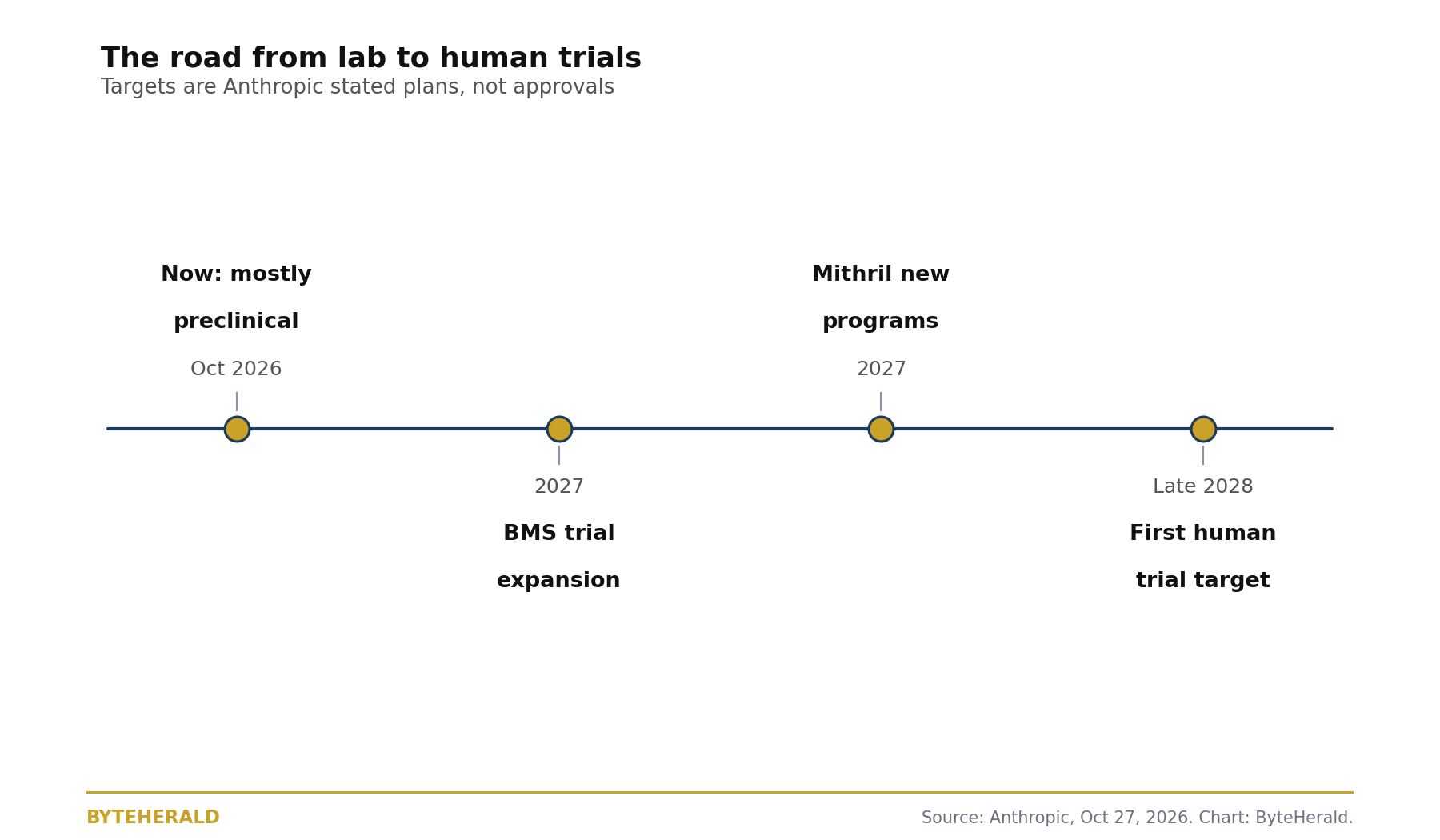
| Mithril Medicine (acquired by Anthropic) | In-house programs, rare childhood muscular dystrophy | Founder Cody Tranbarger used Claude to organize contracts, logistics and experiments across 11 external labs | Idea to promising mouse results in less than 18 months; human trial target as soon as late 2028 if candidates hold up | Formal drug candidates, human safety data, and every step between mouse results and a trial |
Reading the table honestly
Three patterns survive a careful reading. First, the strongest results are in tasks with a clear measurement: binding strength, solution temperature, clumping rate, pages reviewed, hours saved. Those numbers can be checked in a lab or on a clock. Second, the weakest results are the ones closest to patients: no program reports human data, and Anthropic says so itself, in the post's own words, that so far the work is mostly preclinical. Third, the most interesting result may be the least glamorous: Enveda's paperwork system caught issues humans missed and cut review time by 89 percent, which is a productivity gain that does not depend on a molecule working in a body.
The table also shows where Claude needed human correction. At BigHat, the team suspected the standard heat-stability and clumping metrics were misleading, reanalyzed the raw data with Claude, proposed different metrics and a protocol change, and the main predictions held. That is a better story than flawless automation, because it shows the loop that drug development actually requires: model proposes, humans test, measurements change, model proposes again.
From partner work to a drug company
Anthropic is not only selling Claude to drug developers. With Mithril Medicine, it bought a one-person company developing treatments for two rare forms of muscular dystrophy, and its founder now continues the research inside Anthropic. The stated logic is that a small team, with Claude handling scientific and operational work across 11 external labs, can run programs that would normally need a much larger organization. If that logic holds, it changes who can attempt a drug, not just how fast an existing company works. If it does not, Mithril is a single anecdote, and one mouse result is not a pipeline.
Anthropic is also widening access in parallel: Claude Science, its workbench for researchers, credits for life scientists, a Life Sciences Verification Program that gives vetted organizations more permissive safeguards for legitimate biological research, and an open call for guest investigators. Those access routes matter, because they determine whether the partner results stay inside six companies or become a method other labs can test. A method that cannot be tested by outsiders is a press release, not a result, and Anthropic's own technical reports, linked from its post, are the place where outsiders can start that test.
What would change this assessment
Four checkable events, in order, would move this story from promising to proven. First, Mithril names formal drug candidates in 2027, as its program aims to do. Second, the Bristol Myers Squibb work expands in 2027 as planned, and produces a trial plan that is actually used. Third, a program from any partner reaches a human trial, with the Mithril target of late 2028 as the earliest date to watch. Fourth, an independent group reproduces a reported result, such as a binding improvement or a document-review gain, outside Anthropic's partnerships. Until at least the first of those happens, the correct description of this announcement is the one Anthropic itself gives: early progress, mostly preclinical, with no drug yet.
By ByteHerald Staff. Anthropic published on October 27, 2026, an update on early progress accelerating drug development with Claude, reporting partnerships with BigHat Biosciences, Bristol Myers Squibb, Divergence Labs, Enveda, Generate Biomedicines and The Column Group, plus its acquisition of Mithril Medicine, with all work described as mostly preclinical and a human trial target as soon as late 2028. Anthropic reported on October 27, 2026, that Generate Biomedicines produced a design about 70 percent shorter with roughly 10 times as many receptors in lab tests, that Divergence Labs generated roughly 35,000 antibody designs in about a month with 3 binding and 20 dislodging IgE, that BigHat Biosciences tested about 1,010 variants in about 10 weeks with binding more than 10 times tighter, and that Enveda reviewed 1,061 pages catching all 11 known issues plus 7 missed, cutting review time by 89 percent. ByteHerald reported on October 28, 2026, an audit of the 35,000 antibody designs headline, finding that a design count is not a drug.
Comments
Post a Comment