Microsoft's president just put the AI talent war into words the industry has been avoiding. Speaking at the International AI Summit in Dublin, Brad Smith warned that the Trump administration's crackdown on skilled immigration could send the next generation of AI engineers to other countries, and keep them there for a generation.
The quotable answer
Microsoft President Brad Smith warned on October 15, 2026, that blocking green-card pathways for skilled immigrants could cripple the US technology industry for more than a generation. The warning came less than a week after Vice President JD Vance announced that Microsoft and seven other companies would be barred from seeking green cards for skilled foreign workers, a suspension US labor rules allow to last up to 180 days during a fraud investigation.
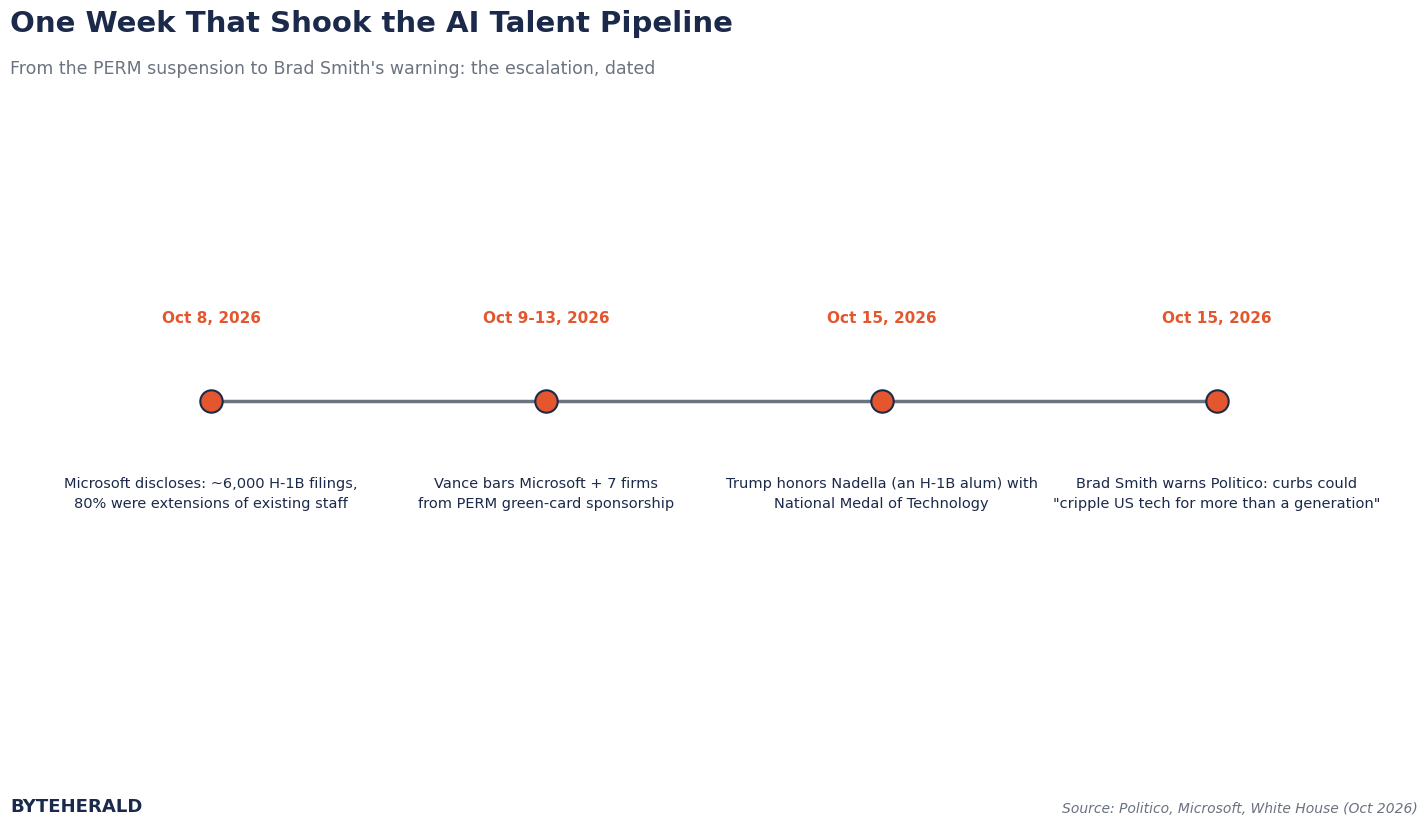
The week, dated
October 8: Microsoft disclosed that of roughly 6,000 H-1B applications it filed last fiscal year, 80% were extensions or status changes for existing employees, not new hires, and said it pays H-1B workers the same as comparable staff (IANS via Hi India). Days later, Vance accused Microsoft of abusing the program to replace American workers with lower-paid foreigners and announced the PERM suspension covering Microsoft, Adobe, Wipro, TCS, Infosys and HCLTech, with two more companies unnamed (Indian Express). October 15: on the same day the suspension landed, President Trump presented Microsoft CEO Satya Nadella, who first came to America on an H-1B visa, with the National Medal of Technology and Innovation. Smith's point wrote itself: five of the six Americans receiving technology and science medals that day had immigrated to the United States, and their companies together account for more than a quarter of the S&P 500's total market value. Hours later, on Politico's Decoded podcast, Smith called the administration's figures "completely off base," noted Microsoft hired 9,200 American workers last fiscal year, and delivered the warning: blocking permanent residency for the highly skilled could cripple US tech for more than a generation.
Why AI talent runs on immigration
Here is the evergreen part. The AI talent pipeline is structurally immigrant-heavy at every stage: international PhD students produce a large share of top-tier AI research, the H-1B program is the standard bridge from graduation to employment, and the green-card backlog is where careers stall for years. Cut the bridge and you do not just lose this year's hires; you redirect the application decisions of students choosing where to do their PhDs, which is a ten-year pipeline effect. That is what "more than a generation" means in practice: the engineers who would have arrived in 2027 are deciding in 2026 where to apply. Smith's warning is self-interested, Microsoft is the company being sanctioned, but the mechanism he describes is the same one our brain-drain tracker documents from the inside: labs are losing researchers from both directions now, to policy on one side and to protest on the other, as October's safety-researcher firings showed.
ByteHerald's reading
Two things can be true. The administration's fraud concerns may be legitimate in individual cases, and no company named has been charged with anything. Meanwhile the signal the policy sends is received globally within days, while any correction takes years. In a talent market where a few hundred researchers decide the frontier, even a small redirection of the pipeline compounds. The winners of this fight will not be decided in Washington this month; they will be decided in graduate-school application portals over the next three admission cycles.
By ByteHerald Staff. Events dated October 8-15, 2026 from Politico, Microsoft statements, and White House announcements as reported. The PERM suspension scope and duration had not been published in writing as of October 13, per immigration lawyers.
Comments
Post a Comment