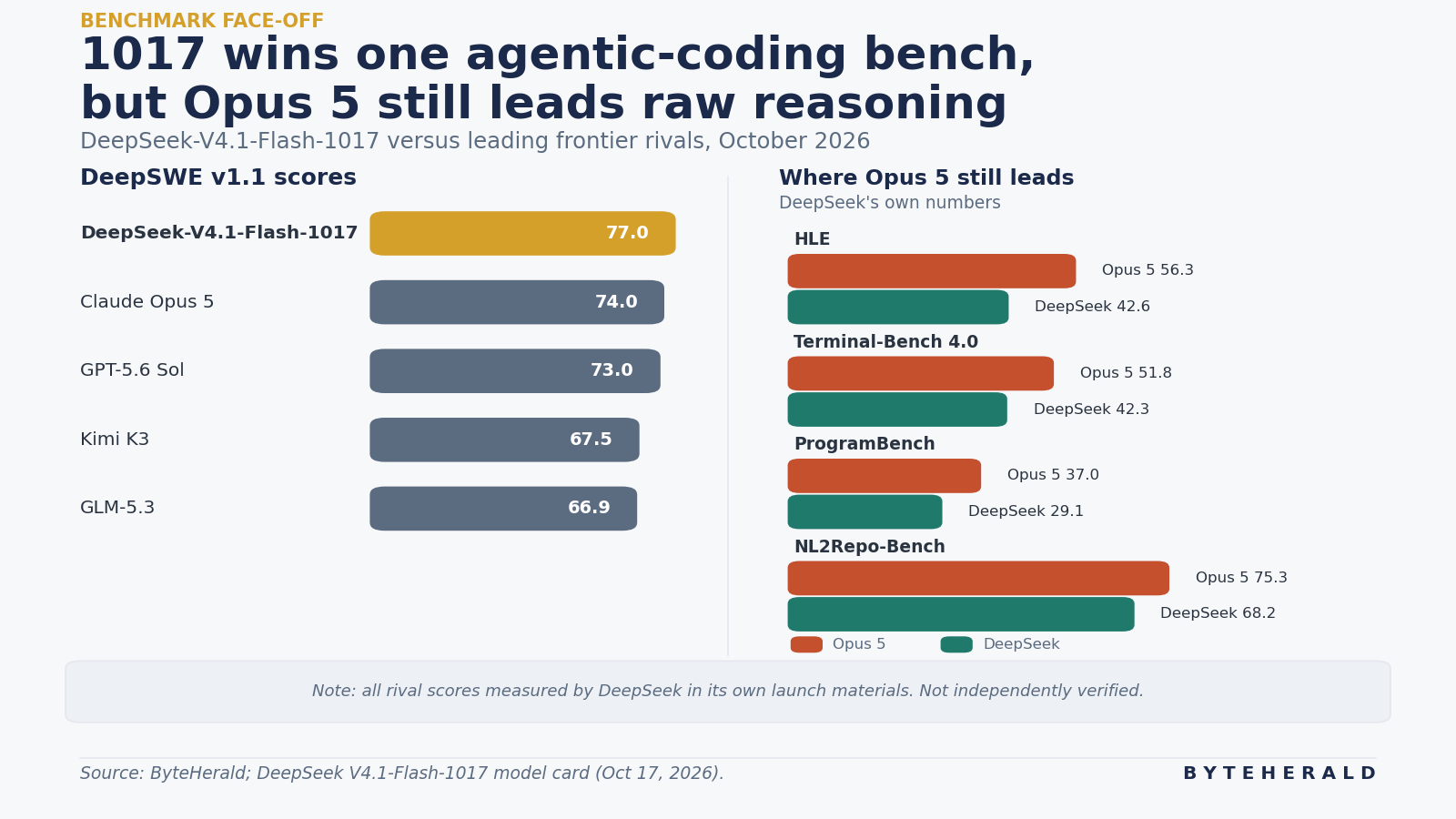
DeepSeek released DeepSeek-V4.1-Flash-1017 on October 17, and the headline writes itself: a new open-weight model scores 77.0 on the DeepSWE v1.1 agentic-coding benchmark, beating Claude Opus 5 at 74.0, GPT-5.6 Sol at 73.0, Kimi K3 at 67.5, and GLM-5.3 at 66.9. The weights are published under the MIT license, and the API price is $0.15 per million input tokens off-peak. It is the best-in-class cheap agentic-coding model on the market today. It is not, on DeepSeek's own numbers, a frontier general model. Both statements are true, and the difference between them is the whole story.
What actually launched
The release is real and verifiable from first-party sources. DeepSeek published the repository deepseek-ai/DeepSeek-V4.1-Flash-1017 on Hugging Face at 02:40 UTC on October 17 under the MIT license, with the weights also on ModelScope, and moved its API over: the quick start now says the deepseek-flash endpoint is served by V4.1-Flash-1017 with no calling-method change. DeepSeek describes it, in its own words, as "a minor update to DeepSeek-V4.1-Flash" delivering improvements across reasoning, coding, agentic, and visual benchmarks with reduced task time and output length. The name decodes cleanly: V4.1 is the architecture family, which launched September 10 with a 74.2 DeepSWE score; Flash is the lightweight efficiency tier; and 1017 is the October 17 snapshot, matching DeepSeek's earlier dated-snapshot pattern.
The 77.0 DeepSWE number is DeepSeek's reported score, corroborated by multiple outlets, and the rival numbers come from DeepSeek's own comparison table in its launch materials. No independent lab has published a rerun yet. That caveat matters more than usual here, because the same official table shows Opus 5 decisively ahead on raw reasoning and several agent benchmarks: HLE (Opus 5 56.3 vs 42.6), Terminal-Bench 4.0 (51.8 vs 42.3), ProgramBench (37.0 vs 29.1), and NL2Repo-Bench (75.3 vs 68.2). The 1017 model does win Automation-Bench, Apex Bench, and Agents' Last Exam alongside DeepSWE. The honest framing: this is a cheaper, faster agentic-coding specialist, not a model that dethrones Opus 5.
The specs and the price
The model card lists a 552-billion-parameter MoE backbone plus 196 billion Engram parameters, with 8 billion active per token in prefill and 16 billion in decode, a 40-layer causal encoder-decoder architecture, 45 trillion pre-training tokens, a 1,048,576-token context window, and up to 384,000 output tokens. It runs in thinking and non-thinking modes with a reasoning-effort setting from 1 to 100, and DeepSeek recommends temperature 1.0 and top_p 1.0, with native vision trained jointly. Pricing is unchanged from September and quoted off-peak: $0.15 per million input tokens on cache miss, $0.003 on cache hit, $0.60 per million output tokens, with peak hours, Beijing weekdays 9:00 to 12:00 and 14:00 to 18:00, doubling both rates. The per-task math is what made the release travel: one outlet's cost-per-task chart puts typical agentic tasks at roughly $0.20 on the 1017 model versus $2 to $10-plus on rivals.
DeepSeek also bundled new Search and Fetch APIs for all developers at $0.75 per 1,000 calls per endpoint, capped at 5 queries per second per account, with calls routed through server-side tools in DeepSeek Harness, Claude Code, and Codex free until billing starts October 31. The model is tuned for DeepSeek Harness v0.2.1-rc.1 and above, Tencent CodeBuddy, and WorkBuddy, with RLSF, reinforcement learning with self-feedback, post-training aimed at end-to-end project work.
Who should actually switch
The judgment call depends on the workload, not the headline number. If you run high-volume agentic coding tasks, SWE-bench-style work, or autonomous repair loops, a 77.0 DeepSWE score at fifteen cents per million input tokens is the best value in the industry by a wide margin, and the MIT license means you can run the weights yourself. If your work is raw reasoning, long-horizon terminal tasks, or repository-scale generation, DeepSeek's own numbers say Opus 5 is still meaningfully ahead, at a meaningfully higher price. The X post that broke the story led with "frontier performance," and the scoreboard supports a narrower claim: frontier value, in one domain. We mapped the open-weight benchmark wars among Meta, Xiaomi, and Mistral on October 16, and this release slots straight into that contest, while our token-price tracker shows why the timing is not accidental: the discount era is ending, and DeepSeek is competing on price while it can.
What "open-weight, MIT license" actually means
The durable lesson underneath the launch is about the words. Open-weight means the trained parameters are published; it does not mean the training data, the training code, or the full pipeline is open. The MIT license is unusually permissive for a frontier-class model: you can download, fine-tune, and use the weights commercially with minimal restrictions. That combination is why open-weight releases move markets in a way closed API updates do not: anyone can inspect, modify, and deploy them without the lab's permission, and every downstream product built on the weights inherits the release's economics. The trade-off is equally permanent. Open weights cannot be recalled, and whatever behaviors the model learned are now everybody's to audit or exploit. That is why the benchmark honesty above matters: with open weights, the scoreboard is the only product sheet, and it deserves the same scrutiny as the license.
ByteHerald's reading
DeepSeek's release strategy is now visible in full: ship dated snapshots, price aggressively, publish the weights, and let the per-task math do the marketing. The 1017 model extends that strategy from September's 74.2 to 77.0 on DeepSWE and widens the price gap instead of closing the capability gap with Opus 5. The market reads this correctly when it buys the 1017 for what it is, an elite cheap coding specialist, and misreads it when the headline compresses to "beats Claude." We will be watching for the independent benchmark reruns, because every outlet so far is quoting the lab's own table. Until those arrive, the verified facts are the release, the weights, the license, and the price; the superlative belongs to DeepSeek.
By ByteHerald Staff. Release details from DeepSeek's Hugging Face repository, API docs, and release note (first-party, October 17); benchmark table from DeepSeek's official launch materials; per-task cost analysis from the-decoder's October 17 coverage; rival scores attributed to DeepSeek's own measurements pending independent verification. DeepSWE graphic is ByteHerald's original compilation.
Comments
Post a Comment