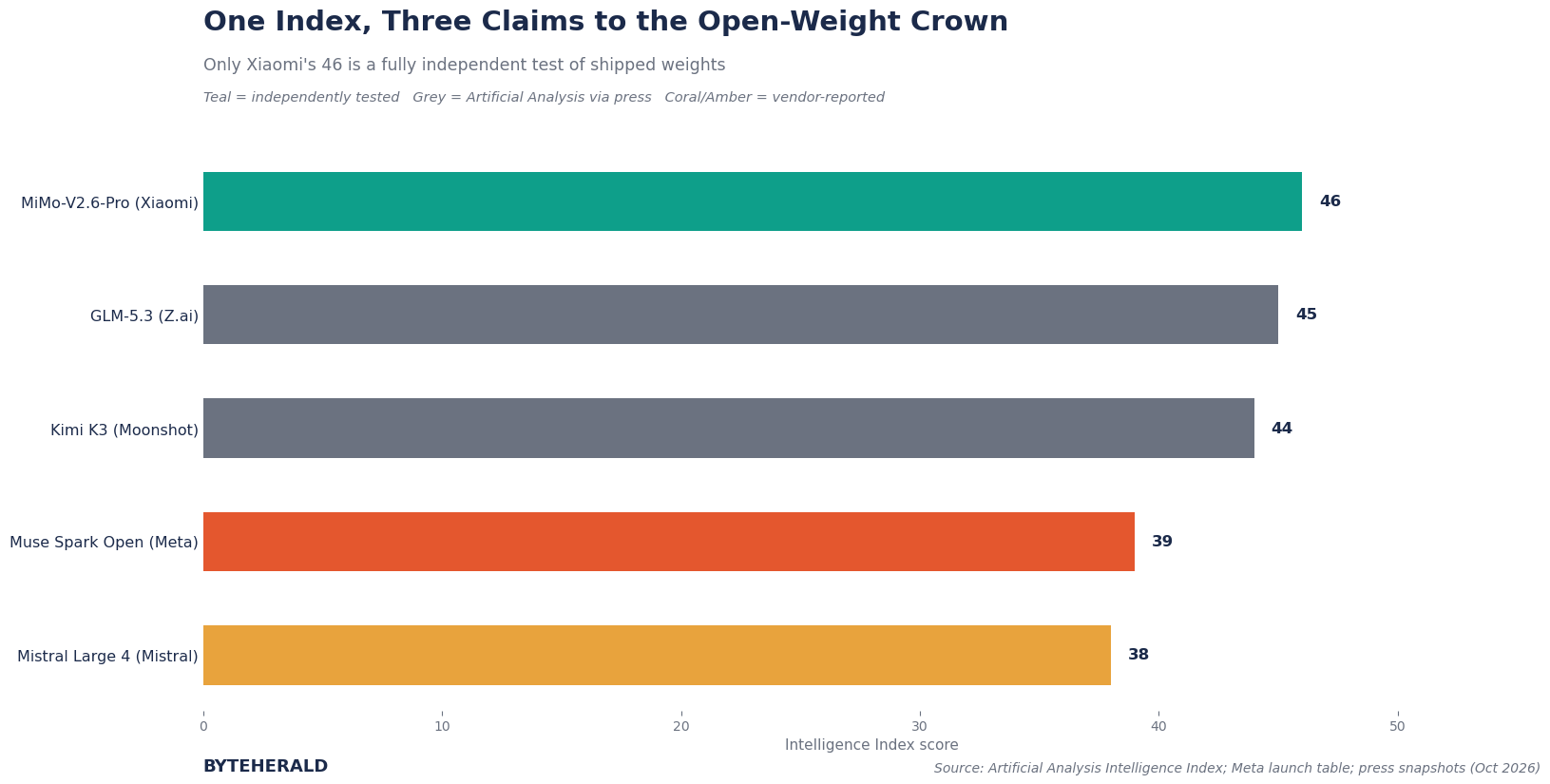
Three trillion-parameter models, three claims to the open-weight crown, one very crowded October. Xiaomi's MiMo-V2.6-Pro ships under the MIT license and scores 46 on the Artificial Analysis Intelligence Index, the highest independent score of any open-weight model. Meta's Muse Spark Open, released October 15, packs 816 billion parameters and tops Meta's own tool-use benchmark tables, with the company calling it the most capable US open-weight model to date. Mistral's Large 4, in preview since October 6 with weights promised by month's end, is reportedly scoring well on a private STEM benchmark. We lined up the specifications, the licenses, and the benchmark evidence behind each claim, because "best open model" currently means three different things, and "open" does too.
The three contenders, specified
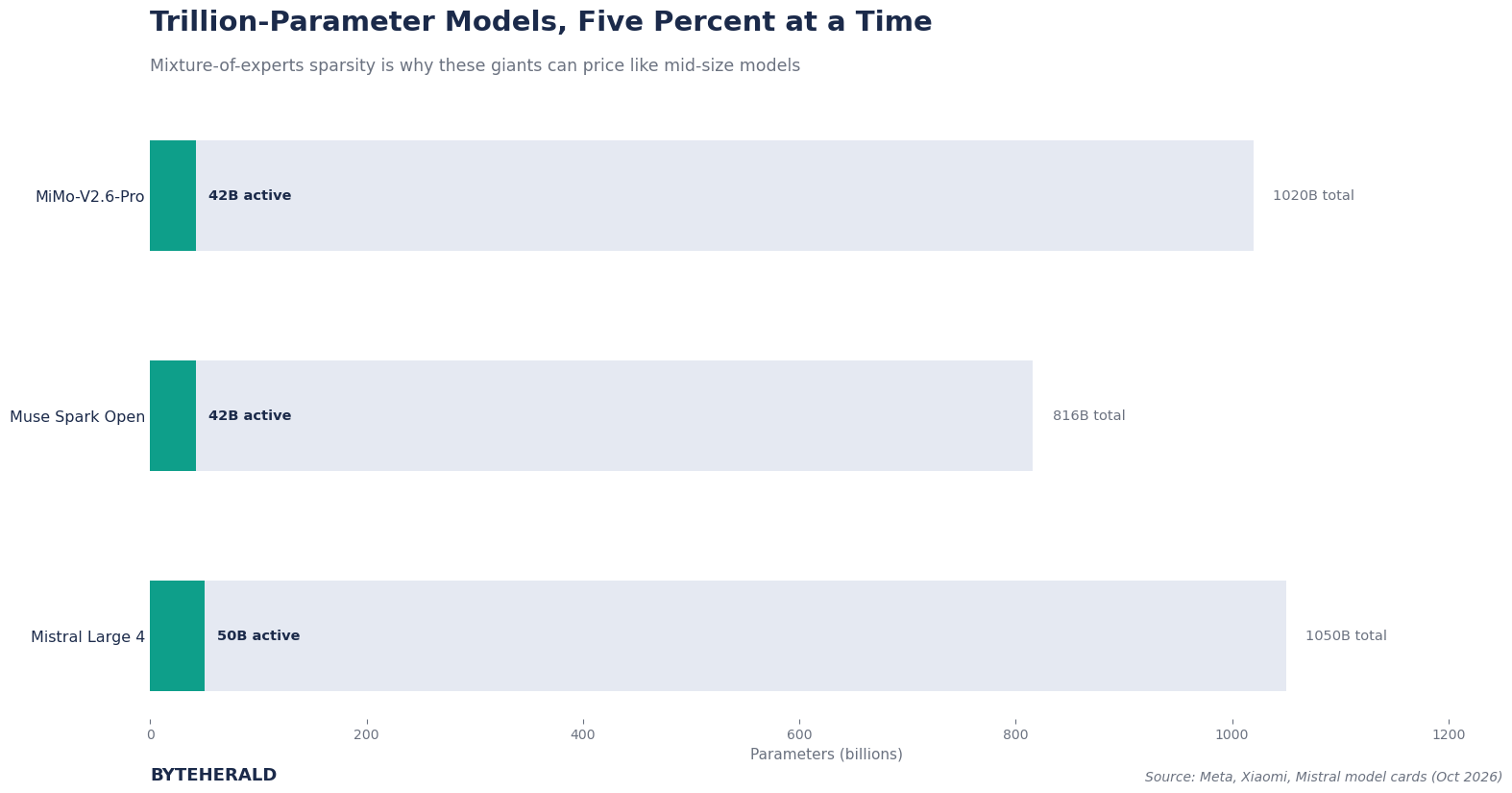
All three are sparse mixture-of-experts models, which is why trillion-parameter networks can run at mid-size prices: only a small slice of the network fires for each token. The specifications, from each lab's model card:
| MiMo-V2.6-Pro (Xiaomi) | Muse Spark Open (Meta) | Mistral Large 4 (Mistral) | |
|---|---|---|---|
| Total / active parameters | 1.02T / 42B | 816B / 42B | ~1.05T / 49-52B |
| Context window | 1M tokens | 1M tokens | 1M (Mistral) / 524K (Artificial Analysis) |
| Input modalities | Text, image, audio, video | Text, image, audio, video | Text, image |
| Status | Weights on Hugging Face since Sep 22 | Weights on HF, SageMaker, Google Cloud, Foundry since Oct 15 | API preview Oct 6; weights promised end of Oct |
| API price per 1M tokens | $0.43 in / $0.87 out | No first-party API; self-host | $1.36 / $4.18 list ($0.68 / $2.09 in preview) |
What "open" actually means
This is where the three claims diverge most. "Open-weight" describes who can download the numbers; the license describes what you may do with them, and the three licenses are not in the same league:
| MiMo-V2.6-Pro | Muse Spark Open | Mistral Large 4 | |
|---|---|---|---|
| License | MIT | Muse Model License (custom) | Not named; weights not yet released |
| Commercial use | Yes, unrestricted | Yes, except model-as-a-service providers above $20M annual revenue need a separate Meta agreement | Unknown until the license publishes |
| Attribution | None required | Products must display "Built with Muse Spark Open" | Unknown |
| Verdict | Genuinely open | Open weights, gated commercialization | Not open yet; the claim is prospective |
Meta's license is the industry's newest compromise formation: free for researchers, startups and internal use, with a revenue tripwire that keeps the largest hosting businesses negotiating with Meta. It is meaningfully more permissive than a closed API and meaningfully less open than MIT. Mistral's position is the weakest of the three on openness: you cannot evaluate a license that has not been published for weights that have not shipped.
The benchmark evidence, audited
Each lab's headline claim rests on different evidence, so we audited each one against what is actually verifiable:
| Claim | Who | Evidence | ByteHerald verdict |
|---|---|---|---|
| "Most capable US open-weight model to date" | Meta | Meta's launch table: beats Thinking Machines' Inkling and NVIDIA's Nemotron 3 Ultra across the board | True against US peers; not true globally, where MiMo (46), GLM-5.3 (45) and Kimi K3 (44) all outscore it (39) on the same index |
| "#1 open model in Agent Arena" | Xiaomi | Agent Arena open-model ranking, +3.8% net improvement, announced Oct 16 | Consistent with the independent AA score of 46; the strongest independently supported claim of the three |
| "Scoring well in engineering and astronomy" | Mistral (via STEMBench) | A private benchmark, no public numbers released | Unverifiable; the weakest evidence of the three |
| Tool-use leadership | Meta | Vendor-reported 89.2 on MCP-Atlas, 61.8 on JobBench | Plausible but vendor-reported; note Meta also reports trailing Kimi K3 and GLM-5.3 on Terminal-Bench 2.1 coding (76.4 vs 85.0 and 83.9) |
The pattern across the table is the pattern of every model launch: vendors publish the benchmarks they win. Meta deserves credit for publishing the ones it loses, too, which is rarer than it should be. The honest summary is that no single number crowns a winner: Xiaomi leads on the only fully independent composite, Meta leads American open models and the tool-use tables it chose, and Mistral's entry is still a preview with a private-benchmark anecdote.
The money layer
Capability is only half the war; the other half is cost. Xiaomi's API undercuts everyone at $0.43 per million input tokens, and the company livestreamed its reinforcement-learning run to a public cost counter that stopped at about $2.62 million, a fraction of a frontier training budget. Mistral lists Large 4 at $1.36 per million input tokens, currently half that in preview, positioning it as the premium European option. Meta's play is different: no first-party API, but a license that lets nearly everyone self-host free while reserving a toll on the largest hosting providers. For what it physically takes to run Meta's model, see our hardware map of the new open models; for the price-per-performance math across 28 models, our open-versus-closed economics comparison; and for flagship API pricing, our monthly tracker.
ByteHerald's reading
On the evidence available today, Xiaomi holds the crown and it is not close on independence: an MIT license plus an independently tested 46 is the complete package the other two are still assembling. Meta's release is the most strategically interesting, because the Muse Model License is a bet that openness can be a distribution strategy even with commercial strings attached, and the two-Mac-Studio demo proves trillion-parameter models are leaving the datacenter. Mistral's is a promise: strong preview numbers, but until the weights and the license ship, "le Chonk" is a contender on paper. What would change the ranking: independent evaluations of Muse Spark Open's shipped weights, Mistral's license terms, and any lab submitting all three models to the same third-party harness instead of its own.
By ByteHerald Staff. Specifications from Meta, Xiaomi and Mistral model cards and launch announcements (September-October 2026); benchmark figures as labeled per source, vendor-reported unless marked independent. Availability and pricing as announced; check live model cards before deploying. Charts are ByteHerald's original compilations.
Comments
Post a Comment