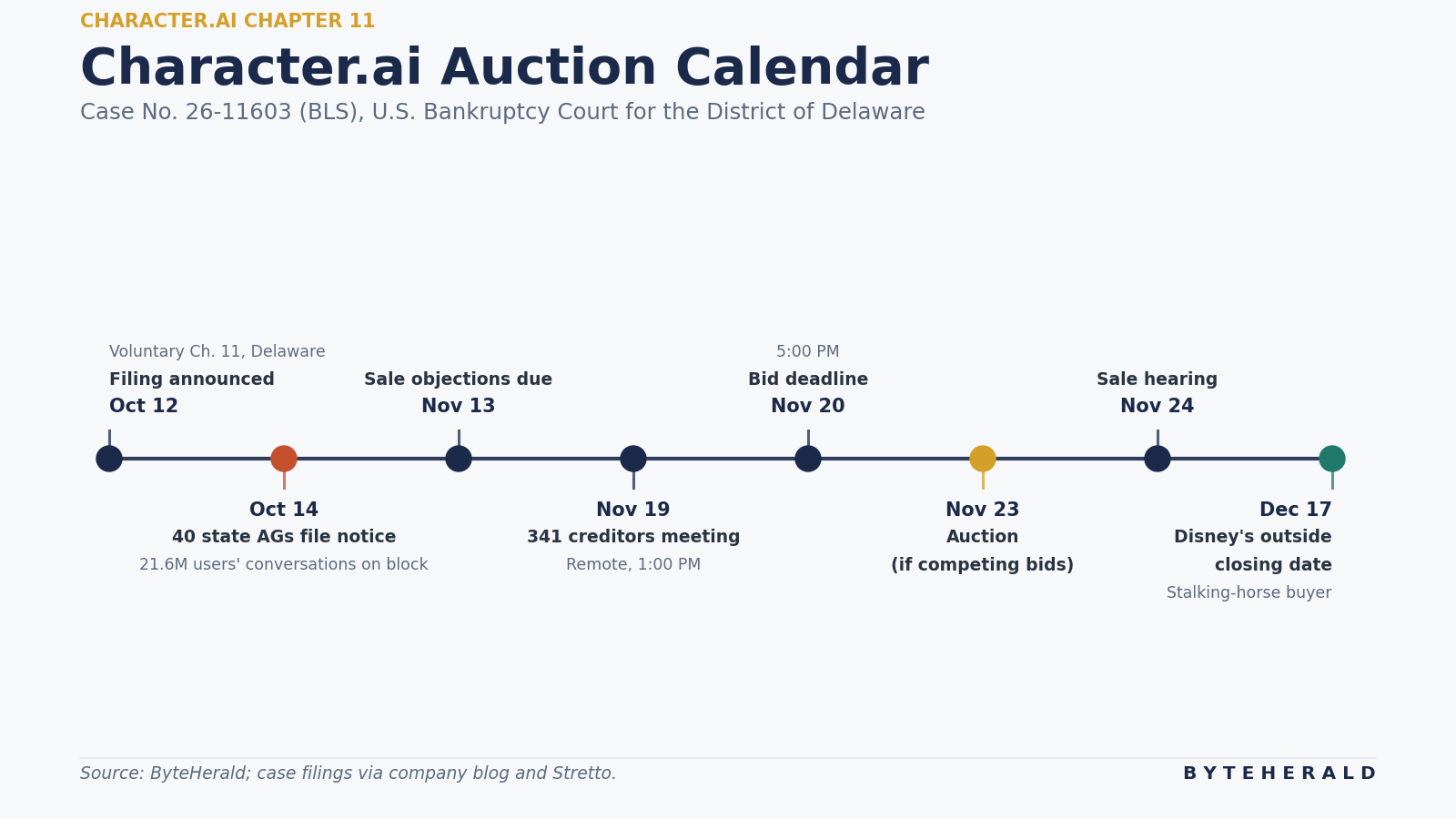
Character.ai's bankruptcy is no longer a collapse story. It is an auction. This week the company published its sale calendar, and the key date is November 20: the bid deadline for a Delaware court to sell what remains of a company that was once worth $2.7 billion. We covered the filing's creditor list and sale mechanics on October 14; since then, the court published the full auction calendar and Disney's role in it got sharper. The opening bid is already on the table. Disney Worldwide Services is the stalking-horse bidder at $20 million, but Disney is not buying Character.AI the app. It is buying the brain behind it.
Disney's bid: the models, not the users
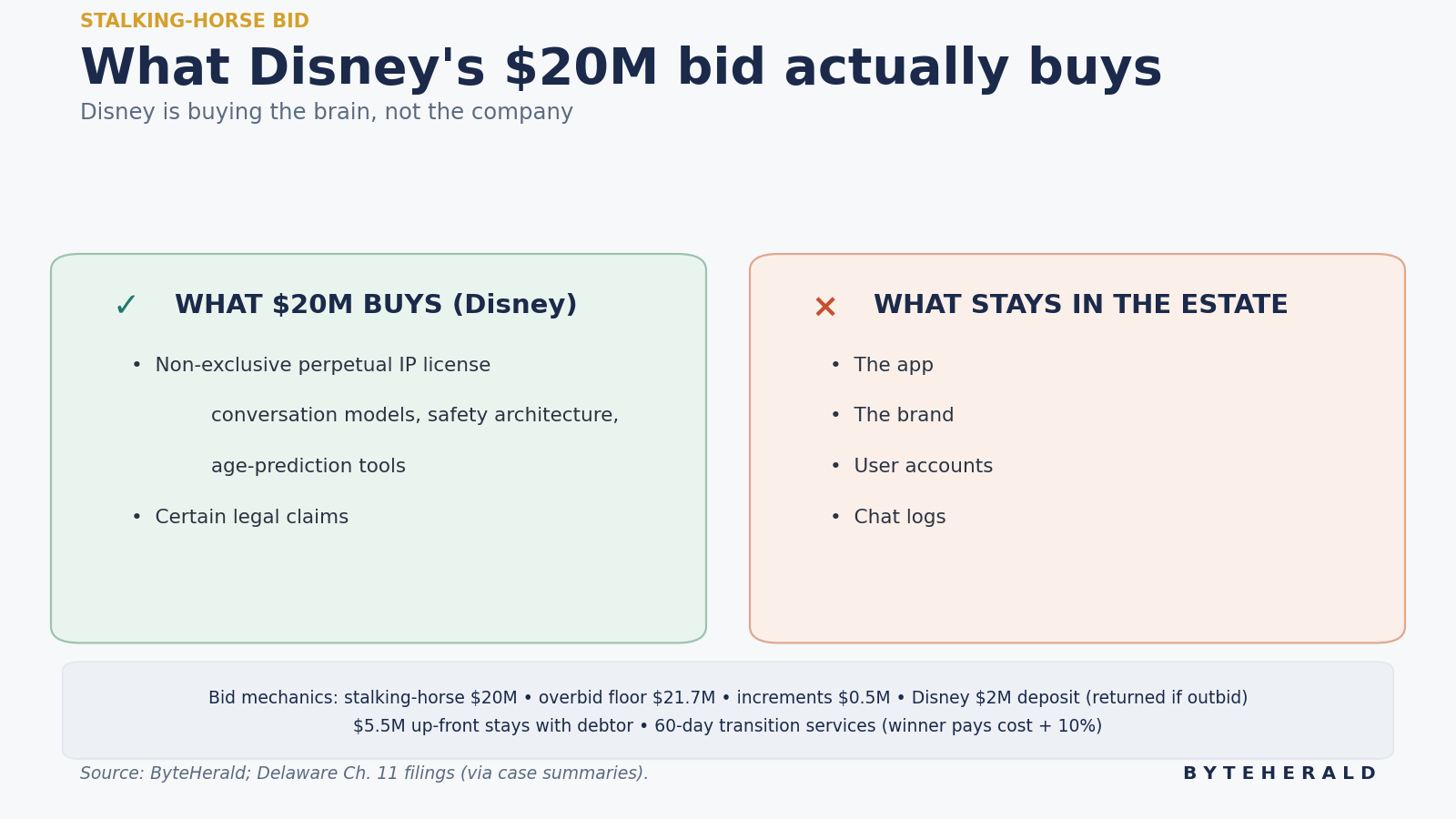
The bid mechanics, drawn from the Delaware filings, are precise. Disney's $20 million covers a non-exclusive, perpetual license to certain Character.ai intellectual property: the conversation models, the safety architecture, and the age-prediction tools, plus certain legal claims the estate holds. Everything else stays in the bankruptcy estate: the app, the brand, the user accounts, and the chat logs. That last item is the radioactive one. Forty state attorneys general filed a notice on October 14 demanding nine binding safety and privacy conditions on any buyer of the app and conversation data, and reserving the right to demand a consumer privacy ombudsman. The states say 21.6 million users' conversations are on the auction block, including accounts belonging to under-18s.
The bid floor mechanics show how the court protects that number. Any competing bidder must clear $21.7 million, the stalking-horse bid plus break-up fee plus $1 million, with $0.5 million increments. If Disney is outbid, it gets its $2 million deposit back plus the break-up fee, but a $5.5 million up-front payment stays with the debtor. Disney also provides transition services to the eventual winner, for 60 days after closing or 75 days after the auction, with the winner paying cost plus a 10 percent margin, and Disney may keep up to 20 percent of the former employees it hired away from any winner's recruiting.
The C&D to CTO arc
The Disney connection is a two-year reversal compressed into a filing. Late last year Disney sent Character.ai cease-and-desist letters over unauthorized AI impersonations of Elsa, Moana, Peter Parker, and Darth Vader. In September 2026 Disney hired Character.ai's CEO Karandeep Anand as its first-ever chief technology officer, along with several technical staff, and Business Insider reports Disney is paying $60 million to bring on 66 Character.ai staffers in total. The company that accused Character.ai of stealing its characters is now buying the technology that animated them. The case is No. 26-11603 (BLS) before Judge Brendan Linehan Shannon in the U.S. Bankruptcy Court for the District of Delaware.
What happens to users and subscriptions
Character.ai's own FAQ, updated October 16, is blunt. The platform remains up and running and users can continue to access all services at this time. Subscriptions remain active and billing is unchanged for now; the company says it intends to notify subscribers in advance if the service changes in a way that affects paid features. User data stays under the existing Privacy Policy, and users can delete their accounts or export their data through the app or website. The hard sentence comes after: if there is no actionable bid for continued operations, the platform will be wound down. The company says in court papers that it hopes the sale process produces a global resolution of all legal claims against it, including state investigations and lawsuits alleging its chatbots pushed children toward suicide and self-harm. Reuters reports court papers describe a Kentucky case alleging a chatbot encouraged a child to cut, starve, and kill, and a Pennsylvania case alleging a chatbot posed as a licensed psychiatrist with a fabricated license number. The company reached preliminary, undisclosed settlements in five private lawsuits in January 2026, but the terms were never finalized or paid.
What an app bankruptcy means for your account
Here is the durable question underneath the auction, and the reason this story outlives November. When a consumer app enters Chapter 11, your account is not one thing legally. Your subscription is a contract with the debtor, which is why billing continues until the court or the buyer says otherwise. Your data is an asset of the estate, which is why it can be sold, and why the 40 attorneys general are insisting on binding privacy conditions before that sale happens. The app itself is property that can be bought, shut down, or sold for parts, which is why Disney's bid carves out the models while leaving the app behind. Three separate legal lives, three separate fates. That is the pattern to remember the next time a beloved app files: watch the bids, not the press release, because the bids show what the buyer actually values. In Character.ai's case, the answer is the technology and the talent. The burn rate Reuters cites, over $8 million a month, explains why the company itself was never the prize.
ByteHerald's reading
The $20 million number is the tell. It is not a valuation of Character.AI, the business; it is a price on the components Disney wants, with the user base and its liabilities carefully excluded. The most important actor in this sale is not Disney or the bankruptcy court but the 40 attorneys general, because their conditions will decide whether the conversation logs, the estate's most sensitive asset, can be sold at all. The November calendar compresses all of this into five weeks: objections by November 13, creditors on November 19, bids by November 20, the auction on the 23rd, the hearing on the 24th. We traced the five-year arc from a $2.7 billion valuation to this filing on October 13; the auction is the final chapter of that arc, and the states' intervention fits the global enforcement wave we mapped across seven jurisdictions, where regulators are now policing AI companies after the fact rather than before.
By ByteHerald Staff. Filing and bid details from the Delaware Chapter 11 case filings as reported in court records, the company blog (first-party, updated October 16), and cases.stretto.com; Disney and staffing details from the Wall Street Journal and Business Insider reporting; attorney general notice from The Verge's October 14 reporting; lawsuit details from Reuters' October 15 reporting; user counts differ across sources and are attributed. Auction calendar graphic is ByteHerald's original compilation.
Comments
Post a Comment