YouTube Music started labeling AI-made songs this week. Deezer will soon let you erase them from search entirely. Spotify, Tidal, Apple Music and Bandcamp have each drawn their own line. We mapped every major platform's AI-music rules into one scorecard, because the industry just split into two camps: disclose it, or delete it.
What YouTube Music did
YouTube Music announced on October 14, 2026 a three-tier labeling system for songs created with generative AI: "Fully Gen AI" for tracks entirely generated by a model, "Partly Gen AI" for works mixing AI components with live performance, and "No Gen AI" for everything else. The label appears on the player page; tapping it explains the specific role AI played, generated composition, synthetic vocals, or both. The labels will also extend to the main YouTube app.
The interesting part is the boundary-drawing in YouTube's partner guidance. Music partners declare AI use through delivery metadata or YouTube Studio, and YouTube combines declarations with its own detection tools. Routine pitch correction, Auto-Tune fixing minor tuning mistakes, counts as "No Gen AI." AI mastering software setting final balance and compression: also "No Gen AI." But a 100%-human song still lands in "Partly Gen AI" if a text-to-video model made its music video. Disclosure does not block monetization, the tracks still earn, but YouTube says failing to declare when required can bring penalties or removal.
What Deezer did, and why it went further
Deezer, the same day, said it is building a user toggle that filters fully AI-generated music out of search results, tracks, albums, and related artists simply stop appearing. The feature arrives worldwide before the end of the year. "We've seen clear user demand for the ability to filter out AI-generated music, " CEO Alexis Lanternier said in a statement, citing a survey in which about 45% of customers wanted AI music out of their feeds.
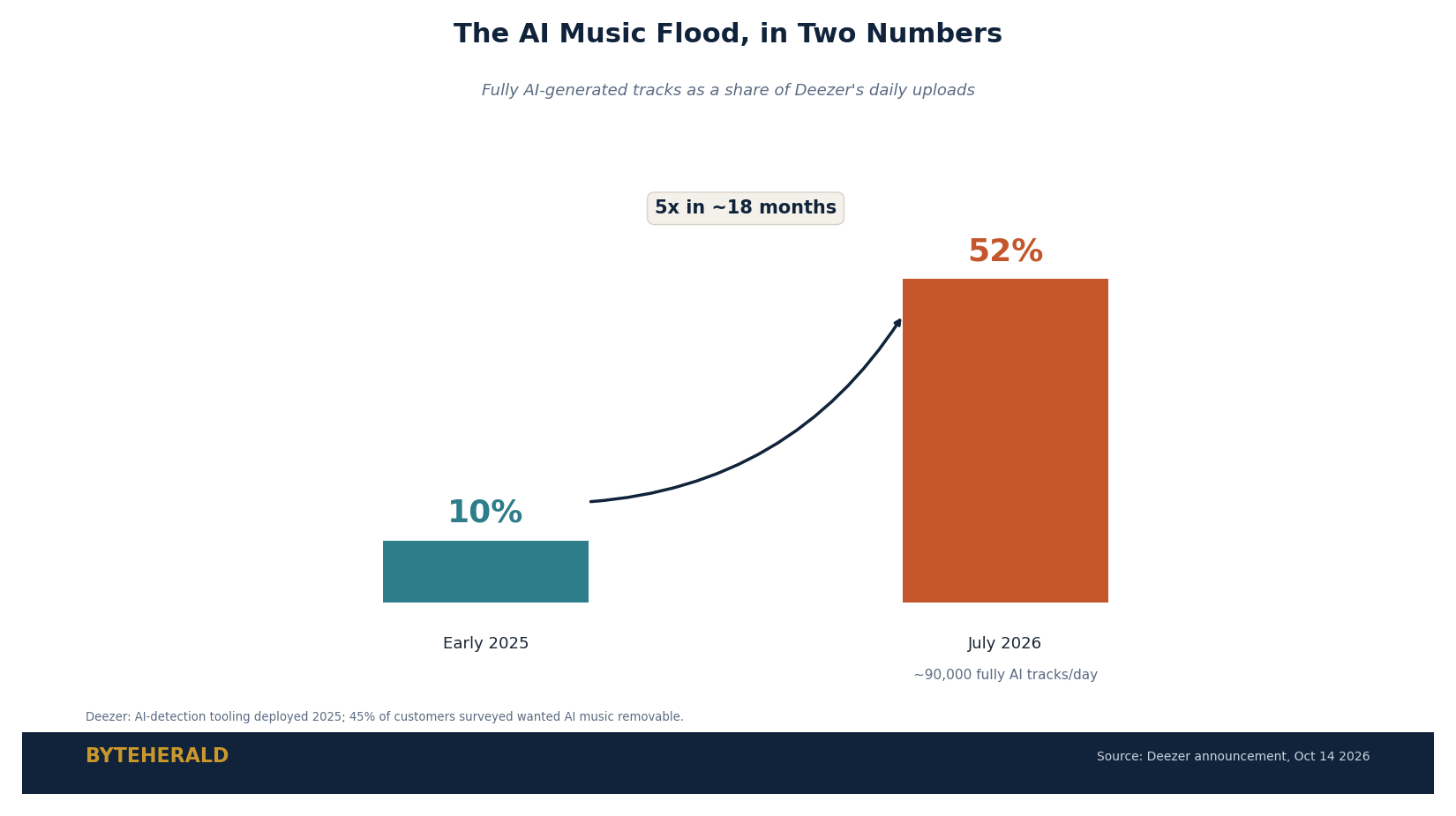
Deezer's numbers explain the urgency. The company deployed AI-detection tooling last year; at the time, AI tracks were about 10% of daily uploads. By July 2026 the share had crossed 50%, averaging roughly 90, 000 fully AI-generated tracks per day. Deezer already excludes detected AI music from algorithmic recommendations and editorial playlists and withholds royalties from fraudulent streams. The toggle extends listener control to search, and it targets fully generated music, with limited AI assistance inside a human creative process treated differently.
The full scorecard
This is the same provenance fight playing out across AI media, we covered the text side when OpenAI moved to watermark ChatGPT output in the EU. Music just got its own matrix:
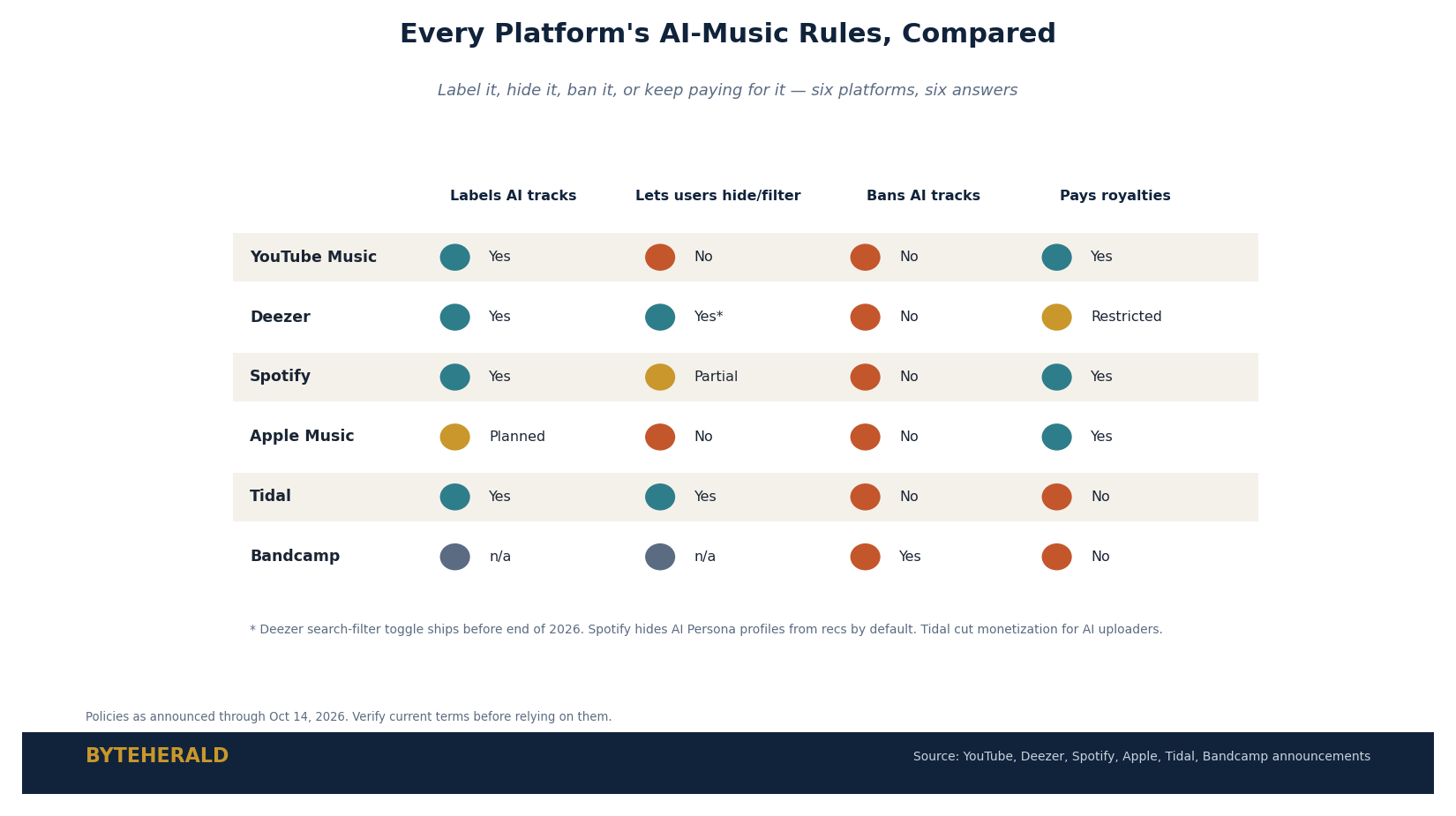
YouTube Music, three labels (Fully / Partly / No Gen AI), self-declaration plus detection, monetization allowed, penalties for non-disclosure. Deezer, labels detected AI tracks, excludes them from recommendations and playlists, withholds fraud royalties, and will add the search filter. Spotify, AI labels plus a spam filter, and "AI Persona" badges (announced August, rolling out since mid-September) for profiles with photorealistic AI-generated identities, excluded from editorial and algorithmic recommendations by default. Apple Music, "Made With AI" tags planned as part of its AI Transparency Tags later this year. Tidal, labels fully AI recordings, lets users hide them, and cut off monetization for uploaders of AI music. Bandcamp, the strictest stance: AI tracks banned entirely.
ByteHerald's reading
The industry has quietly sorted itself by business model. Ad- and subscription-scale platforms (YouTube, Spotify) disclose and keep the catalog, fraud is a spam problem to filter. Artist-centric platforms (Bandcamp, Tidal) restrict or ban, because their value proposition is human creators. Deezer is the swing vote, and it swung hard: when half your daily uploads are synthetic, a label is a nicety and a filter is a product feature. The open question is detection, every one of these systems assumes platforms can reliably tell synthetic from human, and that assumption has not been stress-tested at 90, 000 tracks a day. As with ChatGPT's move into ads, the monetization layer is where the real rules get written: who gets paid for AI-made content decides how much of it gets made.
By ByteHerald Staff. Platform policies: YouTube Music announcement and partner help page, Deezer announcement (Oct 14, 2026), TechCrunch. Policies change; verify current terms before relying on them.
Comments
Post a Comment