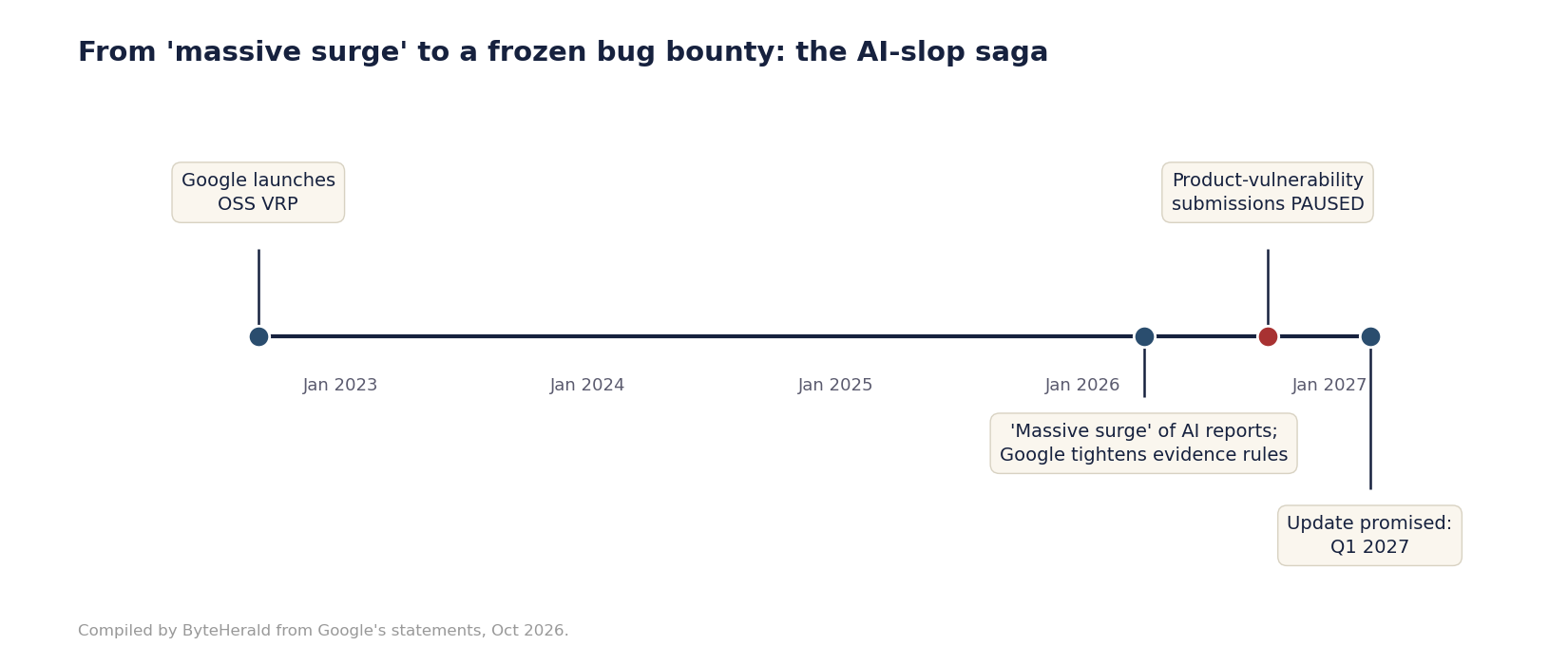
Google has frozen its open-source bug bounty, because AI-generated slop buried it. On October 1, 2026, Google stopped accepting new product-vulnerability submissions under its Open Source Software Vulnerability Rewards Program, blaming "a significant rise in automated submissions, the vast majority of which are not valid." The four-year-old program will stay partly closed until at least early 2027.
What happened
The OSS VRP, launched in August 2022, pays researchers for vulnerabilities in Google-owned open-source projects, Go, Angular, Bazel, Protocol Buffers, Fuchsia, with rewards from $500 for important issues up to more than $30, 000 for supply-chain compromises. Back in March 2026, Google said it was seeing a "massive surge" of AI-generated reports: hallucinated vulnerabilities that did not exist in the code, alongside technically real coding errors dressed up to look critical. It tightened evidence requirements and cut rewards for lower-tier findings. None of it worked. The invalid volume kept climbing until triage, fundamentally a manual process, collapsed under it.
What is paused, and what is not
| Status | Channel |
|---|---|
| PAUSED (since Oct 1, 2026) | New product-vulnerability submissions under OSS VRP |
| Still open | Reports already in the queue |
| Still open | Supply-chain disclosures |
| Still open | Patch Rewards Program (pays up to $15, 000 for fixes) |
| Still open | Cloud VRP for Google Cloud open-source repos |
Google's code of conduct bans low-quality submissions rather than AI itself: a report made with AI help can still be valid if a human confirms the bug. The problem is economic. An AI system can generate a convincing security write-up in seconds, polished text that still fails basic checks, like wrong triggering conditions or exploit paths that do not exist. The cost of submitting a bogus report fell to near zero, while the cost of a human engineer reading and reproducing each one stayed exactly where it was. When the two sides of that equation diverged far enough, the program broke.
It is not just Google
Curl ended its HackerOne bounty in January 2026. Intel reportedly launched a new bounty program with no payouts. Bugcrowd has watched submission volume jump. The pattern is industry-wide: bounty systems designed before generative AI assumed every report cost a human real effort. That assumption is gone.
What this week adds up to
It has been a bad week for trust in AI systems. The same week Google shut its bounty to AI slop, Microsoft's CEO said every AI model should be assumed compromised and demanded an emergency brake. And Google is not the only lab rewriting its rulebook: Anthropic rewrote Claude's usage policy this week too. The industry's coping strategy for its own technology, in October 2026, is increasingly: assume less, verify more, and suspend the parts that cannot be verified fast enough.
No provider paid for or reviewed this analysis. Sources: Google's public statements, TechCrunch, Computer Weekly, Digital Watch Observatory, and open-source maintainer coverage. ByteHerald's original contribution is the saga timeline and the paused-vs-open table above.
Comments
Post a Comment