Google's Universal Cart is live in the US. Save a product you find in Search or the Gemini app, and it waits in one cart, across retailers, with price-drop alerts, restock pings, promo codes, and credit-card-perk advice at checkout. It is the thirteenth major agentic-commerce move in thirteen months. We dated every one of them, and checked what the traffic data actually proves.
What Universal Cart does
Google announced the launch on October 15, first previewed at Google I/O in May. The cart collects items from multiple retailers into one hub, so a shopper can leave and return without re-searching. Google says it will notify users when a saved product's price drops or an out-of-stock item returns, surface promo codes, and, via Google Wallet, factor in each saved credit card's perks when suggesting how to pay. Checkout happens two ways: pay with Google Pay in a few taps at participating stores, or hand the items off to the merchant's own cart. The merchant stays the seller of record. Named launch partners include Nike, Sephora, Target, Ulta Beauty, Walmart, Wayfair, and many Shopify merchants.
The plumbing matters more than the cart. Checkout runs on Google's Universal Commerce Protocol (UCP), an open standard introduced earlier this year, designed so AI agents and retailers can work together across the shopping journey. Google co-developed it with retail leaders and has been adding technology partners to steer it. UCP checkout is slated to expand to Canada and Australia in the coming months, then the UK, and to YouTube in the US, plus hotel booking and local food delivery. In other words, the cart is the wedge; the protocol is the play.
The 13-month buildup, dated
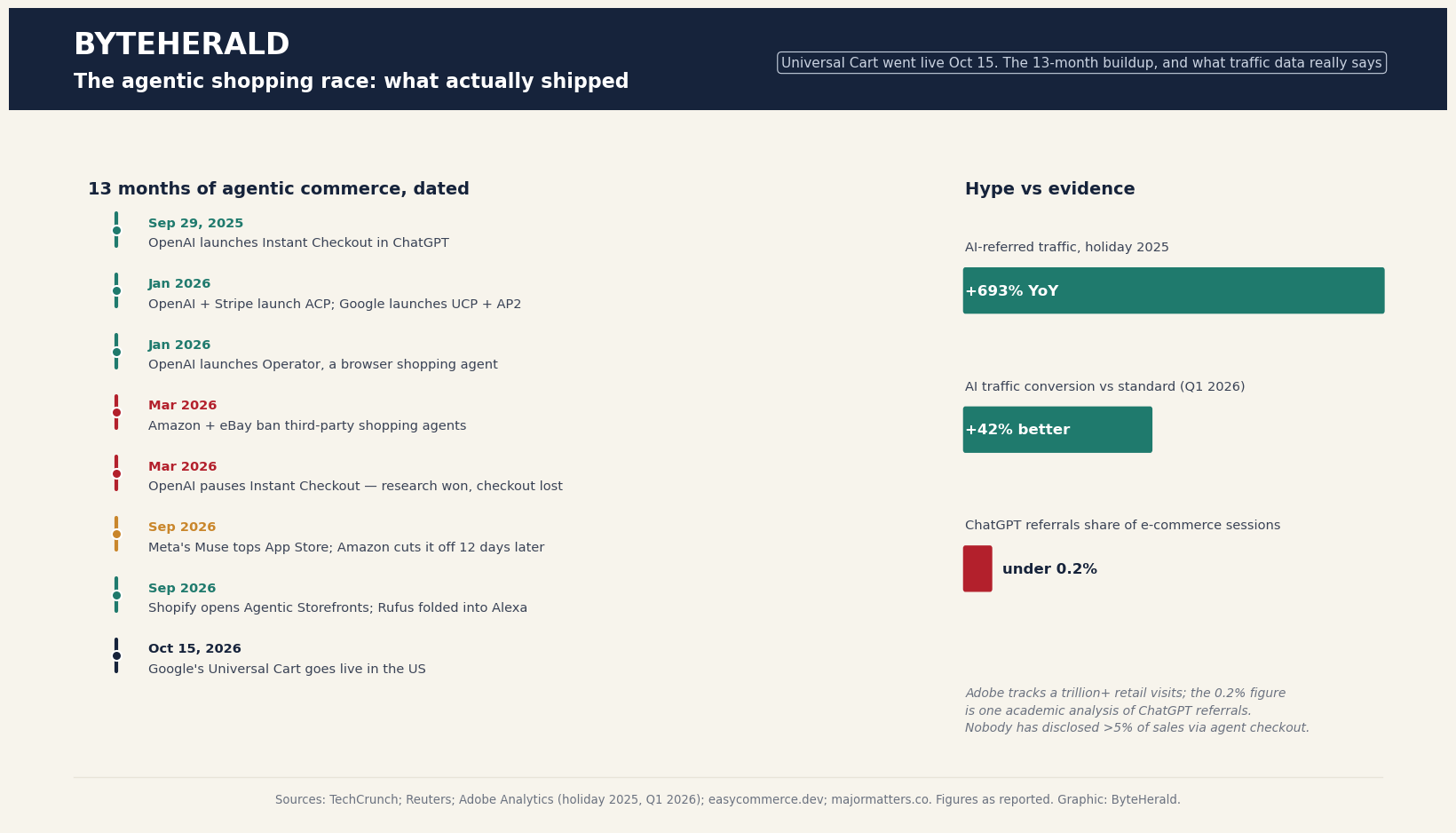
The tracker above is the original record. OpenAI fired the starting gun on September 29, 2025 with Instant Checkout inside ChatGPT, built on the Agentic Commerce Protocol co-developed with Stripe, real in-chat purchases from Shopify merchants. Then the reversals started. In March 2026, Amazon and eBay banned third-party AI shopping agents, each launching proprietary alternatives; the same month, OpenAI paused Instant Checkout, conceding shoppers used ChatGPT for research but rarely bought inside the chat. The merchant revolt peaked in September: Meta's Muse, a personal agent that shops and pays through Link by Stripe, hit the top of Apple's free app chart, and twelve days later Amazon cut it off for violating its terms. Shopify, meanwhile, opened its Agentic Storefronts program to AI agents. Google's entry today is the establishment's answer: no autonomous buying, just organized tracking plus assisted checkout, running on an open protocol merchants can inspect.
Hype vs evidence, the honest numbers
This is where ByteHerald's reading diverges from the victory laps. Adobe Analytics, tracking over a trillion visits to US retail sites, reports AI-referred traffic grew 693% year over year during the 2025 holidays and converted 31% more often than other traffic; by Q1 2026, AI traffic was up 393% and converting 42% better. Genuine signal. But a separate academic analysis found ChatGPT referrals specifically accounted for under 0.2% of e-commerce sessions, and no major retailer has publicly disclosed more than 5% of sales coming through agent-completed checkout. Salesforce's widely cited "20% of holiday orders" figure measures AI-influenced purchases, not purchases an agent actually completed. The traffic is real; the autonomous checkout revolution is not, yet. That matches what we found tracking OpenAI's own ChatGPT monetization push: the money is in influencing the purchase, not completing it.
ByteHerald's reading
Watch the protocol layer, not the cart. Four competing standards now exist for roughly the same idea, OpenAI and Stripe's ACP, Google's UCP and AP2, Visa's and Mastercard's agent-payment frameworks, and none has become the default. The next twelve months will be decided by merchant adoption: who shares catalogs, who publishes the machine-readable product files, who keeps the door open to third-party agents. The agent failures we've been cataloguing in production are the other half of this story, shoppers will hand agents their wallets only when the failure modes are contained. Google's bet is that a watchlist with assisted checkout earns that trust faster than an autonomous buyer. Given OpenAI's March retreat, that looks like the right read of the evidence.
By ByteHerald Staff. Timeline compiled from TechCrunch, Reuters, and industry reporting; figures as reported by the cited sources. The tracker graphic is ByteHerald's original compilation.
Comments
Post a Comment