Mistral released the weights of Large 4 on October 29, 2026, turning its flagship model from a hosted preview into something an organization can download, inspect, and run itself. Self-hosters and API buyers should weigh one comparison: after three weeks of added training, the open model lifted Terminal-Bench 4.0 from 28 percent to 41 percent, and it now matches GLM-5.3 on the Coding Agent Index while using 47 percent fewer tokens per task. The weights are the news. The token math is the reason to care.
What changed since the preview
Mistral introduced Large 4, nicknamed Le Chonk, in public preview earlier in October 2026 as a 1-trillion-parameter, natively multimodal model. The October 29 announcement, published by Mistral itself, says the response to the preview exceeded expectations and that three more weeks of reinforcement learning, guided by developer and customer feedback, produced the version whose weights are now public. This is not a rerun of the October benchmark comparison of open models. That post compared preview specifications. This post covers the weights release and the training gains since preview, which are the facts a self-hosting decision actually turns on.
| Measure | Preview | Weights release, October 29, 2026 |
|---|---|---|
| Terminal-Bench 4.0 | 28 percent | 41 percent, up 13 points |
| Terminal-Bench output tokens | Preview baseline | Down 30 percent |
| FrontierCode 2.0 (Cognition, private) | Not reported as a lead | 19.7 percent, first among open models |
| Artificial Analysis Coding Agent Index | Not reported as tied | 48 percent, effectively tied with GLM-5.3 |
| B3 Agent Security Benchmark resistance | 93.3 percent | 97.1 percent |
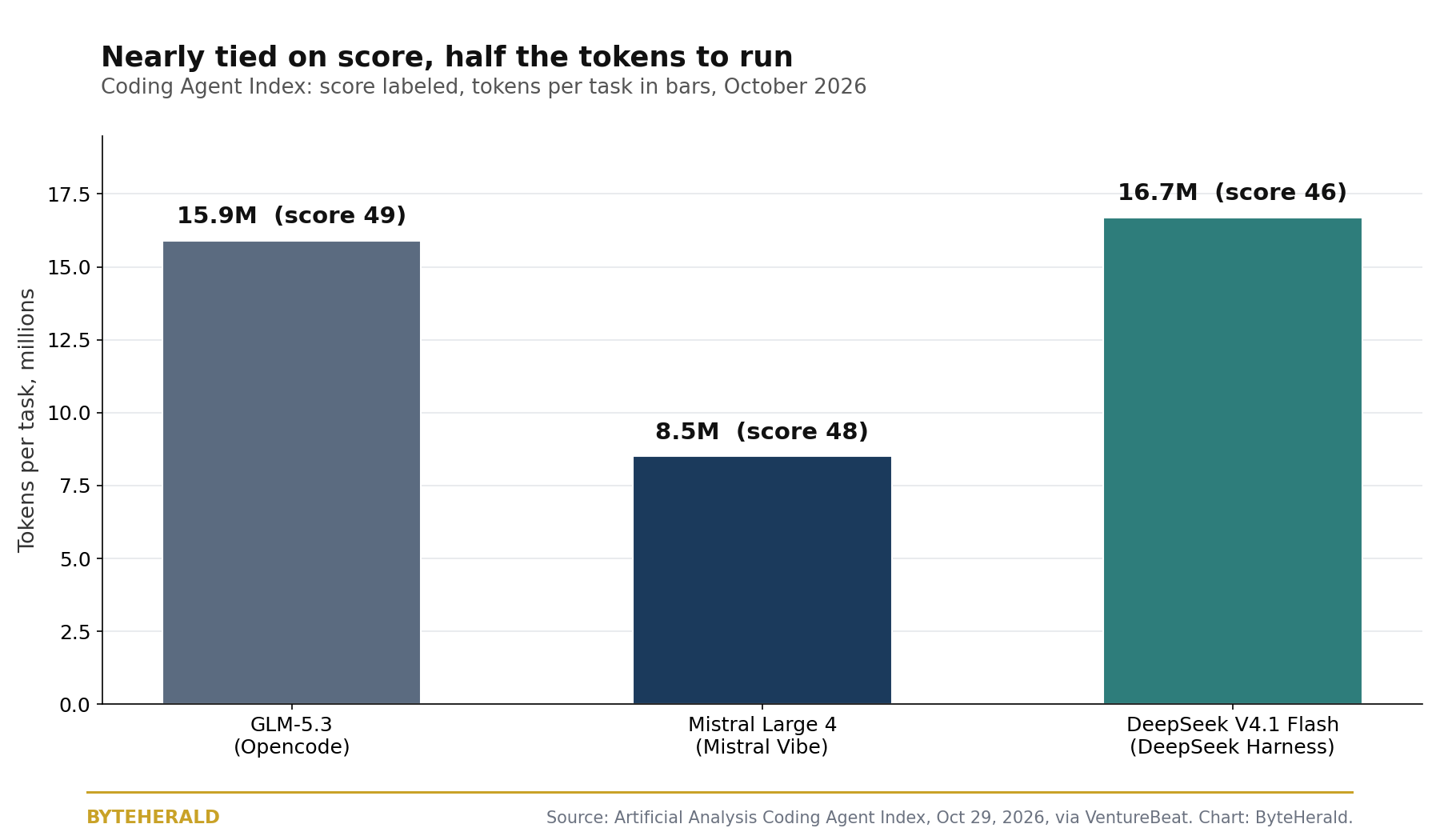
Two other Mistral-reported figures complete the coding picture. On the Artificial Analysis Coding Agent Index, Large 4 scores 48 percent while using 47 percent fewer tokens per task on average than GLM-5.3. In blind pairwise comparisons run by Surge Code, human graders preferred Large 4 over GLM-5.3, Kimi K3, and DeepSeek V4.1 Flash, and ranked it behind only Claude Opus 5.5 among the models tested. The full technical report has not been published yet, so these remain vendor-reported figures awaiting independent reproduction, a point the article returns to below.
The token math, read honestly
The chart above needs its harness attached, or it misleads. Artificial Analysis reports the Coding Agent Index as a model-plus-harness result: GLM-5.3 runs with Opencode, Large 4 with Mistral Vibe, and DeepSeek V4.1 Flash with the DeepSeek harness. The scores therefore compare complete agent configurations, not bare models on identical scaffolding, and a one-point gap between GLM-5.3 at 49 and Large 4 at 48 does not establish a meaningful capability difference. What the token side does establish is cost behavior under those configurations: 8.5 million tokens per task for Large 4 against 15.9 million for GLM-5.3 and 16.7 million for DeepSeek V4.1 Flash. For long agent sessions, that gap compounds, which is why Mistral frames the result as a Pareto gain rather than a pure score win. Readers who want the price side of the same decision can start from our flash-model price scoreboard, which shows how the cheapest pick changes by workload and by hour, because token counts only become money once a price is attached.
A second honesty note concerns the Terminal-Bench number. Mistral reports 41 percent for the weights release. A separate Artificial Analysis evaluation of Large 4 under the Intelligence Index harness reports a different Terminal-Bench figure, because the harness, the effort setting, and the task set differ. Neither number is wrong on its own terms. The lesson for buyers is to never compare a vendor headline number against an independent number without checking that both came from the same harness, and to treat any single-benchmark lead as a claim to reproduce, not a verdict.
Cyber defense is the second bet
Mistral positions Large 4 as a defender's model as much as a coder's model. It scores 51 percent on the Artificial Analysis Cyber Index, which measures finding a vulnerability in a codebase, reproducing and validating it, and patching it without breaking existing functionality. Its guardrails refuse an average of 96.6 percent of malicious cyber requests across JailbreakBench, StrongREJECT, and AgentHarm, which Mistral says is the highest rate it measured among open models. On the B3 Agent Security Benchmark, resistance to attacks rose from 93.3 percent in preview to 97.1 percent, which Mistral places at the top of the open frontier.
The caveat matters as much as the scores. Mistral says monitoring of live traffic showed potential for the model to assist real attacks, and that it is modifying guardrails in response. It is also giving vetted enterprise partners, including Orange Cyberdefense, preview access to a specialized variant for penetration testing, vulnerability assessment, and red-teaming, restricted to owned or explicitly authorized systems under contractual safeguards. A model that can patch a vulnerability can also describe one, and the line between defensive use and offensive uplift is a deployment policy, not a property of the weights. Any team that self-hosts Large 4 for security work needs that policy written before the first scan, not after.
What open weight actually buys, and what it costs
Open weight means an organization can inspect, customize, and deploy the model on its own infrastructure without depending on Mistral to serve it through an API. Mistral stresses that Large 4 was trained from scratch on European infrastructure, which is the foundation of its sovereignty pitch: control over the model, the data it touches, and the agents built on it. Hosted access remains available through Mistral Studio, the Mistral API, OpenRouter, and Microsoft Foundry, so self-hosting is an option, not an obligation. The model ships under the Mistral Ecosystem Open-Weight license, a modified MIT license that is free to use, modify, fine-tune, and commercialize, with one condition that every prospective hoster must read: a business operating a Model-as-a-Service offering must obtain a separate commercial license from Mistral before using the model commercially. The license is not the same as permission to resell the model as a service.
On hardware, the figures reported by secondary coverage, not by the Mistral announcement itself, put Large 4 at 52 billion active parameters out of 1 trillion total, with a 1-million-token context window and a quantized version intended to run on four Nvidia B200 or B300 GPUs. Treat those hardware figures as reported, not as announcement figures, until the technical report lands. The memory math behind any self-hosting plan follows the same rule we used for phones: parameters times precision sets the floor, and the serving stack sets the rest, as explained in our parameters-to-memory explainer. Mistral also added three reasoning modes, Low for simple tasks, Medium for everyday tasks, and High as the default for the hardest work, which lets a team trade reasoning depth against token cost instead of paying the maximum on every call. API list prices in the announcement are 0.70 dollars per million input tokens, 0.07 dollars per million cached input tokens, and 2.10 dollars per million output tokens.
How to decide: host it, rent it, or wait
Host it if control is the requirement: regulated data that cannot leave a firewall, a custom fine-tune on proprietary code or security data, or an audit trail that demands inspecting the artifact itself. Rent it through the API or a managed endpoint if speed to production matters more than control, since the hosted route avoids the serving, quantization, and guardrail-maintenance work that self-hosting adds. Wait for the technical report if the decision turns on a specific benchmark, because the headline gains are vendor-reported and the report that would let outsiders check the training and evaluation details is still listed as coming soon. The durable question behind this release is not whether a 1-trillion-parameter model can be open, because as of October 29, 2026, one is. It is whether open weights plus token efficiency are enough to move teams that already run on a hosted frontier model, and that answer will come from reproduction attempts and production bills, not from launch-day scores.
By ByteHerald Staff. Mistral announcement titled "Mistral Large 4 (Le Chonk) is now open weight," published October 29, 2026, gave the weights release, the FrontierCode 2.0 score of 19.7 percent, the Coding Agent Index score of 48 percent with 47 percent fewer tokens than GLM-5.3, the Terminal-Bench 4.0 rise from 28 percent to 41 percent with output tokens down 30 percent, the Cyber Index score of 51 percent, the 96.6 percent malicious-request refusal rate, the B3 resistance rise from 93.3 percent to 97.1 percent, the Finch score of 73.3 percent, the BrowseComp score of 84.5 percent, the three reasoning modes, the API prices of 0.70, 0.07, and 2.10 dollars per million tokens, and the modified MIT license with a Model-as-a-Service carve-out, and the Surge Code blind comparisons in which human graders preferred Large 4 over GLM-5.3, Kimi K3, and DeepSeek V4.1 Flash, ranking it behind only Claude Opus 5.5. VentureBeat coverage, published October 29, 2026, added the Artificial Analysis Coding Agent Index token figures of 15.9 million for GLM-5.3, 8.5 million for Large 4, and 16.7 million for DeepSeek V4.1 Flash, and noted that Artificial Analysis ranks GLM-5.3 first at 49 against Large 4 at 48 while Mistral characterizes the result as effectively tied.
Comments
Post a Comment