Nvidia released Nemotron 3.5 Transcribe on October 28, 2026, an open-weight model that transcribes 40 languages, translates 31 of them to or from English, labels speakers in 13 languages, and answers questions about a recording, all from one checkpoint. The direct answer for teams choosing a transcription stack is this: if your audio is already recorded, one promptable checkpoint now replaces a chained pipeline, but if you need live captions, this model is the wrong tool, because Nvidia built it for files, not streams.
What one checkpoint replaces
Most speech tools chain separate steps: detect speech, write it down, attach speaker names, then summarize. Transcribe folds those jobs into a single pass that a plain-language instruction steers. The same meeting recording can produce a verbatim transcript, an English translation, or an answer to what decisions were made, depending on the prompt. That is the practical change. The buyer question is no longer which transcription vendor to rent, but whether one self-hosted checkpoint can carry the whole job, including the formatting rules for a specific field.
Nvidia publishes the limits alongside the claims, and the limits decide the purchase. Recordings run up to one hour long, with up to eight speakers labeled. Audio question answering is trained in English, even where transcription covers more languages, and language support differs by task, so a team must check the task-by-language matrix before assuming every feature works in every language. Nvidia also tells developers to spot-check names, speaker changes, and answers against the recording, which is the right warning: a transcript that looks clean can still mislabel a speaker at a turn boundary.
The numbers that matter
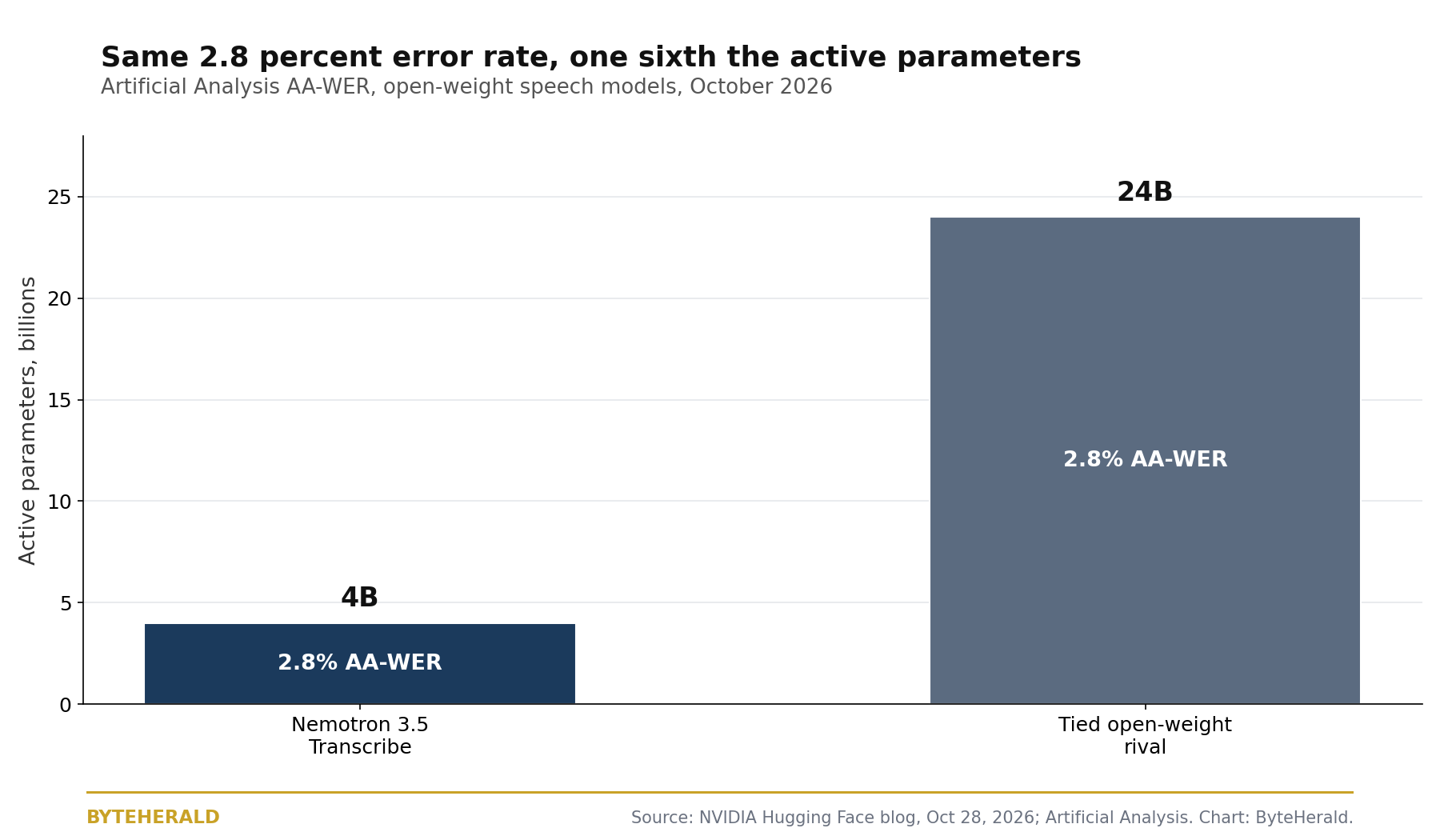
On the Hugging Face Open ASR Leaderboard, Transcribe ranks first among open-weight models for English at 5.33 percent average word error rate, with 4.62 percent mean across seven languages on the multilingual track and 10.98 percent on long-form audio. On Artificial Analysis, it ties for first among open-weight models at 2.8 percent AA-WER. The tie is where the engineering story sits: Transcribe reaches that error rate with about 4 billion active parameters, against 24 billion for the model it ties, which SiliconReport identifies as Mistral Voxtral Small. The model totals 30 billion parameters as a mixture-of-experts design, so most of the network stays quiet on any given token, and that sparsity is what lets it run on a single GPU.
Speaker attribution is where Transcribe leads outright rather than tying. It posts the lowest diarization error rate of 14 systems on David AI's 21-language benchmark at 18.26 percent, and ranks first of 14 on VoiceArena's English full-session comparison at 32.4 percent concatenated minimum-permutation word error rate, with deletions at 8.32 percent of reference words against a median near 31 percent. For meeting products, that second number matters more than the headline transcription score, because a transcript that drops every twelfth word at speaker changes is a different product from one that drops a third.
Speed, hardware, and the recorded-only catch
Nvidia says one RTX PRO 6000 Blackwell Server Edition GPU processed 100 hours of audio in under three minutes using a forthcoming NVFP4 quantized version, measured on 30-second clips at high concurrency. ByteHerald arithmetic puts that at about 2,000 times real time, but the conditions matter: short clips, high concurrency, and a quantized build that is not yet the shipping checkpoint. Treat the figure as a throughput ceiling for batch backlogs, not a promise for a single long file on a laptop. The shipping checkpoint serves through vLLM today, with SGLang-Omni support from day one and local NeMo-Speech.cpp deployment still coming, and Nvidia places the hardware range from a Jetson AGX Thor edge controller and DGX Spark desktop up to Blackwell data-center cards.
That hardware range is the reason this release connects to the small-model story ByteHerald has tracked all month, because the same question applies: what can a model actually do on one machine with limited memory. Readers weighing a single-GPU deployment should start with Small AI's Big Scoreboard: What a 4GB Model Can Actually Do, which works through the edge-hardware math from memory footprints to tokens per second on real boards, and then judge Transcribe on capability per gigabyte rather than raw parameter count.
The leaderboard tie deserves the same second look ByteHerald gave the last open-weight claims fight, where announced scores and measured scores diverged. Meta vs Xiaomi vs Mistral: The Open-Weight Benchmark Wars shows how to read a tie like this one, with a claims audit that separates measured results from announced ones, and it is the right lens for the 2.8 percent figure above.
Why Granary v2 is half the release
The model ships with Granary v2, an open data curation pipeline whose public manifest covers 463,062 hours across 48 languages and 16 source corpora, up from 25 languages in version one. Nvidia is careful to say those figures describe the dataset release, not the full training mixture or its sampling weights, and that distinction matters for anyone auditing what the model learned from. The pipeline produces three transcript forms per recording, plus captions, code-switching restoration, speech-grounded question-and-answer pairs, and translations with quality scores, which is the machinery that lets a developer define a written form and then train toward it.
The medical case study shows what that machinery buys. Naming English and the Latin alphabet in the prompt cut word error rate on Eka Care's Indian medical speech benchmark from 30.8 percent to 23.8 percent, and fine-tuning brought held-out speakers from 22.44 percent to 12.17 percent, a 45.8 percent relative reduction, using about 14 GPU-hours on one GB300. The cost of that gain is real data work: about 153 hours of synthetic speech plus 92 hours of public accented and medical speech, and at least 100 real labeled clips kept back for checkpoint selection. Prompting is free; the fine-tune that makes a medical transcript trustworthy is a data project.
How to decide
Choose Transcribe when the audio already exists, the languages fall inside its task matrix, and the team can run its own GPU or pay a hosted endpoint from Baseten, DeepInfra, or Simplismart. Keep a chained pipeline, or a streaming specialist, when the job is live captions, when audio question answering must work beyond English, or when speaker counts regularly pass eight. The evergreen question behind this release is not whether open speech models can transcribe, because they can, but whether one checkpoint can hold transcription, translation, speaker labels, and question answering without each job degrading the others. On the October 28 benchmarks, transcription and speaker attribution hold. Live audio and non-English question answering are the open items, and they are the ones to test before signing anything.
By ByteHerald Staff. NVIDIA Hugging Face blog, published October 28, 2026, announced Nemotron 3.5 Transcribe and Granary v2 with 40 transcription languages, 31 translation languages, 13 diarization languages, up to eight speakers, one-hour recordings, 5.33 percent English Open ASR word error rate, 2.8 percent AA-WER tie at about 4 billion active parameters, 18.26 percent diarization error rate, and the medical fine-tuning results. TechCrunch, published October 28, 2026, reported the single-chip hardware range from Jetson AGX Thor and DGX Spark to Blackwell, the meeting and medical transcription uses, and the recorded-audio limit. SiliconReport, published October 28, 2026, identified the tied open-weight model as Mistral Voxtral Small at 24 billion active parameters.
Comments
Post a Comment