Three model references named aurora-red-alpha, aurora-green-alpha, and aurora-blue-alpha briefly appeared in OpenAI's API on the morning of October 18, 2026, then were removed, while image models carrying the Aurora name were simultaneously battle-tested on LMArena. OpenAI has said nothing about them, which is exactly why this story needs care: what is confirmed, what is merely reported, and what is pure speculation are three different piles, and this article keeps them separate.
The sighting ledger
Every entry below is dated, sourced, and carries a status. This is the complete public record as of the evening of October 18, 2026.
| Date | Variant | Where spotted | What happened | Status |
|---|---|---|---|---|
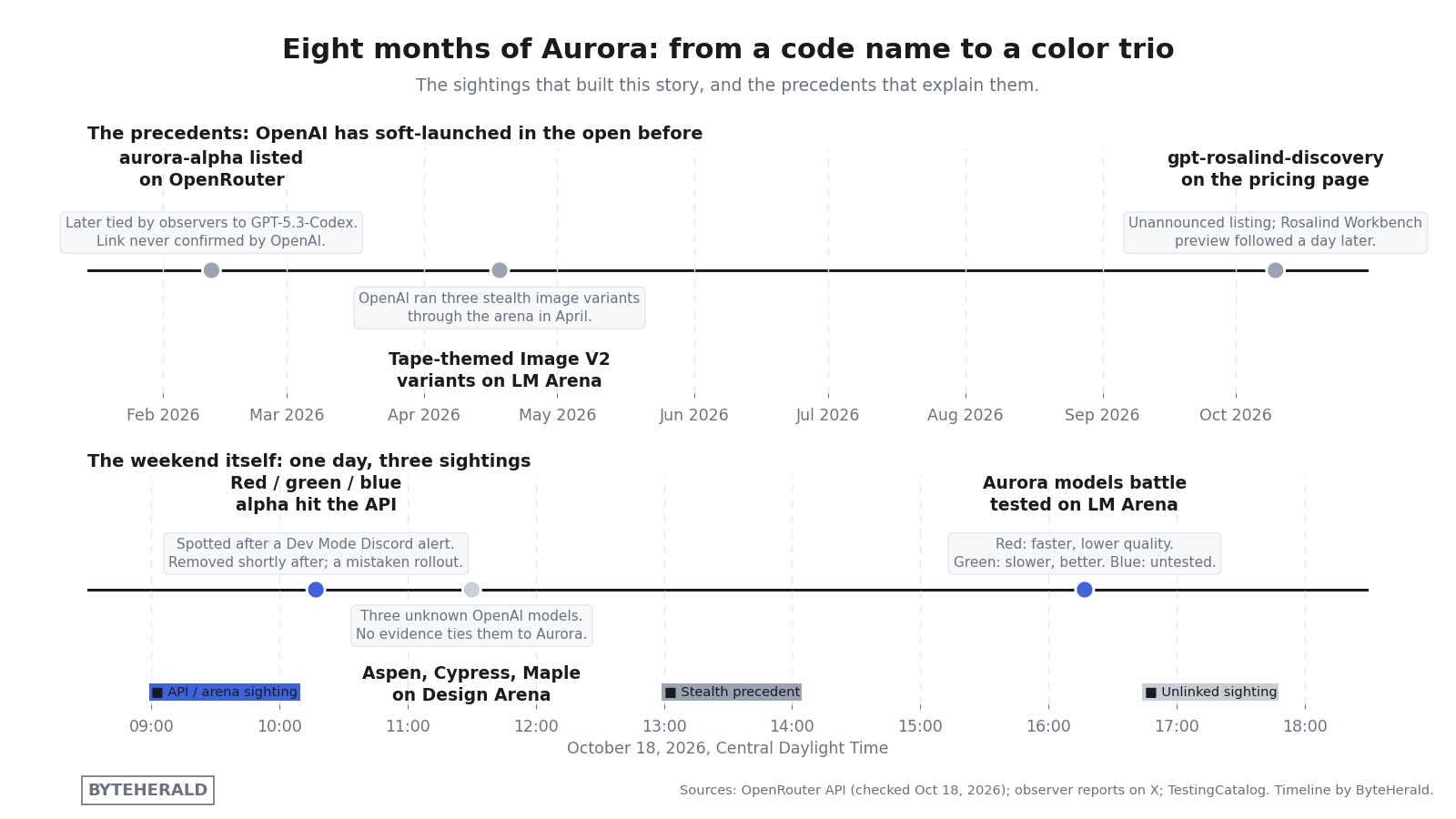
| Oct 18, 2026, morning | aurora-red-alpha, aurora-green-alpha, aurora-blue-alpha | OpenAI's API model list | Three identifiers appeared with no documentation, pricing, or changelog. A Dev Mode Discord alert flagged them, and TestingCatalog amplified the report on X | Removed within hours; reported as a mistaken rollout |
| Oct 18, 2026, afternoon | aurora-red-alpha | LMArena image arena | Generated a cat-portrait image in blind testing; the capture was posted by Lumina | Reported tested |
| Oct 18, 2026, afternoon | aurora-green-alpha | LMArena image arena | Generated a second cat portrait; Lumina described green as slower but higher quality than red | Reported tested |
| Oct 18, 2026 | aurora-blue-alpha | LMArena (reported) | Named in the API references; no test images had surfaced by the evening | Untested |
| Oct 18, 2026 | Aspen, Cypress, Maple | Design Arena | Three unknown OpenAI models appeared about an hour after the API references, reported by observer Intius | Unlinked: no evidence connects them to Aurora |
| Feb 2026 | aurora-alpha | OpenRouter | Listed on the multi-provider routing platform; observers later speculated it was a GPT-5.3-Codex-Spark variant | Link never confirmed; OpenRouter's current catalog, checked by ByteHerald on Oct 18, lists no aurora models at all |
What the three colors most plausibly are
The arena evidence settles the first question. Models that produce images in blind image-arena battles are image models. That single observation outweighs the competing theory, that these are coding models, which rests on the unconfirmed February thread tying aurora-alpha to a Codex variant. A coding model does not show up generating cat portraits in an image arena. If the coding reading somehow proves right anyway, the field it would enter is the one we measured in our five-assistant coding scorecard, but the evidence points the other way.
Inside the image-model reading, the red/green split already has a reported shape: red runs faster with lower quality, green runs slower with better quality. That mirrors a genuine OpenAI precedent. ChatGPT Images 2.5 shipped as two API models, GPT-Image-2.5 Flare for speed and GPT-Image-2.5 Sunburst for precision. Two tiers, two trade-offs, one product line. The color trio looks like the same playbook with a third variant, and blue's tier is simply unknown because nobody has tested it yet.
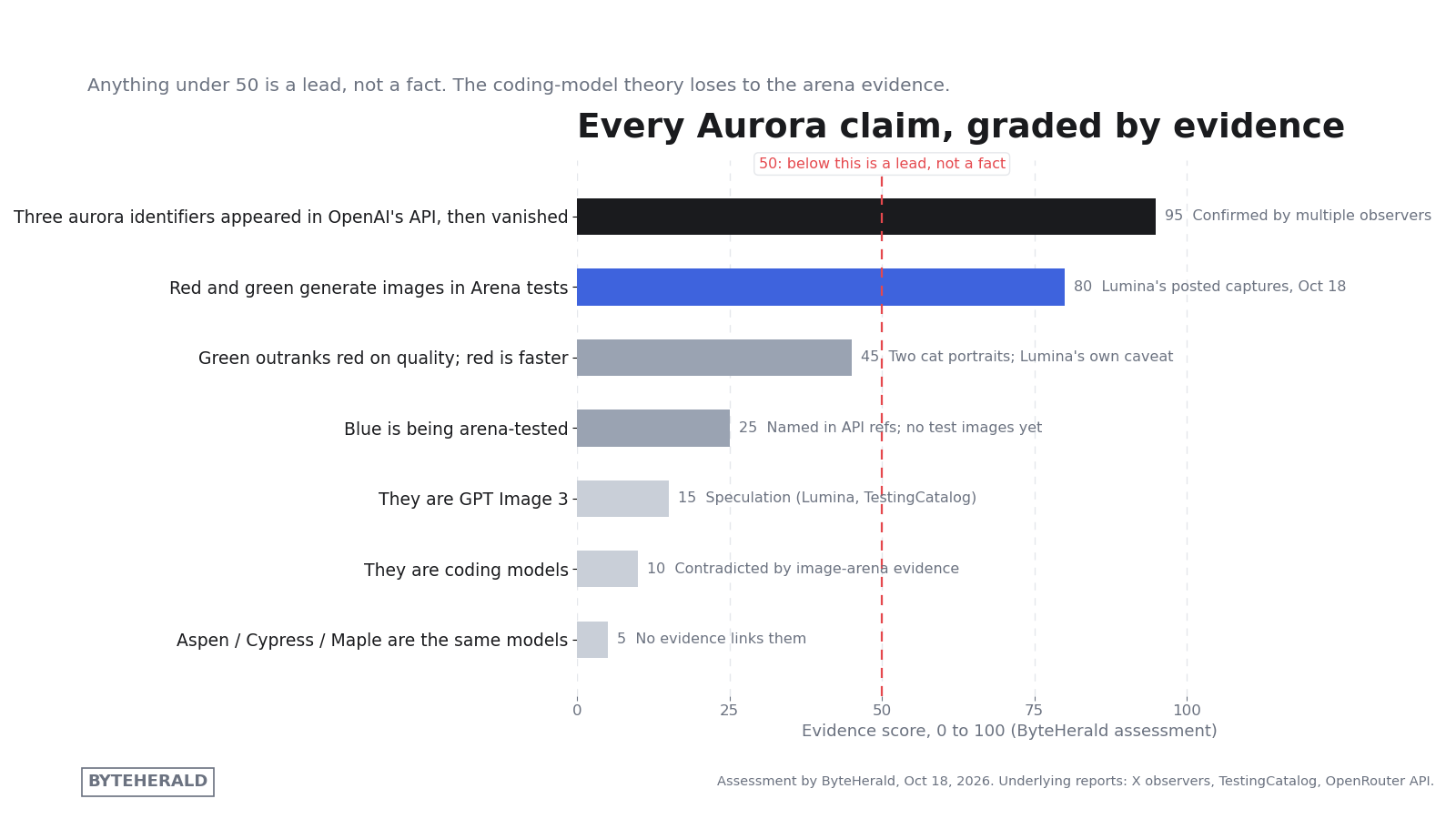
Are they GPT Image 3? Both Lumina and TestingCatalog float the idea, and both call it a guess. It stays in the speculation pile. Our judgment, labeled as judgment: three image-model variants in the GPT-Image lineage, red as the fast tier and green as the quality tier, blue unplaced. The chart below shows exactly how much weight each claim in this story can carry.
How to read a stealth sighting
This is the durable part of the story, the part that outlives the weekend. Frontier labs test under codenames on public arenas because blind preference votes at scale are worth more than any internal eval: thousands of real users, real prompts, no briefing documents. The codename is the point. If the model underperforms, the name dies quietly and nobody ever connects it to a product. If it wins its battles, the lab already has the preference data to justify the launch.
Sightings follow a recognizable sequence, and readers can check each stage themselves. First a trace appears where engineers look: an API model list, a pricing page, a router catalog. Then the codename starts fighting blind battles on an arena. Then, sometimes within days, the official name arrives with documentation. Anyone can watch the first two stages: OpenRouter's public catalog, the LMArena leaderboards, and OpenAI's pricing page are all one search away. That is how a Discord alert caught Aurora before any announcement existed.
| Date | Stealth trace | What it became | The lesson |
|---|---|---|---|
| Feb 2026 | aurora-alpha on OpenRouter | Reported as a GPT-5.3-Codex-Spark variant; OpenAI never confirmed the link | A codename can outlive its supposed reveal |
| Apr 2026 | Three tape-themed GPT-Image V2 variants on LM Arena | Folded into the image-model line | Arena-tested image variants ship quietly |
| Early Oct 2026 | gpt-rosalind-discovery on OpenAI's pricing page | Rosalind Workbench opened in research preview a day later | Pricing-page leaks can precede launches by days |
Stealth sightings are how the next entries in the model record usually begin. We keep the full dated record in our complete timeline of every major AI model release from 2024 through 2026; Aurora's row is unwritten until OpenAI names it.
Confirmed, reported, speculated
Confirmed. Three aurora identifiers appeared in OpenAI's API and vanished within hours, seen by multiple observers. Red and green generated images in arena tests, with posted captures. OpenRouter's catalog currently contains no aurora entries; ByteHerald verified this directly through the platform's public API on October 18. OpenAI has published no documentation, pricing, or statement about any of them.
Reported. Green outranks red on image quality while red is faster, per Lumina's tests, with the caveat that two cat portraits prove almost nothing. Blue is arena-bound but untested as of the evening. Three unknown OpenAI models named Aspen, Cypress, and Maple appeared on Design Arena about an hour after the API references; nothing ties them to Aurora.
Speculated. That these are GPT Image 3. That they answer Anthropic's Claude lineup, one X thread even floated "Astra" models as a countermove to Fable 5.5 and Opus 5.5, though Astra is already a shipping GPT-6 model name. That they are coding models, a theory the image-arena evidence argues against. That they launch on any particular date; nobody outside OpenAI knows.
Why OpenAI tests in the open
The mistaken API rollout is the tell. Internal tooling and public endpoints clearly share a namespace, so a flag flipped early exposes the codename to anyone watching the model list. OpenAI accepts that risk because the alternative is worse: launching a model without blind preference data. A codename costs nothing. A failed launch costs reputation. So the company keeps testing where the voters are, behind names that mean nothing until they mean something.
The ledger stays open. Blue has no test images yet, Aspen, Cypress, and Maple have no link to Aurora, and OpenAI has said nothing at all. The next sighting will fill one of those rows. When it does, this article will be updated at this URL rather than replaced by a competing one, because authority compounds on a single page.
By ByteHerald Staff. Sighting dates and arena reports via observer posts on X and TestingCatalog's October 18 coverage; OpenRouter catalog state verified directly through the platform's public API on October 18, 2026. The evidence-grading chart, sighting timeline, and hero graphic are ByteHerald originals.
Comments
Post a Comment