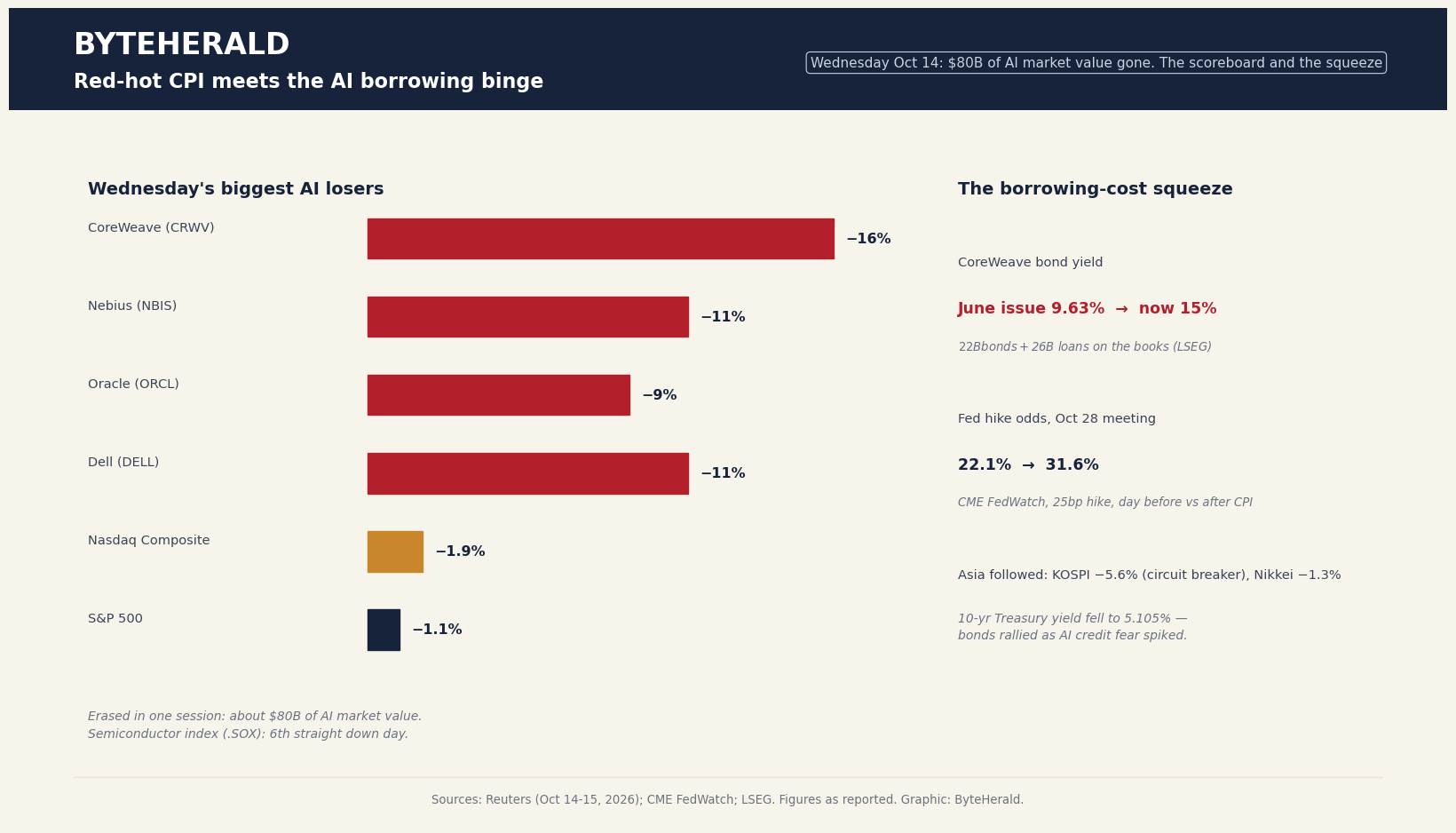
September's inflation report came in hotter than expected on Wednesday, and the AI trade paid for it. CoreWeave fell 16%, Nebius dropped 11%, Oracle and Dell each lost about 9 to 11%, and roughly $80 billion of AI market value vanished in a single session. A bond CoreWeave issued in June at 9.625% is now yielding 15%, distressed-credit territory for the poster child of the AI buildout. The catalyst this time was not an earnings miss or a revenue scare. It was borrowing costs.
What the Wednesday scoreboard says
The S&P 500 fell 1.1% and the Nasdaq tumbled 1.9%, but the damage was concentrated in the AI complex. The semiconductor index extended its losing streak into a sixth day. Barclays downgraded Dell and two other enterprise hardware stocks on the same day, noting Dell shares have quadrupled this year and that 16 stocks in the S&P 500 technology sector have at least doubled in 2026, an AI-fueled investor binge now running into a hot-inflation wall. Reuters' reporting adds the macro kicker: Fed funds futures repriced the odds of a 25-basis-point rate hike at the October 28 meeting from 22.1% to 31.6% in a day. "While the initial selloff was triggered by the hotter-than-expected CPI, tech was the main driver of today's selloff, " JPMorgan analysts wrote, adding that "AI was again the main challenge ... with financing risks and IPO timelines still at the centre of the story." This is the second leg of a two-day repricing: this morning we tracked the first leg, when Anthropic's revenue deceleration met the same financing fears.
The borrowing-cost squeeze
The most leveraged names fell hardest, which tells you this is a credit story wearing an equity costume. CoreWeave has issued $22 billion of bonds and $26 billion of loans, per LSEG data, and its June bond now yields 15%, up from 9.625% at issue. Analysts polled by Reuters are blunt: CoreWeave is "a proxy for other highly leveraged companies, " and investors are worried about "a debt crisis associated with these highly levered tech companies." CoreWeave CEO Mike Intrator called the market "irrational" in an internal memo, Bloomberg reported. Meanwhile the contagion crossed the Pacific overnight: South Korea's KOSPI fell 5.6% and triggered a circuit breaker, the Nikkei dropped 1.3%, and, in a sign of how fearful credit has become, Treasuries rallied even as inflation ran hot, with the 10-year yield falling to 5.105%. We traced CoreWeave's bond distress line last night, when the 2032s fell below 80 cents; Wednesday moved that stress from the bond desk to the stock tape.
ByteHerald's reading
Two selloffs in two days with two different triggers, revenue deceleration, then inflation, point to one underlying condition: the market has decided the AI buildout is a financing trade first and a technology trade second. When the marginal buyer of AI equity is really pricing AI credit, every macro print becomes a tech catalyst. The honest question nobody on the tape is answering yet: at what yield does the buildout slow, not because demand failed, but because the debt does? Watch the October 28 Fed meeting and the next CoreWeave bond print. That spread is the whole story now.
By ByteHerald Staff. All figures as reported by Reuters (Oct 14-15, 2026), CME Group FedWatch and LSEG; analyst quotations are brief excerpts. This is analysis, not investment advice. Scoreboard graphic is ByteHerald's original compilation.
Comments
Post a Comment