Six AI startups announced $232.3 million in funding between October 8 and October 31, 2026, and more than three-quarters of it went to two companies, Dulo and Broccoli, while 60.4 percent of the total went to seed-stage rounds. The money did not chase chatbots; it chased AI that designs hardware, runs operations, and guards the agents doing the work.
The ledger
Every figure below is a reported funding amount, and the totals are ByteHerald sums of those reported figures, not any company's own presentation. Broccoli's $52 million counts as one company's combined total across two rounds, not as a single round. Amounts marked as company figures are the companies' own claims, not independently verified.
| Company | Round | Amount | Announced | What it builds | Lead and backers |
|---|---|---|---|---|---|
| Dulo | Seed | $130 million | Oct 29, 2026 | Foundation models for hardware design | Eric Schmidt, John Doerr, Marc Benioff, others; no lead disclosed |
| Broccoli | Series A $22M + Series B $30M | $52 million | Oct 28, 2026 | AI agents for home-service businesses | Khosla Ventures led both; Y Combinator, Operator Partners |
| Infisical | Series B | $40 million | Oct 27, 2026 | Agent Vault: agent access without holding credentials | Elad Gil led; Gradient, Y Combinator |
| Phinity | Seed | $5.2 million | Oct 8, 2026 | Autonomous chip-design agents, architecture to tapeout | Uncork Capital led; Moxxie, angels incl. Jeff Dean |
| Minicor | Seed | $3.8 million | Oct 14, 2026 | AI bridge to legacy desktop software without APIs | IA Ventures led; Y Combinator, Paul Graham, others |
| Subvocal | Pre-seed | $1.3 million | Oct 30, 2026 | Silent-speech glasses using radio-frequency sensing | Y Combinator, Afore Capital, angels |
| Total, six companies | $232.3 million |
Three patterns in the money
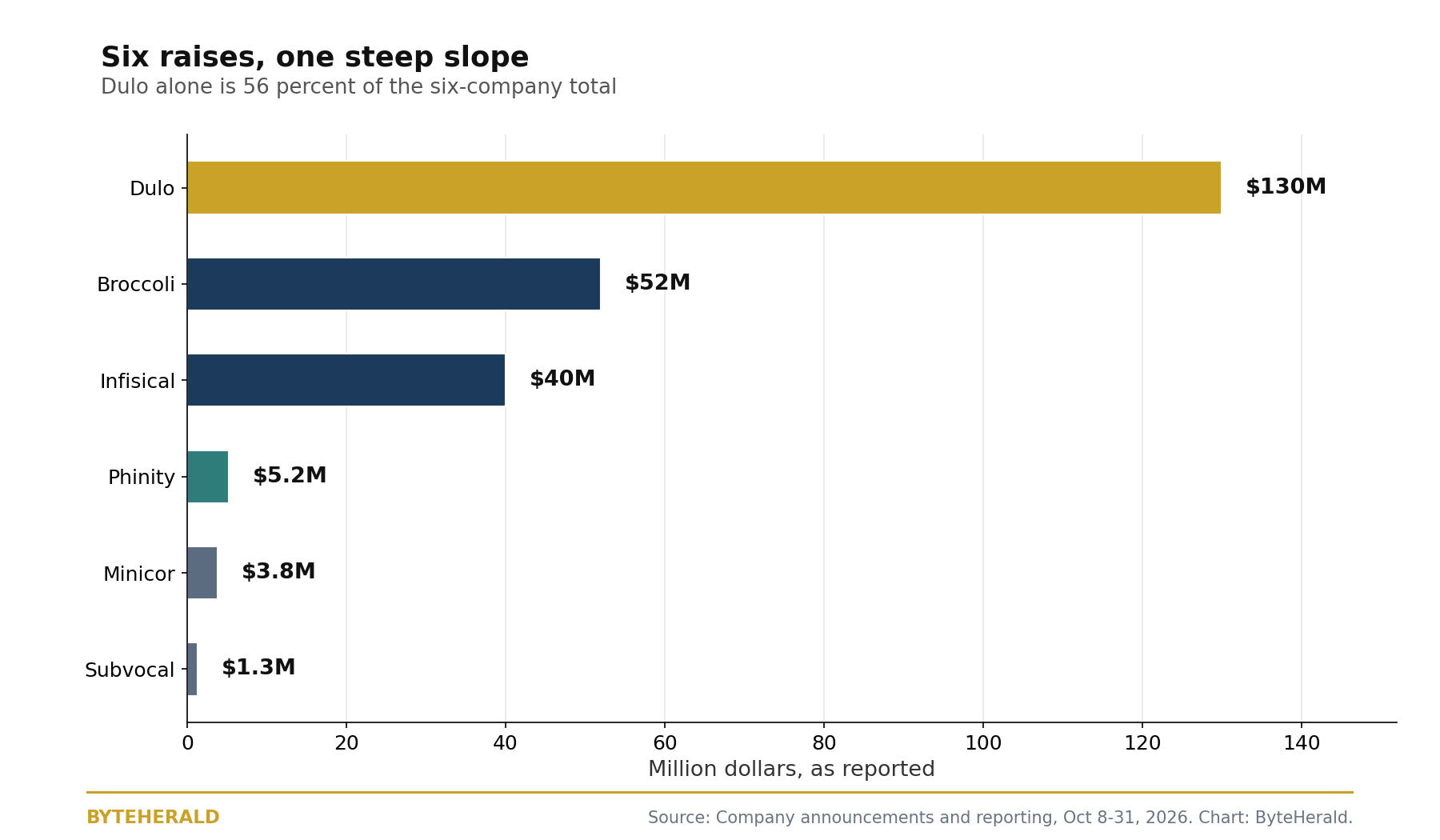
First, concentration. Dulo alone is $130 million of the $232.3 million total, or 56.0 percent, and the top two companies, Dulo and Broccoli, are $182 million, or 78.3 percent. A ledger whose top two rows hold nearly four-fifths of the money is not a broad boom; it is two large bets plus four small ones.
Second, stage. Seed-stage rounds, Dulo, Phinity, Minicor and Subvocal, total $140.3 million, or 60.4 percent of the ledger. But Dulo's seed is not a typical seed: at $130 million it sits above the 99th percentile for all-time United States robotics seed rounds by funding amount, according to Dealroom, and the company has disclosed no valuation, no lead investor, no product, no customers and no revenue. The seed share is real arithmetic; it is not evidence that seed investing is healthy in general, because one round is most of it.
Third, direction. Group the six by what the money buys and the physical world dominates: hardware design (Dulo plus Phinity) is $135.2 million, or 58.2 percent; operations agents (Broccoli plus Minicor) are $55.8 million, or 24.0 percent; agent security (Infisical) is $40 million, or 17.2 percent; the consumer interface (Subvocal) is $1.3 million, or 0.6 percent. October's small-round money went to AI that touches things, designs chips, answers a plumber's phone, connects a medical records system, and the company that keeps agents away from passwords. None of the six is a chatbot company.
Row by row: what is proven, what is claimed
Dulo was co-founded in 2026 by Sebastian Thrun and Adrian Aoun, and its round was first reported by The Information on October 29, 2026, then confirmed by Aoun. Everything else about it is undisclosed: no valuation, no lead, no product specifications, no commercial customers, no independent performance benchmarks. The honest description is a very large bet on a founding team and a thesis, not a product result.
Broccoli's $52 million is the best documented row in one respect and the weakest in another. The two rounds, $22 million Series A and $30 million Series B nine months apart, plus a prior $1.5 million seed, are confirmed by the company's own announcement. Its operating figures, more than 1,500 businesses, more than 10 million customer conversations, 2.5 million appointments booked, revenue tripled since Series A, headcount from 15 to more than 150, are company figures. Its $300 million post-money valuation is reported by Fortune via a person familiar with the matter and is not confirmed by the company; this article reports it as reported, not as fact.
Infisical's $40 million Series B at a $600 million valuation, led by Elad Gil, who also led its $16 million Series A in June 2025, is the round with the clearest product story: Agent Vault brokers an agent's access to enterprise systems through a proxy so the agent never holds the password or API key itself. Its scale figures, more than 1,300 customers, 300,000 developers, 10 billion secrets a day, describe the whole platform, not Agent Vault alone, and this article does not merge them.
Phinity's $5.2 million seed, announced October 8, 2026, on the company's own blog and confirmed by its law firm's client news, aims at fully autonomous chip design with a closed loop: agents design, measure against physical feedback, and revise, from architecture discovery through tapeout. Its eight-figure annualized revenue run rate and its work with large foundation-model labs are company claims with no independent verification, and the company has not disclosed its customers or valuation.
Minicor's $3.8 million seed, announced October 14, 2026, connects AI applications to legacy desktop software that never shipped with an application programming interface, a gap its founders found when a prospective customer needed to connect an AI product to a medical records system without one. Two honesty notes apply. The founders reached Y Combinator's Spring 2026 batch after seven applications and three interview invitations; headlines call those seven rejections, but the record does not confirm that all seven applications ended in rejection, so this article says seven applications. And its 2.5 million automation executions are company-reported and unverified, as are its valuation, revenue and paying customer count, all undisclosed.
Subvocal's $1.3 million pre-seed, announced October 30, 2026, is the smallest row and the easiest to misread. The glasses use radio-frequency sensing to read silent mouth movements and claim text entry above 200 words per minute, a speed nobody outside the company has independently verified, with pre-orders at a $499 early-bird price and shipping targeted for the first quarter of 2027. The free version a developer built in nine minutes, Subvox for AirPods, is different technology: it reads head-motion data, handles a few trained words, has no language model and publishes no accuracy score. It is a demo that a rough version can be built quickly, not evidence that the glasses work as claimed, and this article does not present it as such.
What the ledger leaves out
This ledger covers six verified rounds announced between October 8 and October 31, 2026. It is not a census of October funding. Private rounds that were never disclosed cannot be counted, aggregate figures whose components cannot be verified are not counted, and one visible round was deliberately excluded: Matiks raised $10 million in a pre-Series A round led by General Catalyst on October 26, 2026, but it is a gaming round whose AI product, a no-code game-creation engine, is planned rather than shipped, so counting it as AI funding would overstate the ledger. Readers who add Matiks back in get $242.3 million and a different thesis; readers who want the AI-only picture should use $232.3 million.
The contrast with the big money is the point of keeping this ledger separate. ByteHerald's five-company capex ledger added up $803 billion to $828 billion of 2026 spending across Amazon, Alphabet, Meta, Microsoft and SpaceX, and the $232.3 million here is roughly three-hundredths of one percent of that wave. And the mega-round mood cooled in the same week: OpenAI cut its funding target from $30 billion to $20 billion on October 31, 2026, with $11 billion reported secured so far. Small-round money kept moving to builders while the largest round shrank, and that divergence, not any single raise, is the story this ledger tells.
What to watch next
Six checkable events, in no particular order, will test whether this ledger was signal or noise. Dulo discloses a product, a customer, or a valuation. Broccoli confirms or corrects the reported $300 million valuation. Infisical moves Agent Vault from preview to general availability with a disclosed customer count. Phinity names a tapeout or a customer, against Dealroom's reported 2028 target for production-ready design files. Minicor discloses paying customers or revenue. Subvocal ships in the first quarter of 2027, or an independent test measures its 200-words-per-minute claim. Until at least one of those happens, the correct summary is the one the table already gives: $232.3 million, six companies, one direction.
By ByteHerald Staff. The Information reported on October 29, 2026, that Dulo raised $130 million in seed funding for foundation models for hardware design, with co-founder Adrian Aoun confirming the round and no valuation or lead investor disclosed. Broccoli announced on October 28, 2026, that it raised $52 million across Series A and Series B rounds led by Khosla Ventures, with more than 1,500 businesses using its home-service AI agents. Infisical announced on October 27, 2026, a $40 million Series B at a $600 million valuation led by Elad Gil to expand its agent security platform. Phinity Labs announced on October 8, 2026, a $5.2 million seed round led by Uncork Capital for autonomous chip-design agents. Minicor announced on October 14, 2026, a $3.8 million seed round led by IA Ventures to connect AI applications to legacy desktop software. The Subvocal Company announced on October 30, 2026, approximately $1.3 million in pre-seed funding from Y Combinator and Afore Capital for silent-speech glasses.
Comments
Post a Comment