Character.AI filed for Chapter 11 on October 12, 2026, and its court-supervised sale is expected to conclude by early December. The companion-chatbot startup that defined the AI consumer boom is being sold for parts. Our autopsy finds three compounding causes of death: inference economics that never worked at 20 million monthly users, a legal-liability spiral that made the company unsellable as a whole, and a funding history in which the famous $2.7 billion was never a valuation at all.
The $2.7 billion was never a valuation
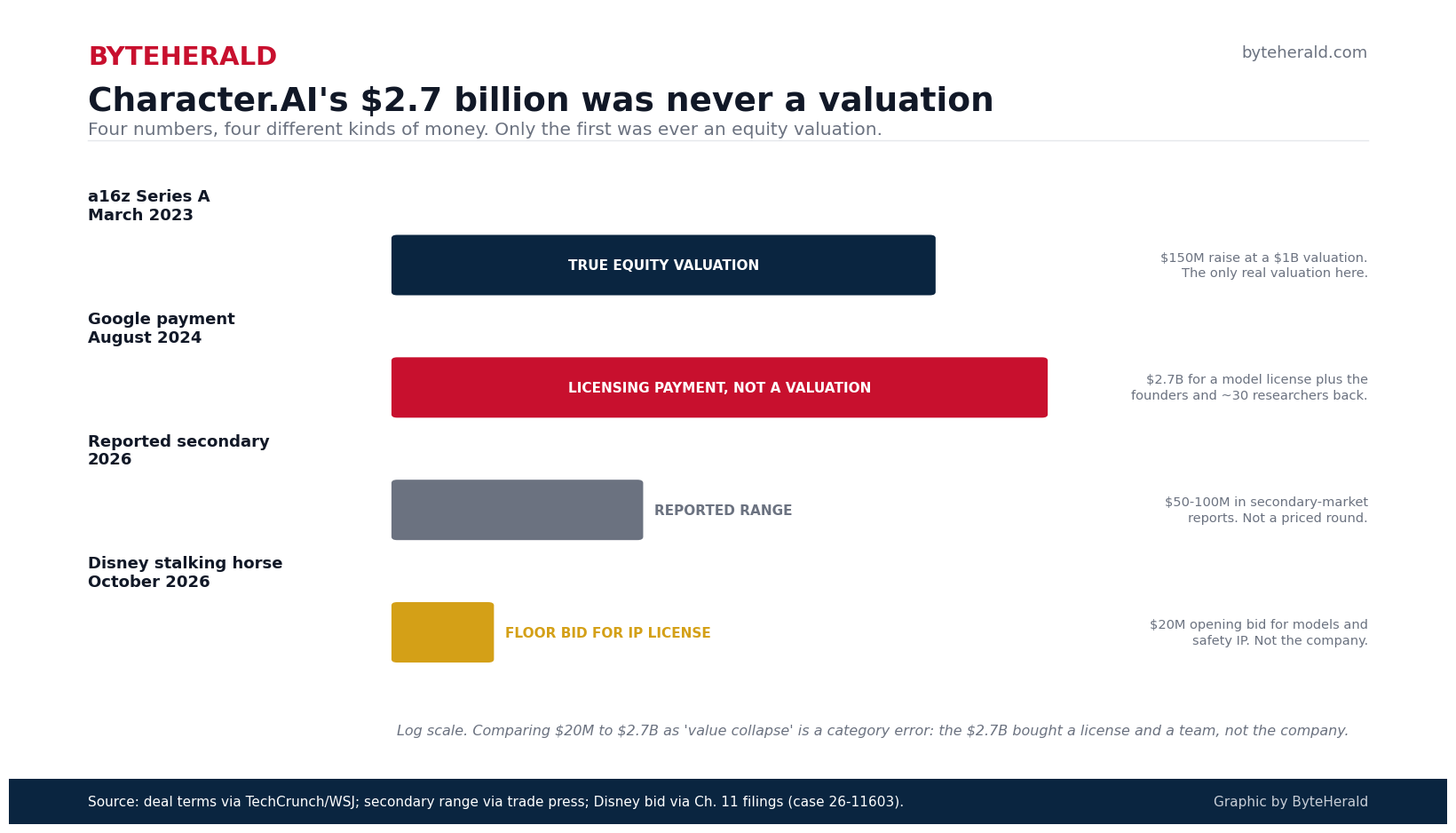
Start with the number everyone cites, because it is wrong in an instructive way. In March 2023, Andreessen Horowitz led a $150 million round at a valuation above $1 billion. That was a real equity valuation: investors priced the company. In August 2024, Google paid $2.7 billion, but Google did not buy the company. It bought a non-exclusive license to Character.AI's models, and as part of the deal co-founders Noam Shazeer and Daniel De Freitas, the former Google engineers behind LaMDA, returned to Google with roughly 30 researchers. The company kept operating capital and lost its research core. We traced the five-year arc on October 13; the correction matters because every "collapse from $2.7B to $20M" headline compares a licensing payment to a bid floor. The honest comparison is $1 billion in equity value (2023) against a $20 million stalking-horse bid for an IP license (2026), and even that compares different things.
The Google deal was a reverse acquihire, the signature transaction of the AI era. Instead of acquiring the startup and inviting antitrust review, the lab pays billions for a license and hires the team. Microsoft did it with Inflection, Amazon with Adept, Google with Character.AI. For founders and early investors it is an exit. For the company left behind it runs in reverse: the users stay, the researchers go, and the product has to survive on momentum.
Cause of death 1: the inference hole
Character.AI peaked at 20 million monthly active users, and Reuters reports the company was burning over $8 million a month. Do the division: roughly $0.40 per user per month in cost, about $96 million a year, for a product whose core interaction, long open-ended conversation, is among the most inference-expensive things a model can do. Companion chat is not a search box; it is thousands of tokens per session, sustained daily, mostly from users who never pay. The company never disclosed subscription numbers, and its advertising business only began in 2025. There is no public evidence the revenue ever came within an order of magnitude of the burn. This is the structural problem with companion apps: engagement is the cost center, not the asset.
Cause of death 2: the liability spiral
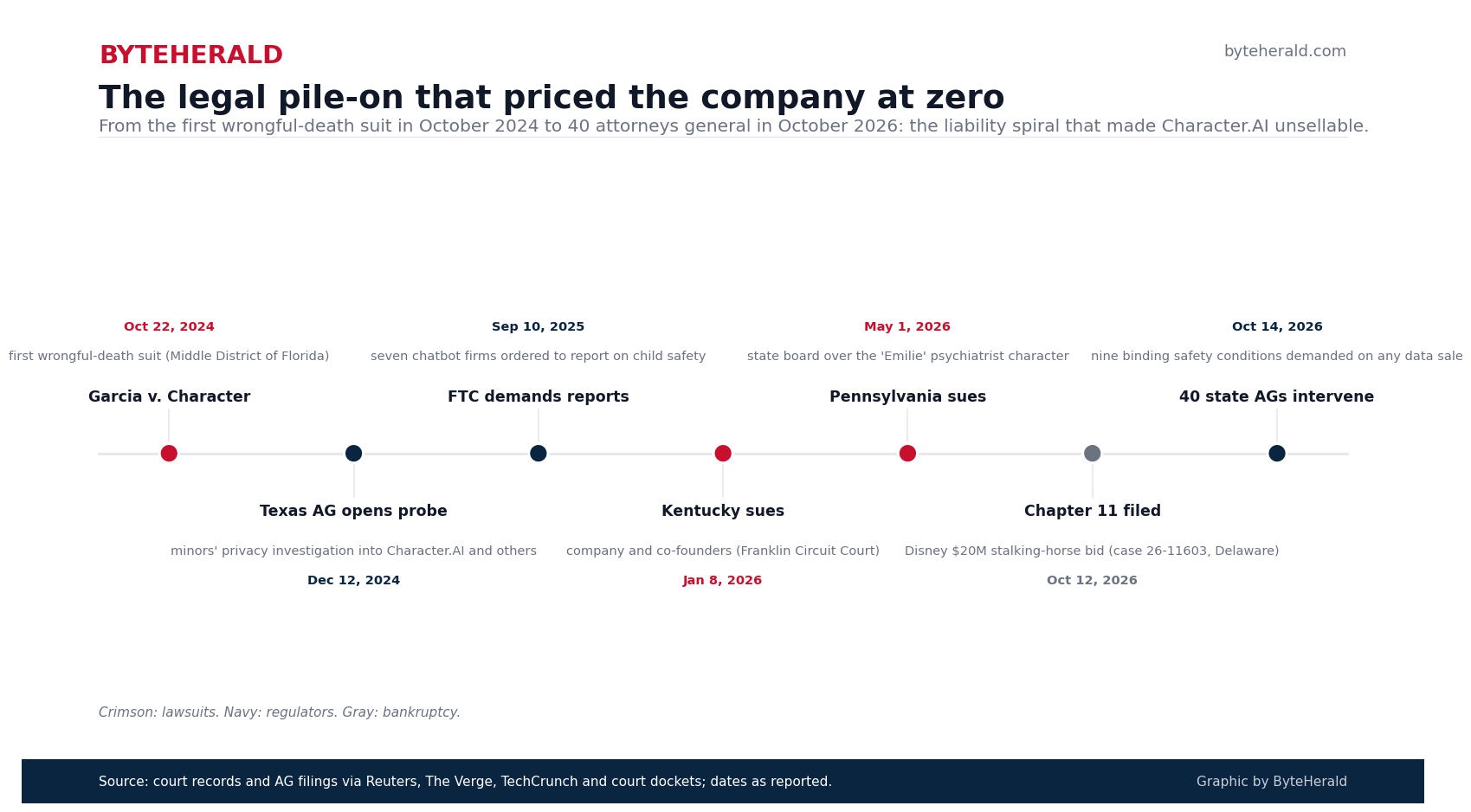
While the economics bled, the lawsuits compounded. October 2024: the first wrongful-death suit, Garcia v. Character Technologies, filed in Florida. December 2024: the Texas attorney general opens a minors-privacy probe. September 2025: the FTC orders seven chatbot companies to report on child safety. January 2026: Kentucky sues the company and its co-founders. May 2026: Pennsylvania's medical board sues over a character posing as a psychiatrist. October 2026: bankruptcy, and 40 state attorneys general demanding nine binding conditions on any sale of user data. Each action did two things at once: it raised the cost of operating safely, and it made the user base, the company's supposed asset, legally radioactive. That is why Disney's $20 million bid buys only the models and the safety IP while leaving the app, the brand, and 21.6 million users' chat logs in the estate. We dissected the bid anatomy on October 17: the brain is for sale, the body is not, because no buyer will touch the liability.
Note the endgame logic. The 40 attorneys general are not only seeking conditions; they are deciding whether the conversation logs can be sold at all. If the data cannot be sold, the estate's most sensitive asset is worth zero, and the "continued operations" outcome the company hopes for gets harder.
Cause of death 3: the funding mirage
The money story reads as triumph until you sort it by kind. The $150 million (2023) priced growth that never converted to revenue. The $2.7 billion (2024) priced the team, and the team left. What remained was a company with 20 million users, no research core, a new CEO in Karandeep Anand, and a burn rate set for a research lab's revenue. Reported secondary-market chatter put the value at $50-100 million in 2026; the bankruptcy auction set the floor at $20 million for the IP alone. The mirage was not that the numbers were fake. It is that each number priced something different, and none of them priced the actual business, because the actual business never made money.
What survives, and what the industry inherits
If the sale closes, Disney gets conversation models, safety architecture, age-prediction tools, and certain legal claims. The estate keeps the app, the brand, the accounts, and the chat logs. Users can export or delete their data; subscriptions keep billing until the court or a buyer says otherwise; and if no bid keeps the platform running, the company says it will wind down. The sale process is expected to finish by the end of November or early December 2026, per the company's own blog.
The remaining companion apps inherit all three causes of death. The inference math is the same for everyone. The safety-liability bar is now set by the accountability wave we catalogued this week: states suing, researchers fired, subpoenas issued, outside watchdogs invited in. And the funding lesson is permanent: in AI, the models and the team are the assets. The app was the liability.
ByteHerald's reading
Character.AI did not die because companion chatbots are a bad idea. It died because it scaled the most expensive version of the idea, free, to 20 million people, while the legal system priced the downside in real time. The autopsy verdict is three lines: the unit economics never worked, the liability spiral made the company unsellable whole, and the famous $2.7 billion was a license fee, not a valuation. Every future companion startup will be measured against this autopsy. Most will fail the same three tests.
By ByteHerald Staff. Deal and filing facts from Delaware Chapter 11 case 26-11603 filings, the company blog (first-party), and WSJ, Business Insider, Reuters, and TechCrunch reporting as cited in our October 13, 14, and 17 coverage; legal-ledger dates via court records and attorney-general filings; burn rate via Reuters; valuation comparisons are ByteHerald's own arithmetic. Graphics are ByteHerald's original compilations.
Comments
Post a Comment